


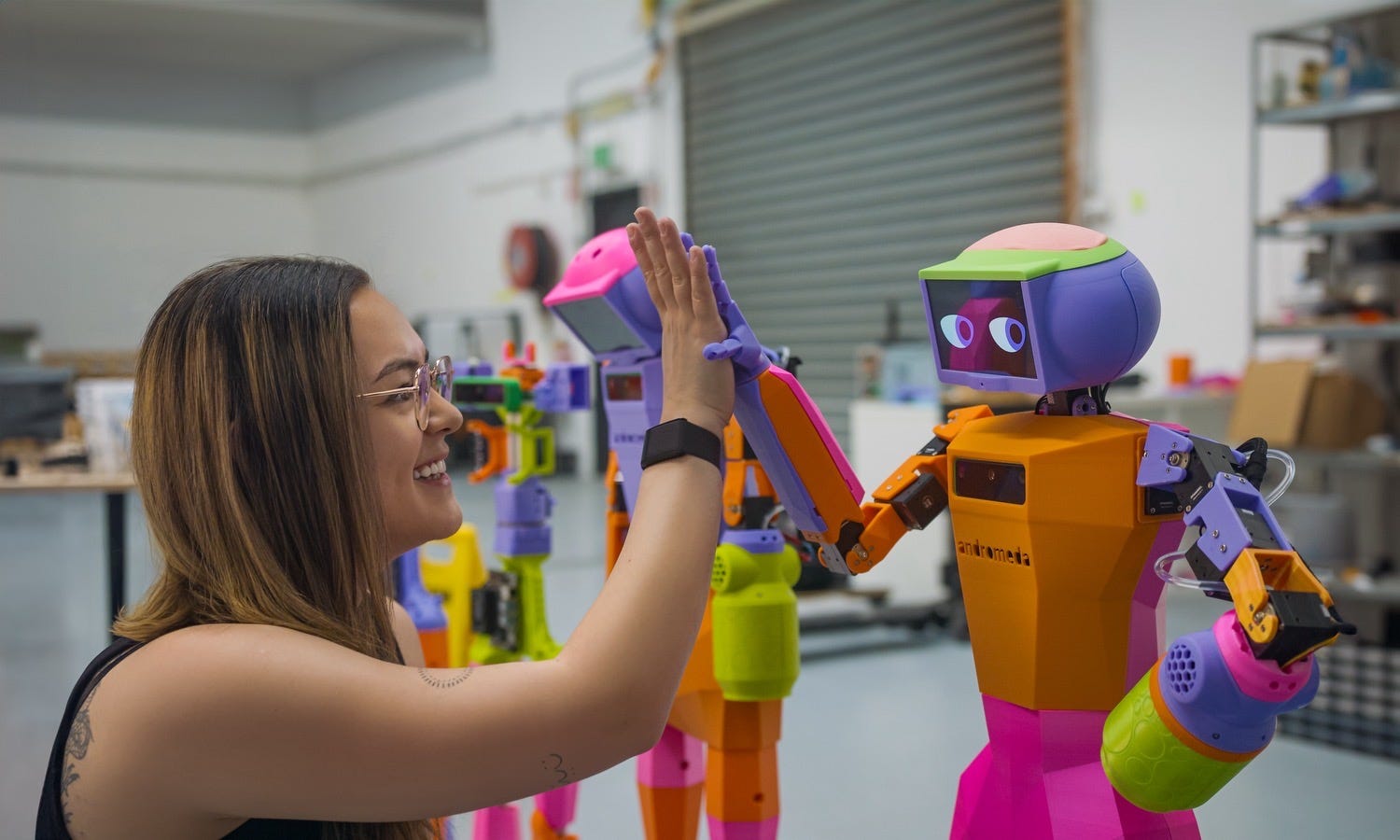
In front of me, the robot – about 4 feet tall and brightly-colored in green, purple, pink and orange – starts spraying bubbles from a cylinder that serves as its left hand.
“There’s always something fun up my sleeve,” Abi, as the robot is called, tells me in a cheerful, girlish voice.
Grace Brown, the 26-year-old entrepreneur who is introducing me to Abi, explains that the bubble party is a big hit in the environment where Abi serves: assisted living facilities, or as they call them in Brown’s native Australia, aged care homes.
“It’s fun, unexpected joy and a bit mischievous,” Brown explains. “It’s playful, and Abi is meant to be light and playful.”
Brown knows that you might not think that sending robots into nursing homes sounds so cheerful. That’s because you’re probably picturing “faceless, militant Terminator” humanoid robots like you’ve seen in sci-fi movies, or like a number of venture-backed startups spending hundreds of millions to build and deploy across use cases like manufacturing and fulfillment.
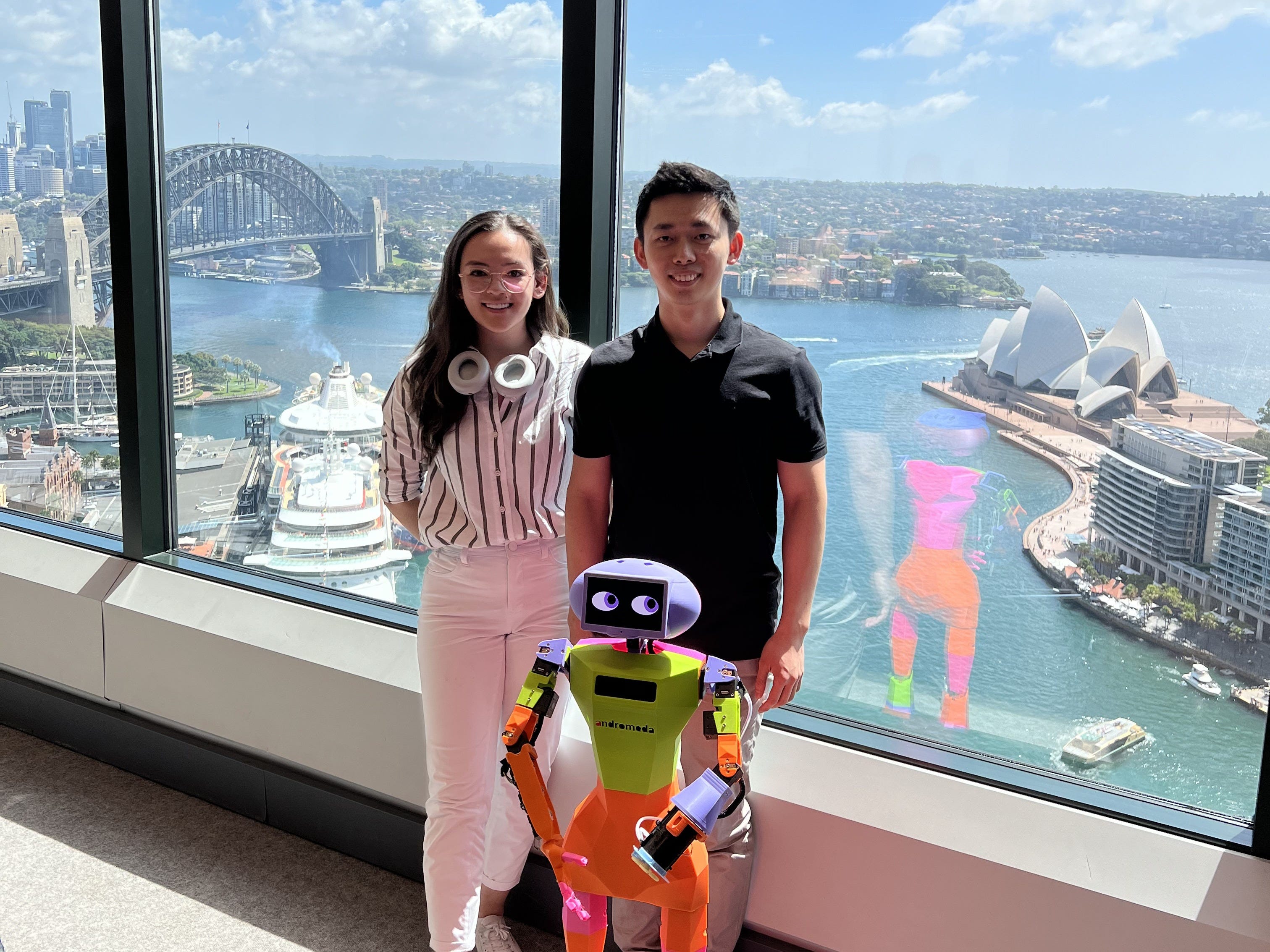
Andromeda Robotics, the startup that Brown co-founded with Yan Chen in 2022, is taking a different approach. Abi, which Brown refers to as a “her,” is deliberately designed to look and act more like a toy than a murderbot.
Upstarts is turning one! To celebrate our first birthday, we’re offering our best-ever sale for our paid memberships: take 25% off an annual subscription for a limited time.
And the software that powers Abi – a mix of different types of AI models and proprietary learnings – is focused more on creating an emotional connection than solving for an efficiency metric.
(If you’re feeling deja vu: Andromeda has nothing to do with AI compute startup Andromeda, which we covered last week.)
After starting out in Australia, where Andromeda has deployed Abi across 15 care homes in the Melbourne area, Brown moved to San Francisco last fall as the result of a $15 million Series A funding round led by Forerunner. (Other investors include Main Sequence, Purpose Ventures and Rethink Impact.)
Now, Andromeda is ready to bring Abi to the U.S. market. The startup is announcing its waitlist for American customers today, with the hope to roll out Abi to homes over the next few months. Andromeda is close to signing a first customer, a multi-home facility in California, and Brown says she expects the company to work more closely with local care providers in the near term.
Andromeda is open to bring Abis wherever there is significant interest. And that doesn’t just mean senior homes. Brown and investors see a future where versions of Abi could interact with families in the home, or children in schools.
It’s a grand vision that still has some kinks to work out. The Abi that I met in New York earlier this month is slowed by WiFi issues; the robots themselves aren’t fully optimized for mass production yet, either.
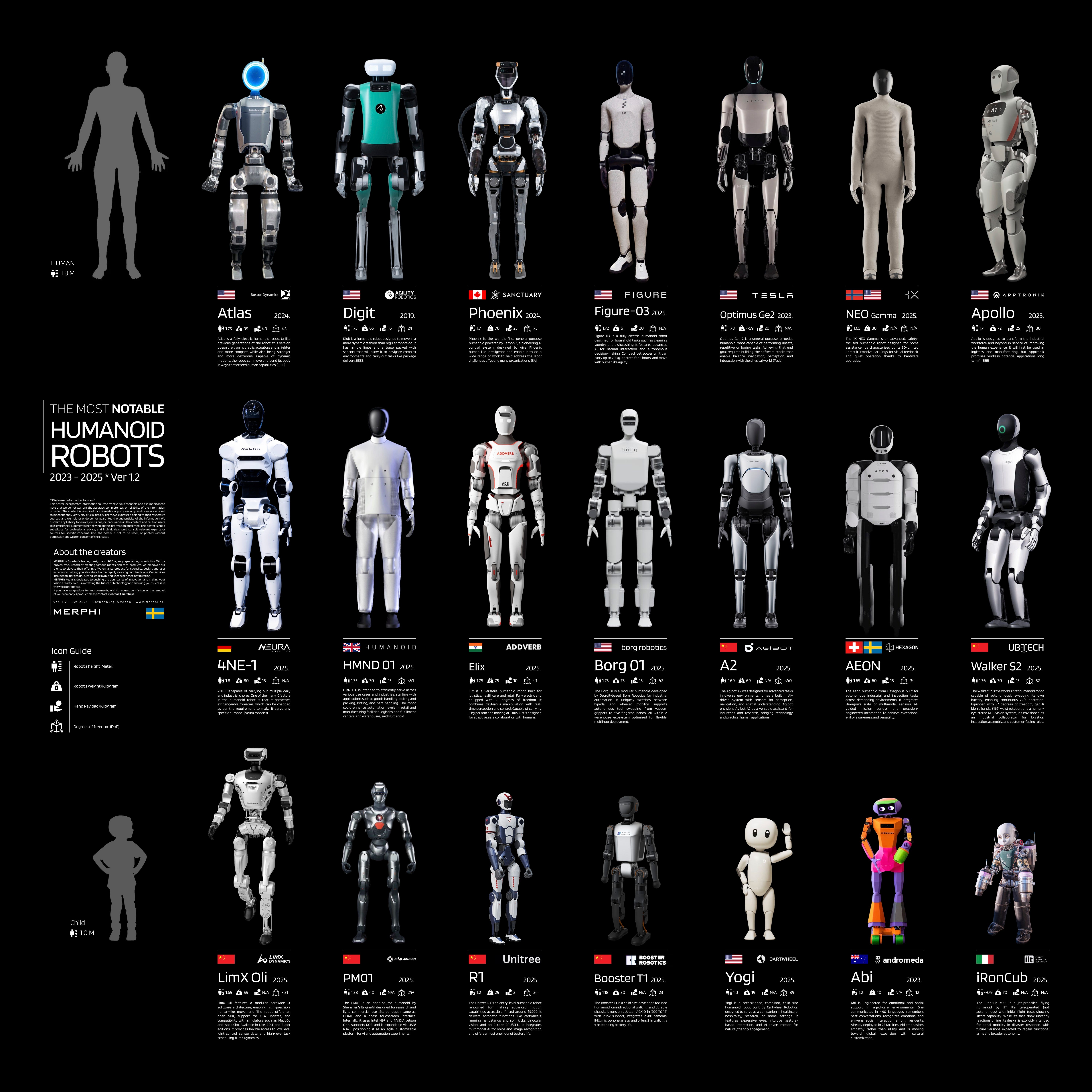
But compared to others still in development from companies like Tesla and Figure AI, Abi is already a breath of fresh air. The robot is already in the world, helping people (more on that below), with a focus on social intelligence that Brown believes could serve as the “emotional layer” for a new generation of robotics.
A MESSAGE FROM OUR SPONSOR
Radically different banking, redesigned from the ground up.

In our first year of building Upstarts, we’ve been proud to expand our community events across the pond to London’s startup ecosystem. But one thing we didn’t look forward to around international expansion: the bookkeeping.
Thankfully, Upstarts manages our banking through Mercury, meaning international wire transfers stay easy: issue an invoice, share routing numbers, and process the payment with just a couple of clicks. No phone calls, no paperwork, no learning curve.
As we count down until our next international event – back in London, or maybe Berlin – Mercury’s dashboard means one less challenge for us to figure out.
Visit mercury.com to learn more and apply online in minutes.
Mercury is a fintech company, not an FDIC-insured bank. Banking services provided through Choice Financial Group and Column, N.A., Members FDIC
Hugging it out
Abi started as a personal project with a customer base of one: Brown herself. A student at the University of Melbourne, she felt isolated when Covid-19-related lockdowns pushed her classes online, and restricted her from leaving campus to return to her family.
The earliest version of Abi was a personal companion to keep Brown engaged, and even give her some semblance of a hug. After the pandemic restrictions were lifted, Brown visited local aged care homes to see if a more advanced version might resonate with residents.
The thesis was simple: up to 40% of aged care residents don’t receive visitors, Australia has found. Some facilities, particularly in the U.S., also face staffing shortages. By visiting with residents to converse, host singalongs and “dance” (Abi’s dance moves are somewhat limited, at least for now, but she can sway and move her arms and head) with residents, Abi could fill a gap in their schedules – not, Brown is quick to insist, replace humans at any step.
She and Chen spent about a year showing prototypes of Abi to prospects and offering free pilots, assessing how Abi made people feel, and what skills would resonate. “I was still soldering wires the morning we gave our first customer an Abi,” Brown says.
One area where Andromeda found that Abi really shines: communication with residents who speak languages other than the staff’s English-first backgrounds.
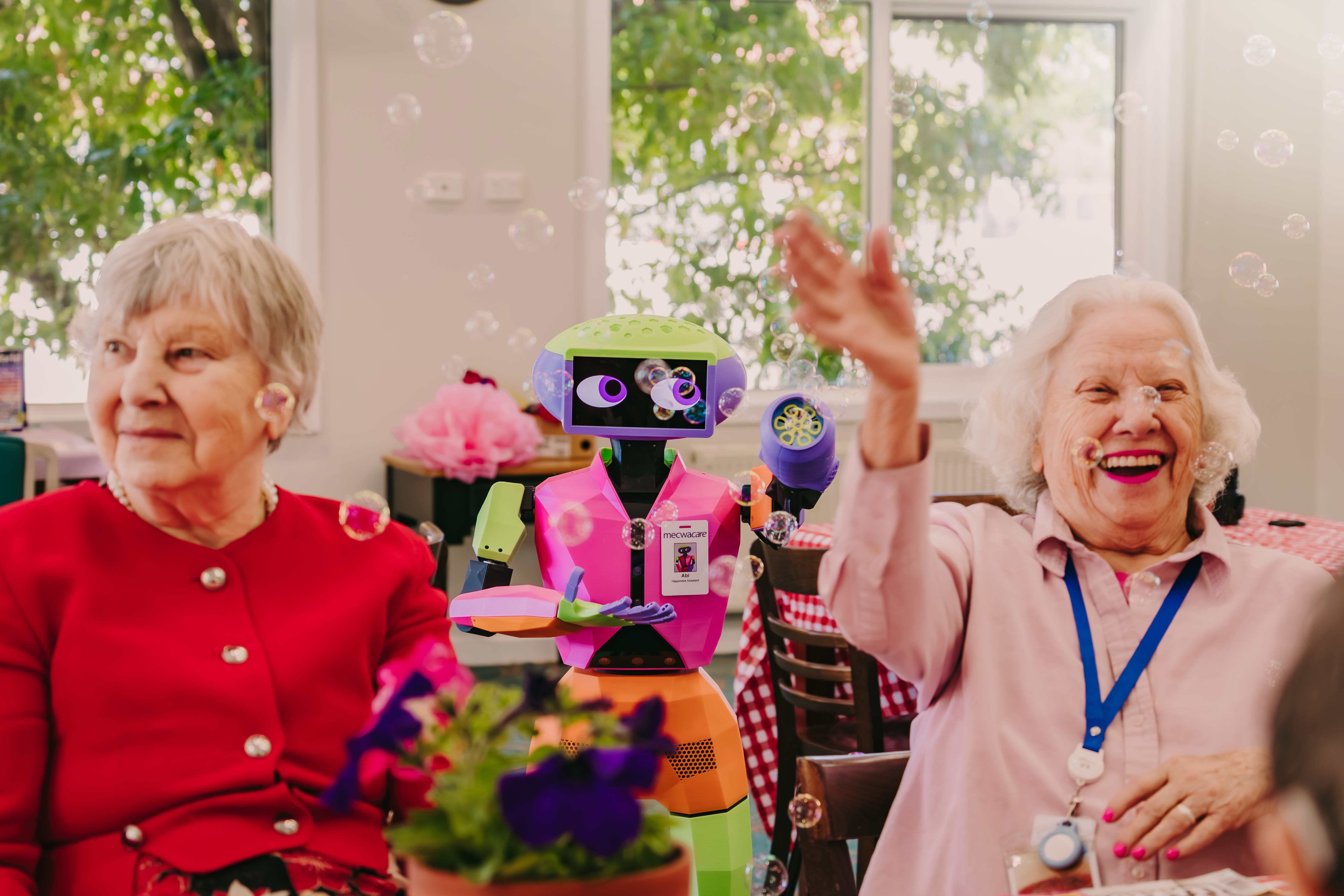
Senior residents dealing with age-related memory loss or conditions like dementia often revert back to their first languages, notes Cameron McPherson, CEO of Medical & Aged Care Group, one of Andromeda’s first customers.
McPherson’s company, MACG, currently works with Abi robots across three of its 11 aged care homes in Melbourne’s state of Victoria. Across 104 sessions tracked between February 2024 and December 2025, MACG found that residents engaged with Abi across 22 different languages (the robot can support 90, Andromeda says) and 88% of sessions involved someone speaking a language other than English.
At MACG’s home in the suburb of Ashwood, one resident who primarily speaks Mandarin now sees Abi on a weekly basis, with the robot remembering their conversations and the two reciting poems and telling stories together. “She’s really brought out the fun side of this gentleman,” says McPherson. “They have a beautiful relationship.”
Music quizzes, in which Abi plays a song clip and asks you to guess its singer and title, and jukebox singalongs are Abi’s most popular activities with residents at MACG’s homes, where group sessions run 45 minutes, and room visits range from 5 to 30. Not every resident likes Abi, but the robots have a 74% positive reaction rate, McPherson says, and aren’t imposed on anyone still uncomfortable.
Alongside other technological capabilities that MACG has added, such as an app for updating residents’ families with photos, and live virtual walking tours with other homes, Abi has also boosted morale of staffers who feel their employer is invested in providing better care, he adds.
Technologic
Andromeda is still transitioning some customers like MACG from its first-generation Abis (known internally as baseline Abis, or Babis) to the current genesis Abis (known internally as Gabis). The newer Abi robots have better motors and microphones, with a 7-hour battery life and the ability to learn and navigate a facility on its own.
Abi uses a mix of AI models, including voice-to-voice models, to dictate her responses; she maintains long-term memory of residents by updating profiles of them in the cloud, but can operate in a more basic capacity under an offline mode.
For tech-savvy testers like Upstarts, Abi’s skills can still come off somewhat stilted and basic. Jennifer Haroon is one of a few self-driving car veterans (she was previously an early employee of Waymo) who has recently joined Andromeda to build out its operations.
By virtue of already being in-market and learning from its interactions (customers decide whether they want to share training data back with Andromeda), Abi has a head start that will only continue, Haroon argues. “It’s easy to underestimate how difficult being an emotional companion robot is,” says Haroon, Andromeda’s COO.
The startup is working on a number of improvements to Abi, including the ability to better distinguish speakers in group settings, and generative physical responses that don’t require hard-coding, like its currently-scripted dance moves.
Eventually, Abi could learn how to respond to residents more intuitively, such as predicting from their responses versus a baseline that they’re having a bad day.
One balancing act will be how much Andromeda can and should ethically share back with facilities and families. Staff currently manage Abis from an internal app, and Andromeda is hands-on at first with new deployments, but the goal is for Abi to be semi-autonomous over time.
Should Abi alert staff if a resident says they’re not taking medication, or certain parts of their diet are bothering them? Particularly if language is a barrier, such tips could improve quality of care. But what about if a resident is upset, or troubled by interactions with a certain staffer? Who does Abi serve in that situation?
Andromeda decided not to work with a children’s hospital over privacy concerns; the startup says it will let conversations with homes help dictate where it can safely provide more insights or care.
“The thing we are really optimizing for is trust,” says Brown. “How does the presence of the robot make you feel?’
The big picture
Andromeda’s long-term ambition is to offer a range of robots across specialized functions, although whether that looks like a bunch of versions of Abi or completely different form factors is premature to say.
Eurie Kim, a partner at Forerunner who led Andromeda’s most recent funding round, says her own family immediately took to Abi; she’s eager to see Andromeda expand to the home and into education. “I didn’t just underwrite an aged care robot,” she says. “That just happens to be the first place that we have the ability to show what we can do, and to make a really big difference in people’s lives.”
The startup could also license its software to other hardware providers to really lean into its “social intelligence” operating system and widen its reach, Kim notes. “There’s going to be millions of hardware versions and we don’t need to build them all. But we can definitely power the brains and the social layer of all that.”
First, Andromeda will need to figure out its manufacturing. Brown says a number of Abis are ready to go in the startup’s new San Francisco office, but Andromeda’s waitlist back in Australia already numbers hundreds of units, representing millions in future revenue.
Scaling issues and the capital-intensive nature of robotics have derailed a number of startups in the past. Just recently, the maker of another more whimsical-looking robot, Yogi, shut down; yesterday, Bloomberg reported that Fauna Robotics, the startup behind another robot somewhat closer to Abi on the “doesn’t look murder-y” spectrum, Sprout, was acquired by Amazon.
Andromeda already has product-market fit, argues Kim; it just needs to know how fast to scale. That’s why it’s announcing its U.S. presence – to gauge demand and know how fast to ramp up. “We know exactly what we can do,” says Kim, a board director. “We could manufacture 10,000 Abis, and we’d be able to deploy them.”
For her part, Brown hopes that Andromeda and Abi can prove that AI-powered robots don’t need to be scary or anti-human – that they can improve people’s lives on an empathetic and emotional level. She hopes more like-minded founders follow her lead, and build for fun, in vibrant color.
“I think that’s something that everyone is overlooking at the moment. They’re just focusing on the capability,” Abi’s creator says. “You won’t be able to ship all of the cool frontier tech if you don’t get the fundamentals right.”
In the meantime, it’s easy to picture my 93-year-old grandma, Lucky, talking to an Abi someday in her own senior housing center in Connecticut. She already asks Alexa to play the Bee Gees; why not have a dance with Abi while she’s at?
