



A startup lawyer in her previous career, travel planner Melissa Zimmerman considers herself tech-savvy. She’s a power user of Claude.
But until recently, when clients asked complicated questions – how would hotel prices change if that flight to Stockholm moved a couple of days? Actually, what if Copenhagen came first, and they did it in April? – she found herself manually updating the numbers for hours.
“Pulling all of those rates, you can imagine, it’s a lot,” she says. “You don’t want to create some awful chart for them, and make yourself insane. Plus, then the rates change.”
So Zimmerman has become an enthusiastic early adopter of Via, an AI agent developed by a New York-based startup, Fora Travel. Drawing upon her own past recommendations, intel from Fora’s wider network, and rates not necessarily published publicly online, Via distills such alternate scenarios into a couple of bullet point takeaways in minutes.
“I’m getting the clients to an answer faster, but I’m also getting them towards a decision,” adds Zimmerman, whose Fora-based practice is called And We’re Off!. “Because they’re excited to book, and they’re kind of lost in the where, what and how.”
It’s the kind of outcome that makes co-founder Jake Peters call Via a game changer for his startup, which offers software, community and back office support for travel advisors – many of them new-gen “travel entrepreneurs,” as Peters calls them, who have built second careers or side jobs from friend networks and social media.
Launched in 2021 by Peters and travel tech veterans Henley Vazquez and Evan Frank, Fora Travel is used by 15,000 advisors today, 97% of whom came new to the travel industry. Those advisors have booked more than $3 billion in travel to date, with some making more than $10 million in annual bookings.
Fora last raised $60 million in July in a Series D led by Forerunner and Tactile Ventures at a $1 billion valuation, and counts Thrive Capital and Insight Partners on its cap table, among others.
And Via, unveiled to great fanfare at Fora’s birthday party in August (Questlove, the longtime frontman of The Roots, spun tracks), represents the startup’s biggest product swing to date, an AI-powered bridge spanning everything it does.
“It really has created a third surface area,” says Peters, who leads product and technology for Fora. “With every new product feature, we need to think about: ‘How does this look on desktop? How does this look on mobile? And how is it going to work in Via?’”
Tested by 1,000 Fora advisors like Zimmerman over three months earlier this year, Via is now used by 98% of Fora’s “top advisors,” the startup says.
It’s saving many of them hours of busywork each week, from fielding new client inquiries to drafting proposals and updating files on client preferences. Moving forward, Fora plans to have Via become more proactive, too: operating as an always-on assistant between an advisor and client, and even helping advisors forecast how spend on marketing could grow their book.
At a time when the big AI labs like recently public Anthropic and IPO hopeful OpenAI continue to push deeper into domain-specific use cases for their LLMs, from healthcare to law to travel, too, Fora’s approach offers a compelling counter-model.
And as agents increasingly infiltrate how we work, consume information and shop, Fora’s mission to augment its human experts, not obliterate them, also stands out.
“We were always thinking about the human, plus technology,” Peters says. “Via is not replacing the advisor, it is supercharging what the advisor is doing.”
A MESSAGE FROM OUR SPONSOR
Hire your dream team

Hyperagent lets you hire AI agents for roles across your business, from sales and marketing to operations. Anyone on your team can work with them in Slack or iMessage, just like a coworker. They share context, hand off work, and keep going after you close your laptop.
The data is the moat
Just as Superhuman (acquired by Grammarly) once streamlined how users consumed, organized and responded to email, so Fora’s founding team hoped to streamline a travel advisor’s workflow.
Building it was a more gradual process. Last fall, engineers inside Fora were already using AI for coding, a push championed by co-founder Frank, when a Fora engineer killing time while his newborn recovered in the NICU spun up a new framework for an MCP server to connect to its own data portal to test their combined capabilities. Testing Claude Code combined with an Obsidian vault of Fora’s internal data wasn’t a long-term solution; but it gave Peters a glimpse of potential.
Fora was already using AI to help automate commissions – a typically painstaking process for travel agents as clients change plans or rates change last minute – and translate travel industry jargon for its databases. A price drop tool, meanwhile, has saved clients more than $4 million so far this year, Peters says.
But Via would be a much more ambitious project, combining third-party models with Fora’s own proprietary data to fine-tune a system built with only travel use cases in mind. (Not that early test users didn’t try to make Via write code or answer random requests.)
Given their superior horsepower and much larger user bases, how could Via get one over Claude and ChatGPT?
For starters, large language models are trained largely off of publicly available data, plus data acquired from vendors who tend to focus on expertise in higher-value fields like engineering, math and science. Basic info like the number of rooms in a given hotel can be hard to find online, says Shaina Shiwarski, a Fora advisor who more recently sold her data startup, Legends, to Fora and is now a vice president of product strategy.
Fora doesn’t just know that sort of answer, but others that aren’t written down anywhere at all and instead logged by its advisors, such as whether a hotel’s front desk receptionist leaves early in the evening, or who might be more generous with an upgrade.
“The biggest unlock for me is the amount of curation and data that Fora has acquired over the last five years, but really the quality of it,” Shiwarski says.
Then there’s the “black box” nature of LLMs, which don’t explain all the factors behind a recommendation, she adds. Say you ask ChatGPT for a hotel in Paris with a pool. Its confident reply might be trained off of years-old information, and that pool was closed in the previous season.
“Even if it shows you sources, in a destination you’ve never been to, it’s really high risk,” she claims.
The agent adoption arc
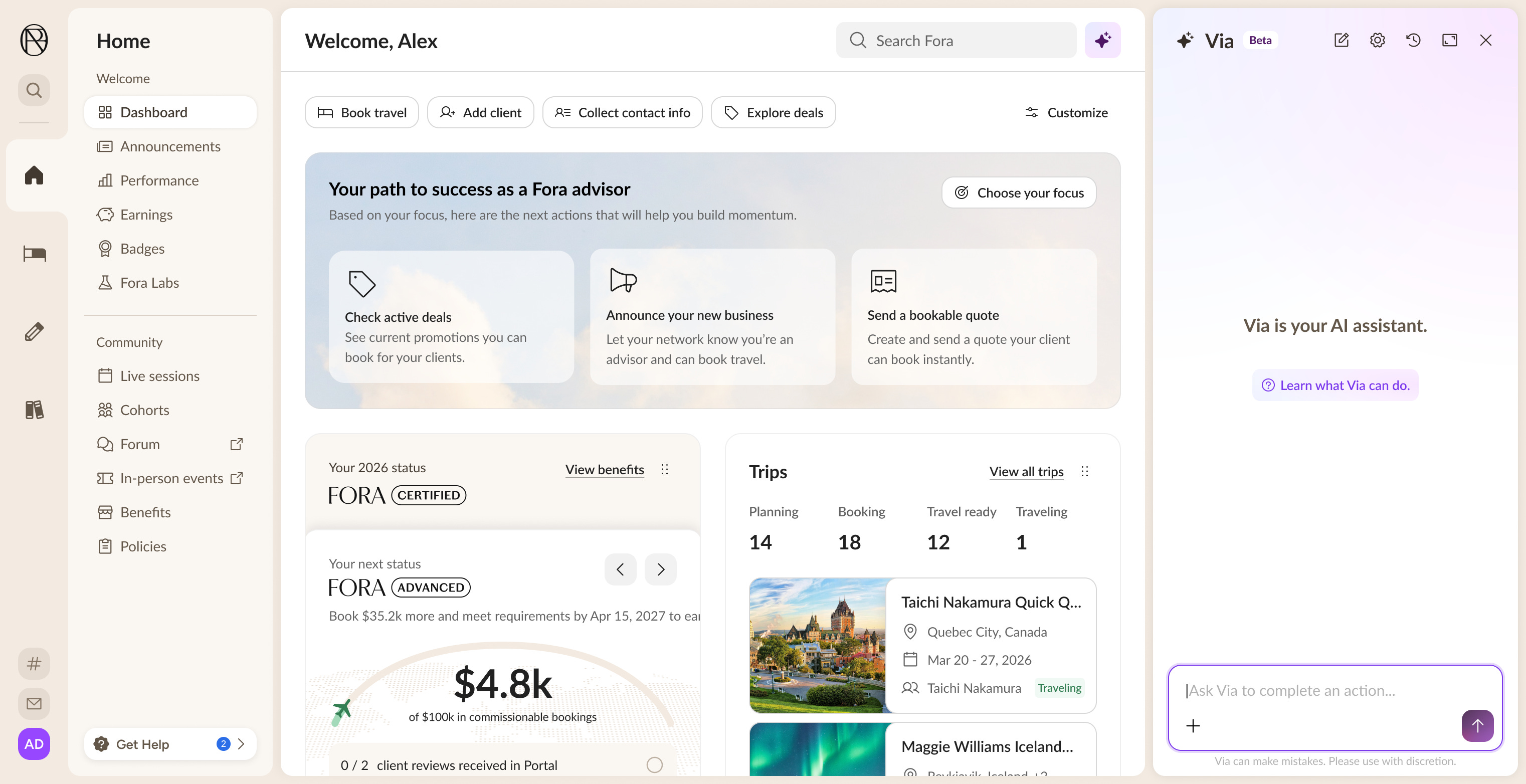
Getting some of Fora’s human agents to try its AI one wasn’t hard. Some advisors, like Zimmerman and Shiwarski, were already accustomed to copying work to and from ChatGPT and Claude.
“I think it’s natural that the people who opt into building their travel businesses on an agency that’s very tech forward are probably naturally selected for being comfortable with AI,” Peters says.
But some Fora advisors have asked the company about the environmental impact of using AI and related data centers, and Peters and the Fora team have had to discuss how they try to use such technology mindfully.
“Travel as an industry also has an environmental impact, so you need to put this in the context of travel as a whole,” he says. Ultimately, by stressing that Fora is focused on streamlining tools and computer use its advisors might be doing on their own, and not replacing them, they’ve swayed some doubters, Shiwarski and Peters both say.
Another natural question would be whether Fora’s agent raises the ceiling of productivity of its top advisors, versus the floor of its most novice ones.
Zimmerman says she uses Via as an extra round of checks on trip itineraries to catch a detail she might have missed. And Shiwarski argues that certain advisor know-how – such as knowing from past experience when the weather in Japan might feel too snowy for a certain kind of customer – still depends on advisor knowledge.
A self-running business
How much is Via helping? Fora’s data on usage so far is mostly based on surveys and anecdotal feedback, but Peters says the product was the startup’s most discussed product launch to date. Fora is tracking how advisors add new clients, how much they prompt Via and use it, and their sentiment around its responses, though the startup declined to share that data.
Instead, Fora says Via gets “the most consistent regular usage” of any of its products to date, with many advisors using its voice capability to prompt proposals or itineraries in less than a minute.
“The alternative is, I don’t know, a thousand clicks?” Peters says. “We can get 90% of the way there in two minutes.”
In the months since its launch, Fora has added new features to Via, including saved lists, notes, and most recently a tool called Delegation, which helps advisors collaborate with team members on workflows.
Looking ahead, the startup wants Via to work more proactively on behalf of users, who increasingly interact with it via buttons and approvals of self-directed actions, versus a chat box. “Chatting is not always the most efficient way to do things,” Peters says.
Fora is integrating Via more deeply into email and other data sources to enable this more always-on, background mode. Top advisors are already testing more reporting and coaching tools, through which Via can help with setting goals, budgets and business plans.
Ultimately, Via will be judged on how it helps those advisors grow their businesses on Fora, he adds: “Otherwise, what are we doing here?”
