



Veteran startup builder Chad DePue can picture it now.
In the not-so-distant future, AI agents outnumber humans. And developers who spin up useful ones – moneymaking trading agents, or reselling tools, or productivity hacks – can easily share, sell, and profit off of them in an app store of sorts.
The version of this future he doesn’t like: one where that app store is controlled by just one or two companies like Apple and Google all over again, but this time maybe with Anthropic, OpenAI, Meta, too.
“I cannot imagine a world where the two or three biggest app platforms won’t eventually use your data to sell you things,” he says.
So DePue, who previously held engineering leadership roles at Whisper, Snap, and Uniswap, is launching a new startup to build an alternate reality. Cowboy launches from stealth today, offering what the startup calls arguably the first true app store for buying and selling AI agents.
Focused initially on traders, especially in crypto circles, who would pay real money to either build their own agents to improve their strategies, or to access tools from others to manage their positions, Cowboy has much bigger ambitions to help developers and consumers across the internet.
Buyers can pay for access to their own locally-hosted versions of such tools that don’t share credentials back with the creator, saving time and energy otherwise spent tinkering on their own, while minimizing concerns around vaporware or hacks. Sellers, meanwhile, gain a more direct path to compensation than they would by posting open source projects, without the hassle of setting up payments, and without needing to give up their source code.
A New York-based team of 10, Cowboy is the result of an incubation out of Uncommon Projects, a fund of ex-Snapchat managers including DePue. The startup has raised $5 million in funding from investors including Nebular, Compound, Semantic Ventures, Anagram, Shine Ventures, and angels including Aashay Sanghvi and Kevin Kwok.
Named after the “Wild West” of agentic tools today, Cowboy’s app store, called The General Store, launches with 100 agents, as well as 10,000 data feeds that developers can use to build their own. The startup has also opened up a test version of a blockchain-based network for payments across these agents, Cowboy Chain, that it plans to launch in upcoming months.
Like any marketplace, Cowboy will face an uphill battle to grow consistent demand for both sides of its store. (If you build it, will they come? And will they find enough value to pay money, fiat or otherwise, to make it worthwhile for everyone?)
But Cowboy taps into a few interesting trends worth watching more closely. It’s part of a movement towards “agents as software,” or as Stripe co-founder Patrick Collison recently described it, “liquid software,” that rethinks how apps are built, shared and operated.
It’s also at the forefront of a push to move agents past a tinkering phase of early adopters building their own tools on top of open projects, or by depending on the big AI labs, towards a more fluid market where agents aren’t just hyped on social media for clout, but easily rented or bought.
And it’s the latest example of how crypto practitioners (see also: OpenRouter, Venice AI) are somewhat quietly helping to lead the way in pushing for privacy-first, local and decentralized access in AI, even if they don’t call themselves crypto founders anymore.
More on Cowboy’s approach, and the implications, below.
A MESSAGE FROM OUR SPONSOR
Ship pricing like a product

Different product bets have different business goals. You’re either chasing market adoption, revenue growth, or profits. You need to test fitting pricing models for each of those goals. Fast. Chargebee can help — Price for usage credits, outcomes, complex contracts, or any other modern commercial construct.
Anti-fragile agents
About two years after he left his role scaling the engineering team at decentralized crypto exchange Uniswap, DePue joined many fellow developers in building his own AI assistant to check email and run his calendar.
And like many of them, he ultimately found he’d built something difficult to deploy and share, and annoying to maintain. “It was incredibly fragile. And I didn’t want it running on a Mac Mini in a closet,” he says.
Around this time, a former Uniswap colleague shared an agent he’d built for crypto trading with DePue and other close friends. Within their circle of trust, the friend was willing to expose his source code to them; DePue, meanwhile, was comfortable connecting his wallet credentials.
Such trust wouldn’t work at scale with agents shared by strangers, however, he thought. So DePue started working on a tool that could do more than send a skill file or API to users, without giving up its codebase, and without needing their accounts and data.
From an architectural perspective, hosting such agents in one place would mean they weren’t sitting idle in virtual machines, making them cheaper to run, says Cowboy head of product Ryan Chan. And with Cowboy as the buffer between buyer and seller, users could protect themselves better from data hacks or misuse.
“We are big Instinct fans, but I don’t know exactly who the Instinct guys are. The model so far seems to be, ‘YOLO’ the data in, and just trust they’ll do the right thing,” Chan says.
“Unless you’re designing the system in a way where it’s constructed to be really difficult, if not impossible, to pull data out, there’s always going to be a chance that you’re part of these vulnerabilities.”
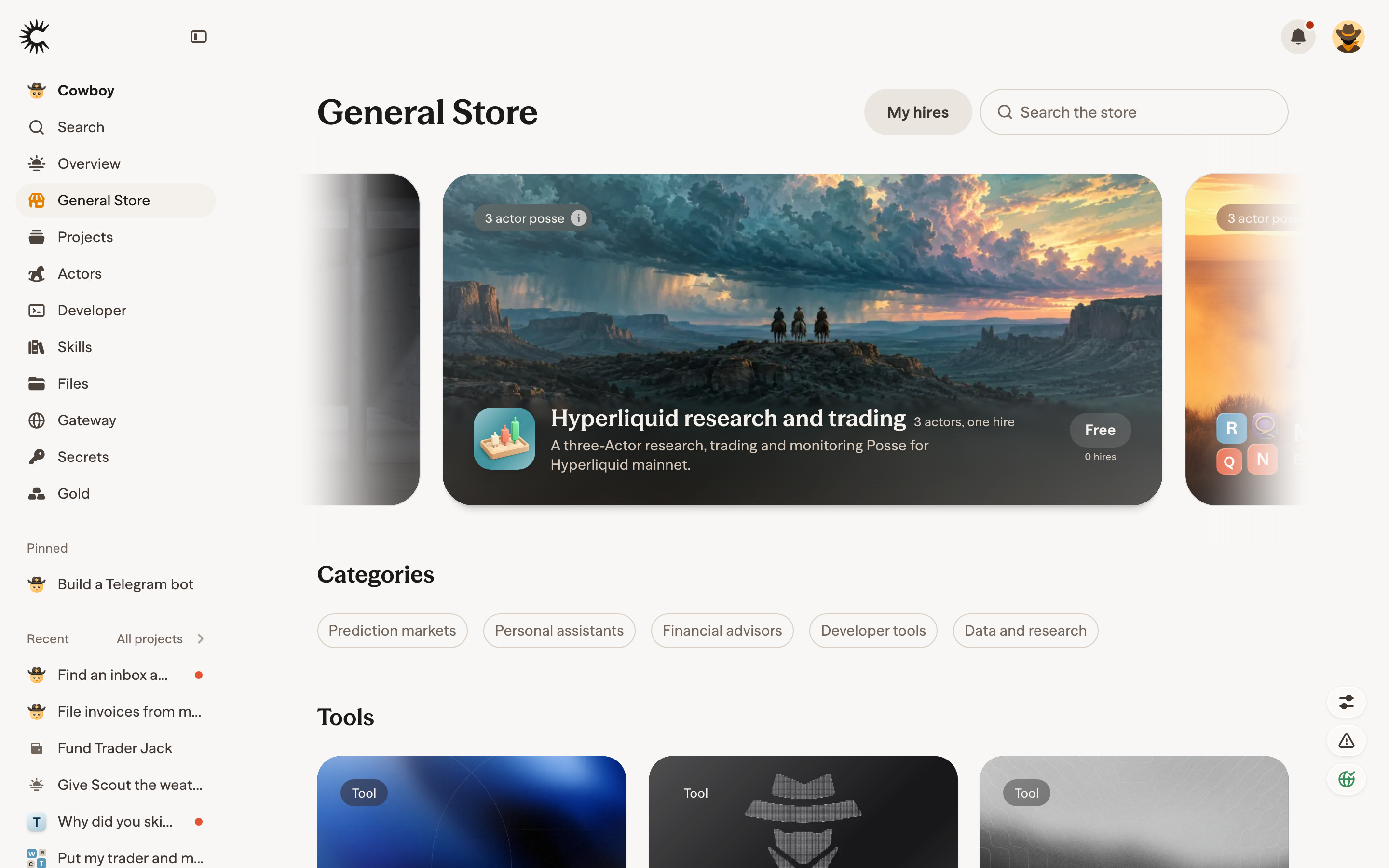
Their hope is that Cowboy’s app store also runs as a meritocracy, where the most valuable agents get used more and thus discovered more, and where people only pay for tools that are actively helping them.
That’s why they started in trading, where hobbyist or part-time traders can easily see immediate financial benefit, and in turn pay real money (up to hundreds per month) to make the experiment worth it for the agent designers. Users can talk to those agents and build on top of them within Cowboy’s platform, through their CLI, or through apps like Slack and Telegram.
For now, Cowboy provides the compute involved, taking a cut of sales and of the cost to run those GPUs. Over time, the startup wants users to be able to bring their own compute, and to support subscription-based and usage-based pricing models.
Finn Murphy, who backed Cowboy at Nebular, argues that Cowboy’s economic model incentivizes people to build smarter agent loops that lead to fun, money-making impact.
“I could end up in a situation where I make $10,000 per month reselling shoes, and I was very happy, but it turns out I could make $100,000 per month listing my shoe reselling agent,” he says.
“Eerie and hilarious”
In chatting with DePue and early fans of Cowboy, one thing becomes clear: the startup is taking a big swing that could go in a number of directions, and no one seems to quite agree which is most promising.
Murphy sees Cowboy’s eventual digital chain and a crypto token as potentially unlocking a new wave of agentic development, as users can invest in and support agents they value. DePue responds to Upstarts by email that Cowboy is currently focused on payouts via dollars, through Stripe; the company does see a token as a path to a “global compute network” over time, but plans to offer multiple payments rails, he says.
“Right now we’re completely focused on giving developers a way to make money with AI,” he writes.
Another early user, AI researcher, founder and investor Matt Mireles, throws a different curveball. He sees the potential for a market for the agents themselves, sure. But what he really wants to talk to Upstarts about is an open-source tool that Cowboy built for its own agents to talk to each other, cowchat.
Cowboy uses cowchat internally to speed up development by as much as 20x, DePue had told me previously; Mireles wakes up to dozens of messages between his agents as they problem-solve and cross-check each other’s work. Crucially, in a moment of distrust around model capabilities and agents going rogue, as with OpenAI’s highly-publicized hack of Hugging Face earlier this year, Mireles can read back and query all of those discussions, so he knows exactly what his agents are really doing.
“It unlocks the ability for them to collaborate and have this peer relationship, and it’s been really powerful,” he says. By default, agents talk but don’t listen, he adds, but by instructing them to do so in cowchat, they find ways to improve each other’s outputs on their own. The experience reminds Mireles of managing human engineers over Slack: “It’s just eerie, and hilarious, how much it mirrors the human equivalent.”
For now, cowchat isn’t the focus for Cowboy either – it’s betting big on this marketplace – but the tool seems like it could provide another flyer of value should Cowboy struggle to prove healthy, long-term demand and supply.
That’s what I’m most curious about with this new app store. Can a tighter financial incentives loop usher in a new wave of accessible agents, such that I might be able to pay $10 for a fantasy football team manager agent, or $20 to continuously monitor my social posts, without sharing that data with a tech giant? Or, like Western boomtowns that became ghost towns, will Cowboy fail to sustain a community beyond its initial settlers, gold-seeking crypto traders?
One thing’s a safe bet: If Cowboy resonates, it will need much more funding than $5 million, the equivalent in AI today of a cheap trial balloon. DePue doesn’t dispute that, but hopes there’s room for a neutral new player to find its footing.
“I think you need a world where you have many different models running on a platform where they’re not all from one or two big labs,” he says. “And I want to create a place for those to live.”