



You’re probably sleeping on HeyGen.
The AI video startup doesn’t attempt to compete with models from ByteDance, Google or Runway in offering up film-worthy, “cinematic” experiences.
Based in Los Angeles, founders Joshua Xu and Wayne Liang have raised a paltry amount of venture funding compared to their peers; they lack an eye-popping valuation.
And while HeyGen users span 85% of the Fortune 100, the company says, its lifeblood customers aren’t heavyweights — they’re small business owners and real estate agents, personal trainers and online course instructors.
“We want to make visual storytelling accessible to all,” Xu says. “What’s more important is the expertise they are getting shared.”
But in its own not-so-little world, HeyGen is growing fast. More than 30 million users have produced about 120 million videos across 250-plus languages to date. And they’re quietly paying for HeyGen, too: annual recurring revenue has recently passed $200 million, Xu tells Upstarts exclusively, doubling from $100 million eight months ago.
In a moment in which AI businesses have claimed to shatter revenue records for startups, what’s more interesting is how HeyGen reached that ARR milestone: doing it while remaining cash flow break-even for 2026 so far, and only burning $25 million, about one-third, of the $74 million in funding it’s raised to date. (Investors include Benchmark, BOND, Conviction, SV Angel and Thrive Capital.)
According to Xu, HeyGen hasn’t really burned cash since it reached $10 million in ARR three years ago. Instead, the company proudly tracks a couple of other metrics: revenue for every dollar raised (now up to $2.70 for each $1 invested) and revenue per employee (now up to $1.5 million per full-time staffer).
HeyGen attributes its ability to grow so sustainably thus far to 3 things:
It keeps its team as lean as possible
It owns its own full stack, from model to app
It focuses on a less competitive, more efficient use case
“We are doing this very differently,” Xu claims. “We focus on the identity and the message first, not the cinematic.”
And that means that HeyGen also believes that its platform is “extending humans” in useful ways, instead of proliferating more AI ‘slop.’ “We’re all about extending humans,” says chief marketing officer Andrew Mok.
Whether you fully buy that is another story. Upstarts spoke to three of HeyGen’s small business customers for their perspective. More on how HeyGen has structured its startup not to bleed cash, and their insights, below.
Looking for scoops, exclusive interviews and profiles, or just interested in supporting independent startup journalism? Take 15% off an annual Upstarts premium subscription, for a limited time.
Self-constrained growth
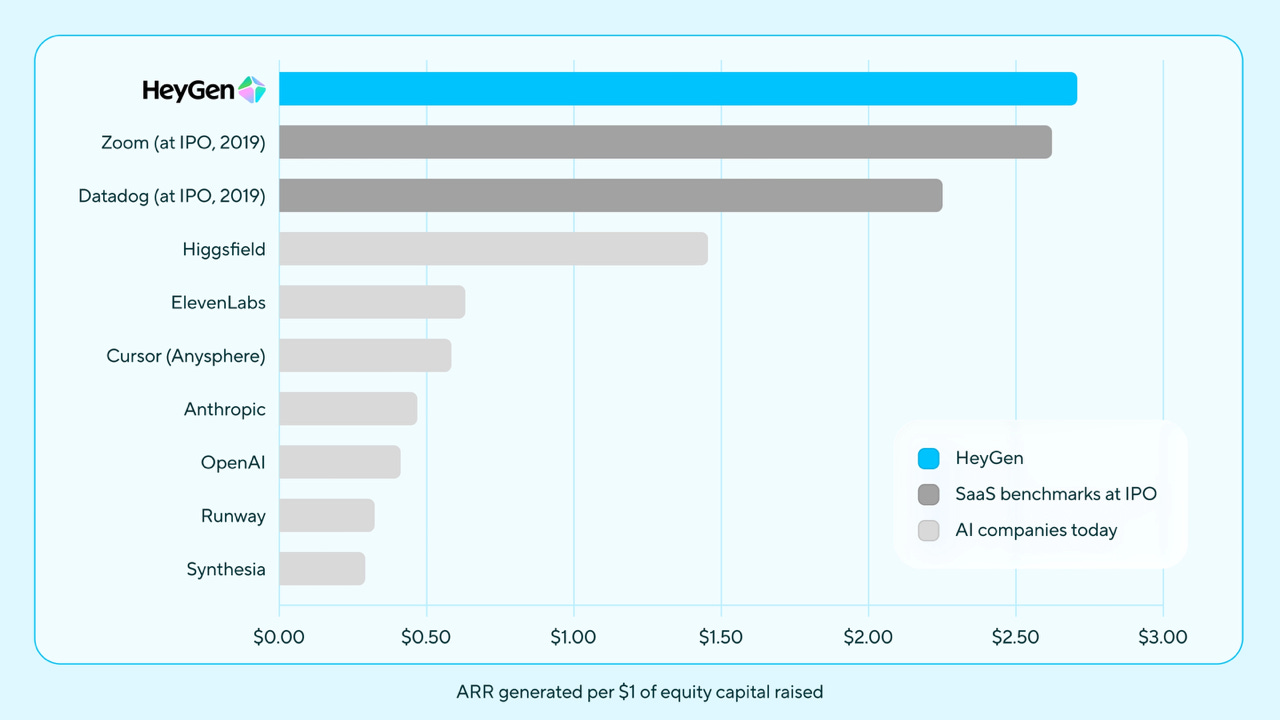
HeyGen’s architecture plays a significant factor in its growth profile to date. One layer deeper, the startup made two key decisions: own its own full stack; and avoid video use cases that would require more expensive development.
Xu divides the video AI market into three buckets:
Message-first video
Cinematic video
Advertising video
Because HeyGen focused on generating a ‘digital twin’ for a single person to be delivering a message, the first bucket, it was able to train models using only 1% to 2% of the total video data available, he says. HeyGen’s models — the most recent is called Avatar V — needed less data and far fewer GPUs than OpenAI’s Sora, or Google’s Veo 3 series.
While the latest from Google, Veo 3.1, can produce videos in the same ballpark as HeyGen’s, the startup’s model generates them 10x more efficiently, Xu claims.
Owning its own full stack allows HeyGen to optimize its inference more efficiently than by using third parties, according to its CEO, while avoiding more costly API calls for features like voice. HeyGen does offer its own API, though, allowing users to generate videos without filming their own baseline video or opening its app.
HeyGen’s pricing is usage-based, and scales based on how many credits users need, and which of its models. The startup’s goal is not to lose money on each — what sounds like basic business sense, but which Xu says is rare in the field today.
The startup has avoided the temptation to expand its capabilities more into the ‘cinematic video’ or ‘advertising video’ markets, where Runway, Higgsfield and others compete. “We’ve been very constrained,” says Xu.
The company has also pushed its own employees to do more with less. Earlier in June, Xu posted a chart on X showing that HeyGen staff were contributing 16.7x more code per person than in 2022.
More important than simply using a lot of AI, Xu says, is that employees are ‘AI native’ finding ways to improve their own workflows. Every job applicant is interviewed for AI ‘fluency’ as part of the hiring process.
“We really believe in a lean team of top performers who are AI native,” Xu adds.
‘A marketing avenue, instead of a clone’
Who are the users actually driving HeyGen’s revenue growth?
Fifteen months ago, YouTube creator Julia McCoy suffered a health crisis including a case of long Covid, among other diagnoses. After more than a decade regularly posting videos about content marketing and SEO, she found herself unable to record, she says.

When she switched over to an AI avatar from HeyGen, her loyal subscriber base of about 50,000 followers rebelled. "People hated it,” she says. “We got such negative comments.”
But McCoy says she had no choice but to keep putting her AI-generated videos out, 2x to 3x per week, “like the most stubborn person on Earth.” After about six months, she saw a significant change. The followers who hated a digital twin had churned out. A new audience, that didn’t care or even embraced it, had found her channel. They gave her avatar, which she dressed in a Star Trek style uniform, a name: Bones McCoy.
“The new audience enjoyed the content for the content’s sake,” she says.
Today, a team of five helps McCoy put out videos to 300,000 YouTube subscribers on her channel; she generated about 700 personal videos last year, to go with monthly courses and promo videos. One video last fall eclipsed 800,000 views; last summer, she was invited on — alongside her avatar — to talk to Dr. Phil.
In each video, McCoy discloses she’s a digital avatar, but she says she reads comments, and followers respond accordingly.
At CrystalNinja, a 20-plus-year-old rhinestone-focused shop in San Diego, founder Kellie DeFries has expanded into an online shop and training platform, centered around a patent-protected rhinestone pick-up tool. She’s got more than 100,000 followers on Instagram for work like a diamond-encrusted Patrón bottle featuring Knicks champion Josh Hart.
Making videos for her VIP members was starting to get overwhelming, DeFries says by email, so she turned to HeyGen for avatars to cut down on time spent on prep, shoots and reshoots. “The time it saves me alone is worth” the price, she notes, signing her email: “Sparklingly yours.”
But while HeyGen says its users follow best practices about disclosing they’re using AI generated video, the distinction doesn’t always seem obvious to these users’ audiences.
Vancouver-area based real estate advisor Craig Veroni spent a decade-plus making videos to promote his clients and listings before learning about HeyGen from a colleague about a year ago and undertaking a 3-day training.
Now his AI-generated hyper-local news reels regularly outperform his human content, he says, with some surpassing 250,000 views. His Instagram following has quadrupled to nearly 6,000, and he’s started to close business through the platform for the first time.
If you know what to look for, it’s fairly obvious when Veroni is using HeyGen: there’s something uncannily perfect about his appearance in them, the lighting too perfect, the backgrounds like the virtual ones we’ve all come to recognize on Zoom.
But if there are disclosures, they weren’t immediately obvious to Upstarts. Veroni himself recently posted a video on Instagram, detailing how his AI had “destroyed the real me.” “Most of you never noticed,” he added.
Veroni is a former working actor, with his own Wikipedia page for his work on Stargate Atlantis. I ask him how he feels about the ethics of using HeyGen to present a digital twin as him.
“I’m firmly in the camp that no production company should use an actor’s likeness without their consent,” he says. “But if an actor says, ‘Yeah, I want a digital version of myself to do stuff,’ that’s cool. This was my choice to make a digital clone, so that it could actually help me focus on my clients, and spend more time in person with them.”
The YouTuber McCoy offers her own advice for people still squeamish about it: think of it as another business channel.
“Look at it as just a marketing avenue instead of as a clone,” she says. “Your whole perspective changes.”
Great article, Alex. It was great chatting with you about HeyGen and how I use it in my business!
slept on in silicon valley is an understatement!