


The Upshot
Some people are ‘inbox zero’ types, making a point to read – maybe even label or archive – every email that comes in each day.
Naveen Gavini is not one of those people. At least not when it comes to his personal life, where he calls his habits more like ‘inbox infinity.’
Until his new startup, Gavini worked as chief product officer at Pinterest, where email “ran his day” on the job. Meanwhile, in his personal inbox, other, arguably as important, notes would slip through: friends’ birthdays and major family updates, notes about his kids, even his pet’s insurance coverage lapsing with an expired credit card.
“Every time I’d open up my inbox, I felt this little anxiety of the never-ending to-do list,” Gavini says.
So after teaming up with two friends from Pinterest – Albert Pereta, its former executive creative director, and Steven Ramkumar, a former distinguished engineer – Gavini decided to take on a problem left largely unsolved since the launch of Gmail more than 20 years ago.
Their new app, Extra, leverages AI capabilities to make inboxes more personalized and proactive.
And after five months in beta testing with about 1,000 users, Extra publicly launches its availability today. Initially open to Gmail users via iOS and web, Extra will onboard people who sign up off its waitlist daily, as fast as they can manage, Gavini says.
(The first 100 or so Upstarts readers to sign up can skip the line with the code UPSTARTS – we’re choosing to share this, and are not being compensated in any way to do so.)
In a few days testing Extra at Upstarts, we saw first-hand what the team is trying to build: a new-look, more responsive, more fun inbox experience; albeit one that is still a work in progress.
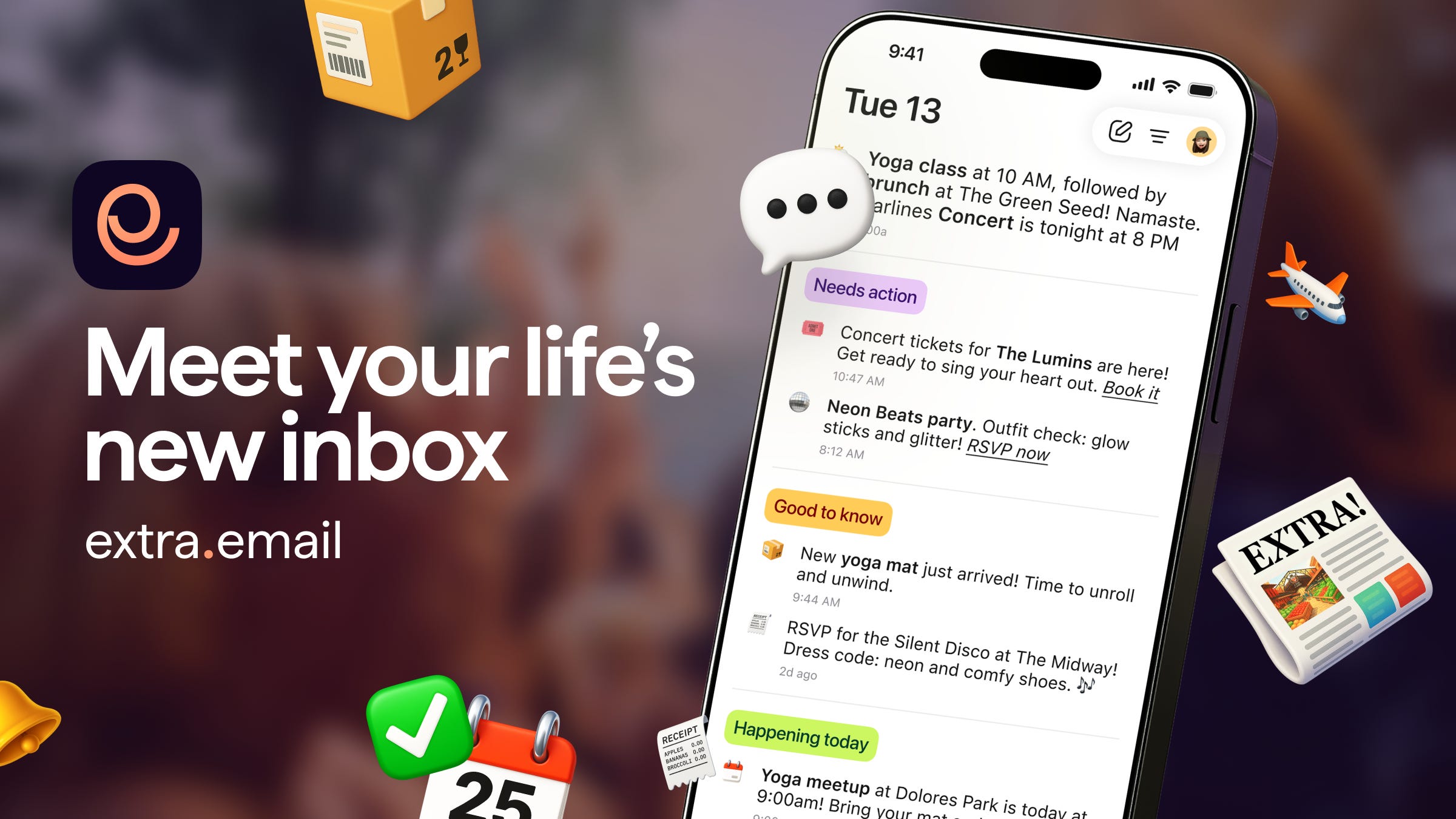
If Gmail looks, as Gavini argues, like a spreadsheet of columns and rows of people and brands asking you for something, Extra presents a more colorful executive summary of what it thinks actually matters to you.
And while “email is the hook,” as Ramkumar puts it, there’s a bigger vision in play here: to build your “life inbox,” part personal assistant, part smart directory to the thousand little things going on in your life.
That’s why the startup behind Extra has a wider-reaching name, BuildForever; it also helps explain how the startup has already raised $9.5 million from investors including Felicis Ventures, Abstract Ventures, A* and Elad Gil.
BuildForever’s founders know the history here, too. Many startups have tried to tackle email since Gmail, from Mailbox to Superhuman; many have failed; the best have been acquired.
They’re making two bets provocative enough to deserve discussion by the wider ecosystem, even if you’re skeptical.
Tools like Gmail weren’t designed for the LLM era
AI builders are under-serving the consumer market
So much money and attention is focused on re-thinking our work tools and processes today, Gavini notes, with many of tech’s smartest people bringing AI to verticals like legal or healthcare.
“My workflow changes every three months now,” he says. “So why are the apps that I use on my phone every day still the same?”
Upstarts recently celebrated one year in operation, and we have big plans for Year Two. To receive our premium coverage and support our work, take 25% off an annual subscription for a limited time.
Extra difficult
Email startup veterans have simple advice for the BuildForever team: don’t do it.
“We’ve learned a lot in the past year,” Gavini responds. “But as a consumer, I would love better personal email, so we’re going to take a shot.”
For such a potentially Quixotic venture, their credentials are strong. At Pinterest, they not only worked in consumer at scale, but launched Shuffles, a standalone collage app aimed at Gen Z that temporarily crested the U.S. App Store in 2022.
And the trio spent months chatting and researching the problem before diving into email eyes wide open. Their thesis: many of the more recent tools to emerge, like Superhuman, have focused on work, because that’s where the obvious money is. But how we use email for work is fundamentally different than when we’re off the clock – much more about continuous, repetitive back-and-forth or outreach; much less about passive consumption.
Busy professionals also tend to try to optimize their workdays first, then scrap together the rest. Not everyone was ‘inbox infinity’ like Gavini, but even ‘inbox zero’ purists like Pereta would spend hours a week tending to their manicured inbox gardens.
Then there are younger people, like the college students who tried Shuffles, who see Gmail as “for old people,” Gavini says. Many of them are now younger than Gmail itself; their names are already taken on the service.
Extra tries to solve the needs of all those groups, although it tends to resonate first with people like Gavini who want to ‘Marie Kondo’ their email backlogs.
At launch, Extra summarizes your daily meetings and what it thinks are key messages, like the delivery status of an Amazon package, or in my case, a looming deadline to purchase college reunion tickets.
For newsletters like Upstarts, Extra could be a double-edged sword. A handful show up in the front-page daily briefing, summarized to potentially drive more follow-through; the rest get grouped into one of Extra’s smart categories, which users can create and edit. Others might include a Kids one for parents, or Reservations for foodies.
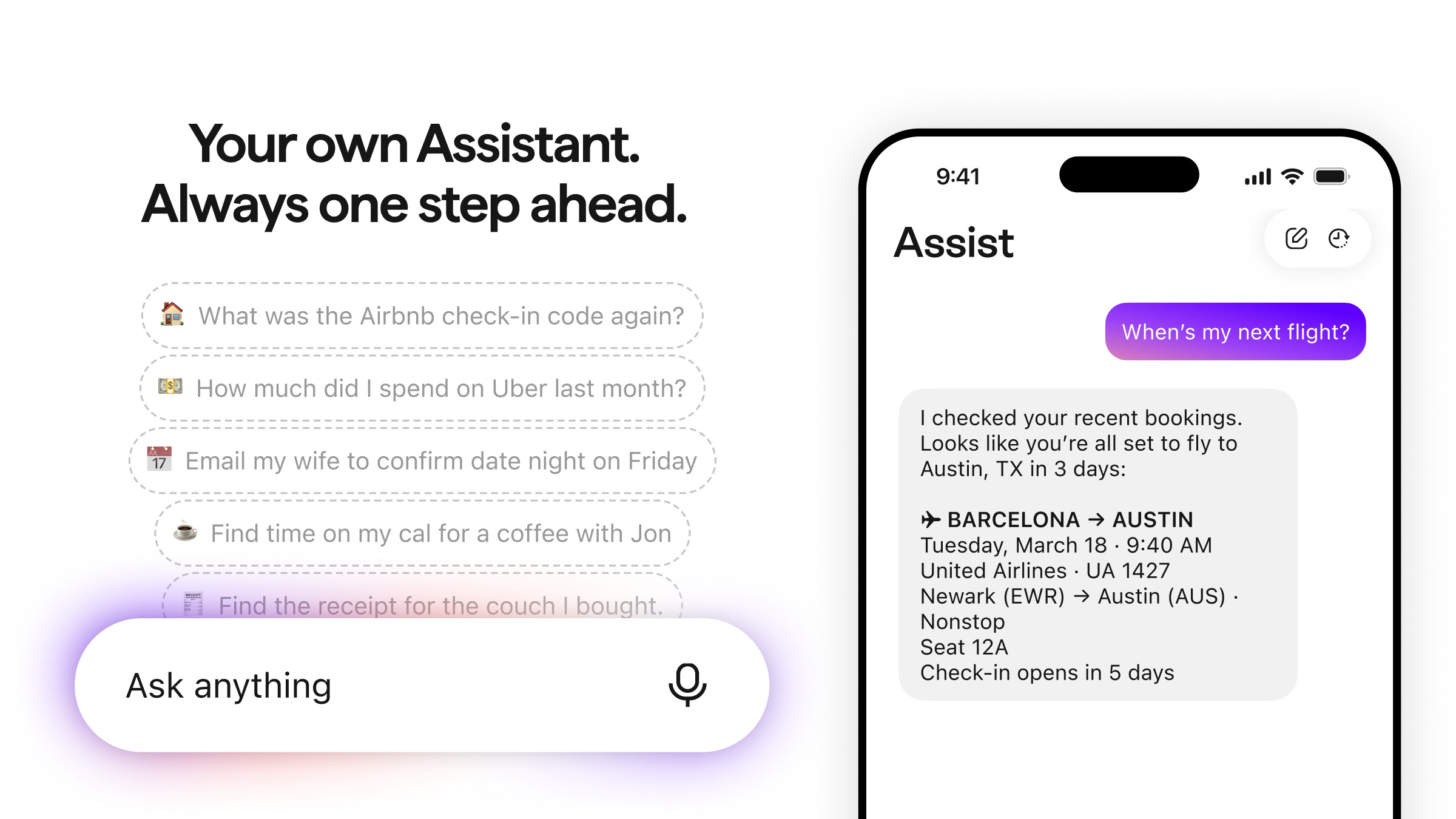
Extra has leaned into smart actions and search. According to Pereta, too many apps still take the approach of a “blank box” – putting the pressure on a user to know what to ask, or retrieve. Emails in Extra suggest a few actions, like adding to calendar or going to a ticket page; you can also query a chatbot similar to productivity tools to ask for suggestions and find old context.
In chats with three test users identified by Extra, we heard three different reasons for adopting Extra. Emma Bates, a startup founder and fractional exec, finds it easier to toggle between six different email accounts without feeling overwhelmed. She’s set up a category for planning her wedding, too.
Emily Yi, a game designer, finds the interface more engaging and less “administrative” than using Gmail on her computer or the Mail app on her phone. As she helps manage care for two elderly parents, she values Extra’s voice capabilities: “The personal assistant part is huge.”
And Courtney Knights, who works in fundraising and development at Columbia University, has used Extra to help break a pattern of relying on two personal emails: one for important info, and another for marketing sludge. Extra has helped remind her to fill out a form for her kids’ summer camp; she’d like a way to connect multiple users, so she could drop updates around their school straight onto her husband’s page and calendar.
Our own experience with Extra has been more of a mixed bag so far. Little things like the reminders and package tracking are appreciated and immediately useful; so is having a simple, visually-pleasing central dashboard of personal tasks.
At other times, the app’s growing pains are more visible. One of the most amusing was when Extra made its first recommendation of a potential email source for me to unsubscribe, due to disuse: official emails coming from Extra itself.
Extra also appeared somewhat lost in time, recommending a year-old dinner reservation as needing action, and offering to check me in to a flight happening in two months.
Gavini says that’s partly the app showing a new user what might appear in certain categories; the app also seems to struggle a bit more with people like me, who take the time to label and archive email whenever possible.
As noted by the test users, it’s easier to get into the swing of using Extra on mobile. It’s also more valuable for people who already use multiple phones, or apps, for work and personal accounts, versus connecting everything into one Gmail inbox.
Racing ahead
How will Extra make money? It’s free for now, and to go up against existing tools, some version of it will likely need to stay free forever.
“We need to be able to support a billion people using the product, and I don’t think a billion people will pay $5 a month when they have a free service,” Gavini admits.
As it adds more assistant-like capabilities, Extra could explore a premium offering; it could also lean into marketing. You can already organize all of your emails from brands into one category to keep track of sales; would a brand gladly pay an affiliate fee to stay top of mind there? If Extra knew you were going on a trip, would Uber or Lyft pay to have a one-click option to book a car from the airport?
“Layering on that funnel is very interesting,” says Pereta. It’s also dangerous – similar to the tension of OpenAI exploring putting ads, or commerce buttons, directly into ChatGPT.
Gavini brainstorms that Extra has much of the info needed to track and identify rewards and special offers coming in from your various credit cards or loyalty programs. Would you, or the cards, pay to keep those top of mind and aggregated in one place? That opportunity reminds us of Paribus, the price-matching tool previously built by Ramp’s founders, and which was acquired by Capital One after being throttled by Amazon. The receipts are still in the email.
A more existential question facing Extra’s builders: if they’re right, and consumers want a new tool here, why won’t Anthropic and OpenAI simply gobble the market up?
It’s not a question that worries Peter Deng, who led the startup’s most recent round at Felicis, and who previously helped oversee ChatGPT at OpenAI. Besides BuildForever’s founders’ own experiences at Pinterest (the now cliche word “taste” comes up), he takes heart in the fact that the labs are focused on the revenue opportunity of work use cases: “They are currently in a world where the user talks first, and the model doesn’t talk at all,” he says.
From tools built DIY using OpenClaw, the recently popular open-source agent builder, to a hypothetical Claude chief of staff, it all might converge on the same super assistant opportunity. For consumers, more competition could mean better options.
“I’m not trying to convince other people to root for this company,” says Deng. “I just want people to try it.”
The “life inbox” idea makes sense, but email has always been hard to disrupt because habits are so deeply ingrained.
Feels like the real challenge isn’t building a better interface, it’s getting people to switch.