


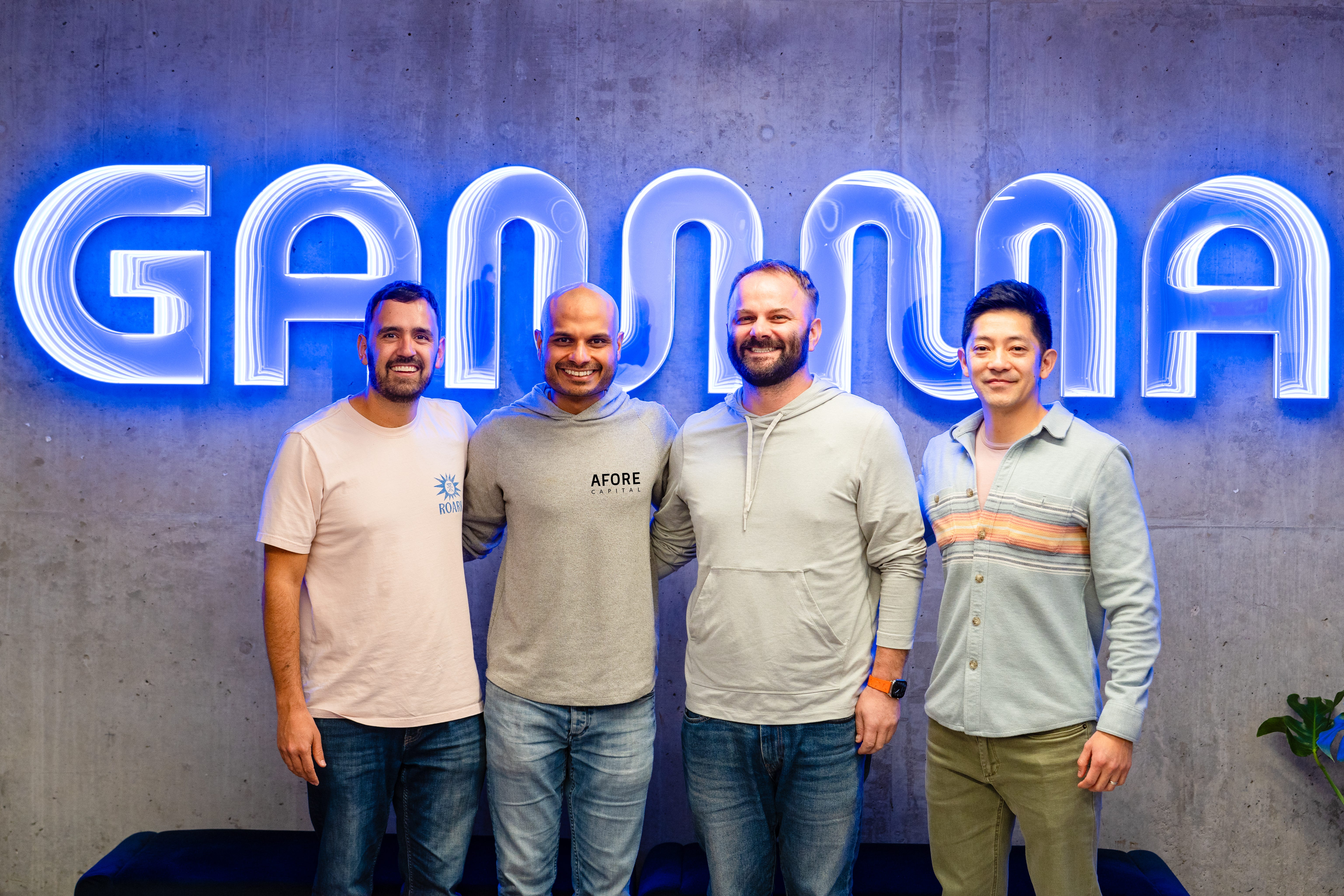
Grant Lee’s software startup, Gamma, has racked up milestones since we profiled it in Upstarts last April: 70 million users, revenue doubled to $100 million, a shiny new $2.1 billion valuation.
Now, Gamma’s following a rite of passage of other AI unicorns before it like Anthropic, OpenAI and Perplexity: launching a venture fund.
Well, sort of. The startup is announcing a fund in partnership with one of its early investors, Afore Capital. And the experiment, should it work, could encourage a new meta in startup / VC firm collaborations.
Called The Ideas To Reality Fund, the new fund will invest $10 million in up to ten idea-stage and pre-seed founders who want closer relationships with Gamma and Lee. Afore is putting up all the capital out of its main fund and leading the charge on the investment side, Lee says.
Gamma, which offers AI tools to generate assets like presentations, websites and pitch decks, is responsible for helping fund startups get the most out of its software, including Gamma’s recently-launched API that can embed its capabilities into another software product. That puts its focus more on training and community-building than picking or managing, Lee says.
“Seeing how people at the earliest stages are thinking about how they build, I’m just personally energized by it,” Lee says. “And I’m a sucker for trying something bold and new.”
For Afore Capital, a $500 million fund that writes checks between $500,000 and $2 million, the fund checks off a couple of boxes: supporting one of the firm’s biggest emerging winners, raising its own visibility, and – hopefully – identifying more returns-driving portfolio companies.
“Gamma is going really big this year, and we felt it was interestingly positioned to build a platform that more of the startup community can use,” says Laura Du, a principal at Afore. Promoting that work through capital, managing partner Gaurav Jain adds, “puts extra punch behind it.”
There’s a big marketing component to all of this: applicants are meant to submit pitches built using Gamma via a splashy new website; the firm will also be sending LED trucks around a handful of cities promoting a related $1,000 giveaway for folks who snap pics with them. But such spending isn’t coming out of the $10 million and isn’t the primary factor, Jain insists: “This isn’t play money.”
The fund is the latest example of a trend that’s been rising across the AI labs. Anthropic announced a $100 million partner fund with backer Menlo Ventures in 2024; Perplexity launched a $50 million fund last year. (OpenAI, notably, runs its own startup fund of at least $175 million.)
And Matt Murphy, a partner at Menlo who works on its ‘Anthology Fund’ with Anthropic, notes that the trend dates back even earlier: nearly 20 years ago, Murphy was at Kleiner Perkins, announcing a $100 million ‘iFund’ with Apple’s Steve Jobs to support its then-nascent App Store.
What’s interesting about this one: Gamma’s still relatively small and unproven to be doing something like this. Is such a co-branded fund the new exploit for any software startup of enough scale to try? Will we see a bunch of firms match up with their favorite portfolio company to launch funds of their own?
Ben Braverman, a co-founder of Saga Ventures, did the whole ‘unicorn investing in other startups’ thing at Flexport, where he built out its ventures arm; he’s skeptical how widely the model can work, but says he wouldn’t be surprised if the tactic spreads.
“It needs to feel authentic to the company, “argues Gamma’s Lee. “And the product needs to be in a position where you can actually be supportive.”
More on how Gamma thinks about it – and what lessons startups can draw from Anthropic’s and Flexports’ more mature experiments in this area – below.
A MESSAGE FROM OUR SPONSOR
Radically different banking loved by over 300,000 entrepreneurs

When I launched Upstarts last year, I knew we needed a banking partner that could move at our speed, and grow with us, too.
Mercury is thoughtfully designed for the unique needs of entrepreneurs like me, offering an easy and intuitive banking experience so I can spend more time with the founders we like to cover.
Building a media startup comes with new challenges every day. But with Mercury, banking is one we don’t need to worry about.
Visit mercury.com to learn more and apply online in minutes, like I did.
Mercury is a fintech company, not an FDIC-insured bank. Banking services provided through Choice Financial Group and Column, N.A., Members FDIC.
Gamma raise
As a profitable, well-funded startup, Gamma could have certainly invested small checks off its balance sheet if it had wanted, but Lee decided against it.
“We think that can become a distraction, because you’re less focused on the core business. You’re starting to sprinkle a lot of resources across other startups,” he says. Gamma also thinks it can be more inclusive by leaving the financials to its VC partner, avoiding the awkwardness of owning stakes in direct competitors as new verticals develop.
A key point for Gamma is that the startup isn’t judging the experiment as a marketing exercise, he says, but a community-building one. What that means in practice: Gamma isn’t attaching growth targets to the startups backed by the fund, like new paid subscribers, or user retention. Instead, the startup hopes to make more brand ambassadors out of the portfolio companies, and to leverage closer access to what it hopes will be ideal target customer personas.
“It’s going to be a multi-year journey,” Lee says. “We want to be the tool that they lean on for visual communication, and supportive in the earliest innings of their journey, and hopefully the reciprocation is longer-term, too.”
Neither Gamma nor Afore believes such a fund can guarantee loyalty, though. “You can’t force people to keep using it,” Jain says. “But you can help show people what’s possible,” Du adds.
“Founders are thinking about defensibility, building moats, building an ecosystem. And this is one way to do that,” she argues.
Anthropic’s example
When Anthropic partnered up with Menlo in 2024, it was bigger than Gamma, but relatively closer in scale: a small startups team, no dedicated venture capital one.
“A lot of developers wanted to understand how to work more closely with Anthropic, and Anthropic didn’t have the resources to support them,” Murphy says.
Like Gamma, Anthropic left all the capital to its venture partner, but identified a few verticals of particular interest, like infrastructure and safety; the company promised access to quarterly deep dives and demo days attended by Anthropic leadership, and $25,000 or more in token credits to use Anthropic’s models.
Over the past two years, the fund has invested in more than 50 companies, Murphy says; Menlo Ventures later led investment rounds in five of them, including API platform OpenRouter, voice AI company Wispr Flow, and research lab Goodfire.
“I think it played out extremely well,” says Murphy. “It allowed us to cast a wider net.”

But the relationship has evolved over time as Anthropic’s grown. Anthropic has more muscle internally to identify and meet with startups; at a certain scale, depending on any one VC firm can seem unnecessarily limiting. “It was originally like, ‘hey, can you be our eyes and ears out there?’ And at this point, they’ve got plenty of eyes and ears,” Murphy says.
The fund remains active, and can make sense for companies looking to more closely align with Anthropic and investors with close ties to it. But its main objectives have already been at least partially met.
Flex-free zone
At Flexport, Braverman says the logistics unicorn was, in hindsight, “only barely big enough” to be investing in startups. Some of Flexport’s investments were more strategic, like trade network Nuvo and supply chain platform Inspectorio; others were more about finding great founders.
Now a full-time VC at Saga, Braverman says he believes that the two extremes of startups backing other startups are cleanest: founders writing their own checks, or as scouts or venture partners, on the strength of their own charisma; or bigger platforms like OpenAI investing real money of their own to generate financial returns.
On the one end, bigger VC firms will happily send winners to founders they want to keep close, meaning startups can get small checks into buzzy companies; on the other, the ability to claim a role as kingmaker can mean that a company like OpenAI, or Coinbase, is able to take meaningful ownership stakes.
“Unless you have sufficient scale that you’re a platform that can create outsized value, it’s so hard to justify the distraction,” Braverman argues. That creates downside risk beyond the financial, as an absentee startup partner might get bad reviews from the startups involved.
Is Gamma big enough to meaningfully help startups from its new fund? From the outside, it’s impossible for him to know. But it’s a warning for others that might want to follow this approach: make sure you can back it up.
Because both Murphy and Braverman say they wouldn’t be surprised to see more startups and funds try this. The limiting factor: a firm needs to see it as beneficial to tie so much of its reputation to one portfolio company; and a startup probably only wants to do this once, at most.
“The irony is that the better one of these tie-ups perform, the less likely the company will agree to do it ever again,” he notes.
Of course, Gamma only needs its fund to work once. Lee, and his VC partners, would gladly take that trade.

Love this! Congrats to Grant, Jon & James!
Cool move, other unicorns should follow this approach, that could be a real smart money!