


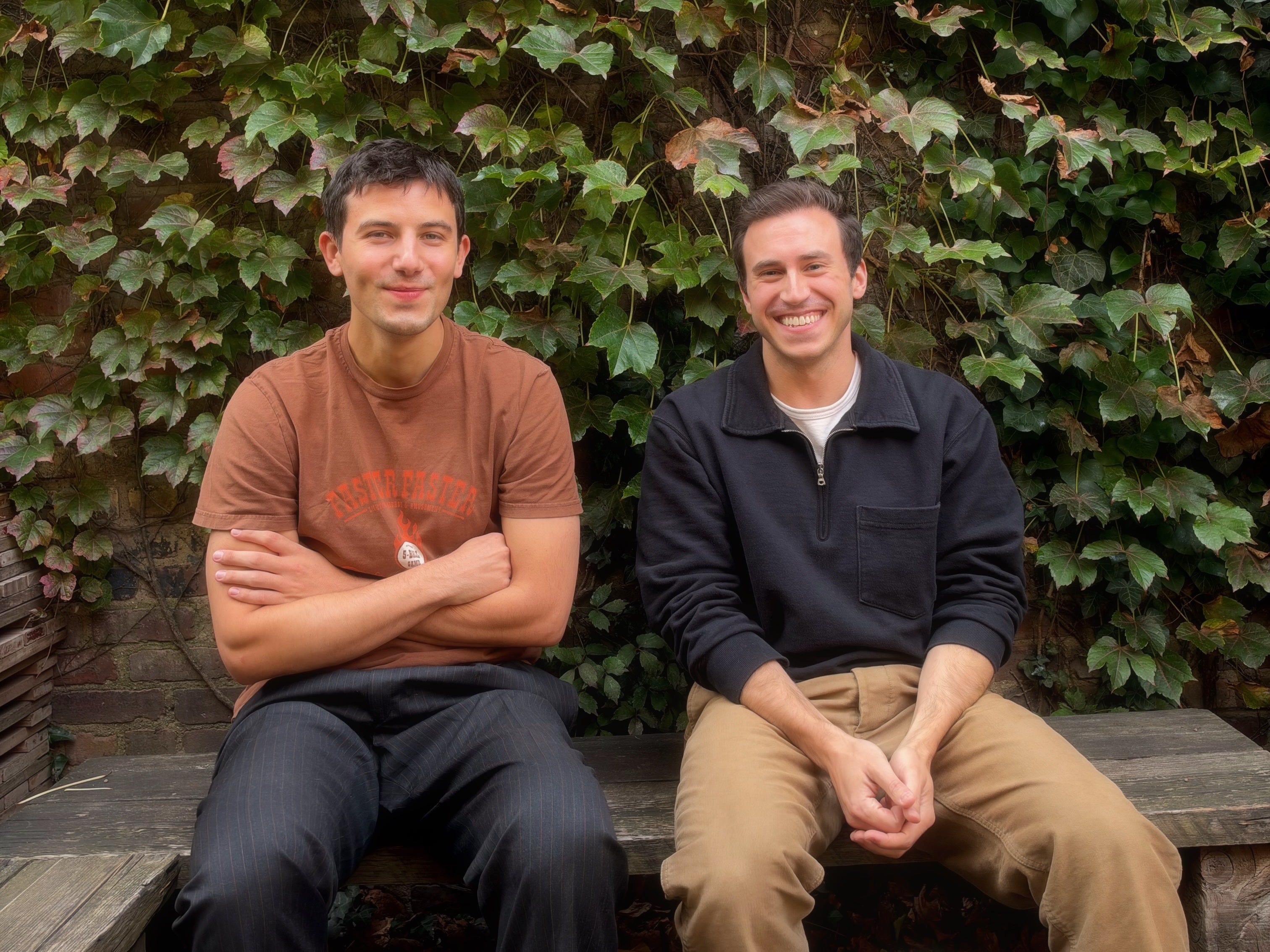
Each time a tech dude goes viral for getting his Resy account banned, Brian Wagner’s phone blows up.
It happened in August, when a New York entrepreneur asked his Hermes AI agent to get him an anniversary table at 4 Charles; earlier this month, it was a local VC’s turn, as a request for Instinct to book the same status-y prime rib restaurant led the AI agent to bombard Resy’s servers. Both begged the booking app for mercy and posted about it on X, prompting Resy’s co-founder to weigh in, and even inspiring a recap article on CNN.
Why ping Wagner? Among friends, and the small but growing number of users of his startup, Spot, he’s known for delivering on that very promise – reservations at seemingly impossible-to-get-into restaurants – by leveraging technology without the kind of “brute force, sledgehammer” approach that leads to bans.
“It shouldn’t only be people who know how to code, or who pay for ChatGPT Pro, who can get all the tables in New York,” says Wagner. “We want people who deserve them to be able to get them: the people who most want to eat at those restaurants.”
Since February, that’s meant people connected enough to have heard about Spot via word of mouth and invite codes – and those who care enough about securing elusive tables to pay $15 or $50 per month for the privilege of Spot managing booking searches for a selection of restaurants across specific dates, flagging any openings at your favorites across any date, and providing access to more tables across a weekly Sunday drop.
And since May, that group has included me. After meeting Wagner at an event in April, I became member No. 107, intent on finding out first-hand if Spot’s tech could deliver on its promise. I’m well aware that Spot’s not for everyone – active only in New York for now, and solving what might seem for many a champagne, or frivolous, problem.
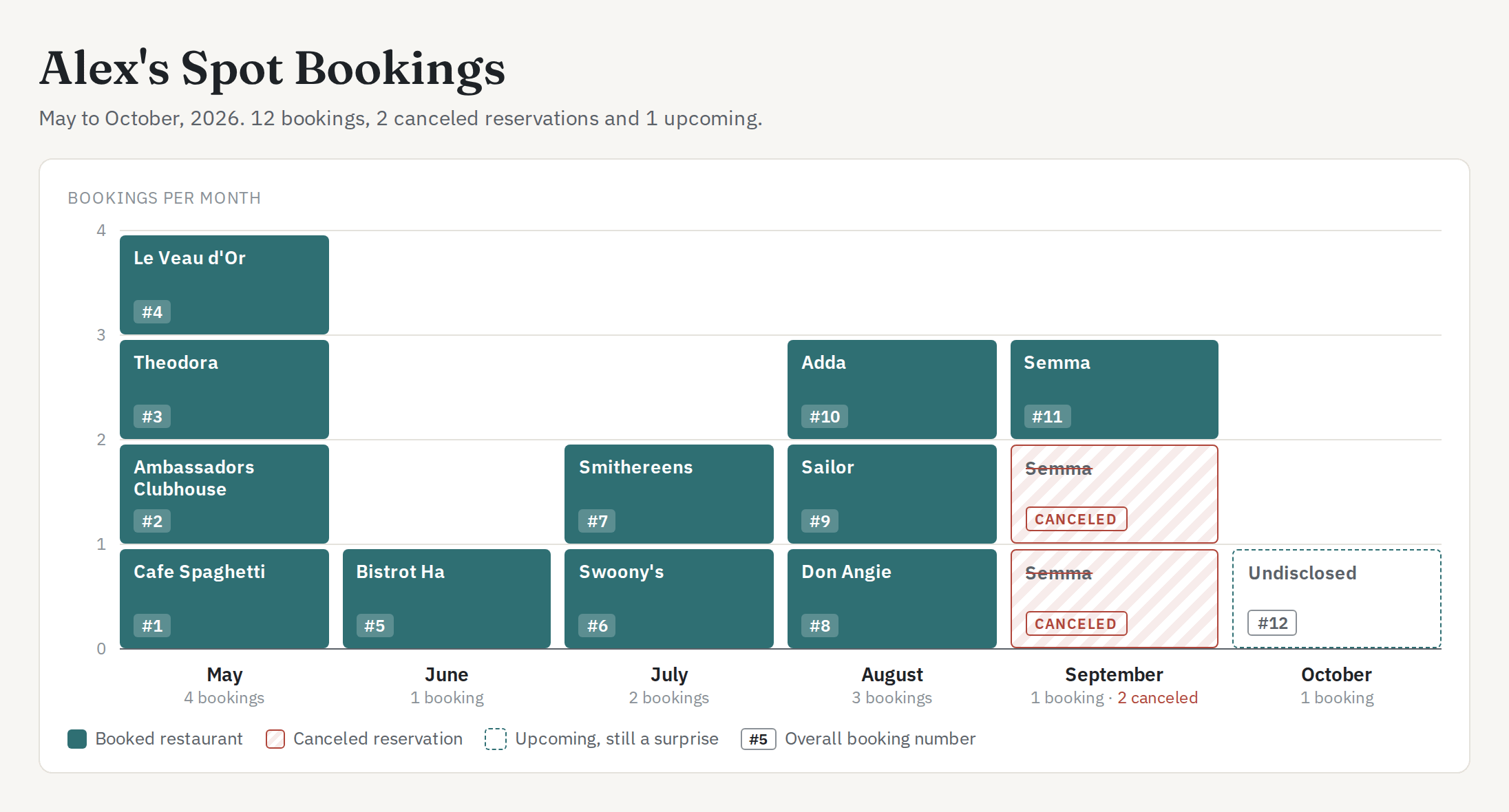
But among my own little network, Spot has proven a secret weapon and a party trick. For a long-scheduled double date, it secured me a four-top at Le Veau d’Or and commensurate kudos; for my wife and one of her best friends, a short-notice primetime table at Don Angie. After months of hearing about Semma’s southern Indian cuisine, Spot got me a table – then helped me reschedule it twice, transferring my booking to other users so I didn’t pay a cancellation fee each time.
“If the platforms start to really try to push back against it, I think it’s probably a losing fight.”
In short, Spot’s worked for me in exactly the way that those high profile failures hoped their AI assistants and agents would. And co-founders Wagner and Andreas Larsen are confident that they’ve done it in a way that will bring the restaurants and booking platforms along for the ride, instead of seeing Spot as an existential threat.
Spot only works in New York for now, with plans to expand to other cities next year. If you want to try it for yourself, you can check out Spot’s App Store listing and skip the waitlist with the code UPSTARTS – then let me know what you think.
More on how they built Spot, the role they see agents playing, and my own reflections on using the app below.
Upstarts recently ranked No. 2 on Inc.’s New Media Power Rankings! A big thanks to the founders and PR pros in our community for your support 🙏
Want to align your brand with one of the top trusted destinations for startup news? Drop us a line at partnerships [at] upstartsmedia [dot] com to set up a chat 👋
Marking the spot
At first, Wagner built Spot for himself. An engineer who previously worked at Travis Kalanick’s cloud kitchen startup, now called Atoms, in Los Angeles, he had moved back to New York to lead a music app (“very much a pandemic idea,” he says) and then consulted with other startups.
Spot’s earliest version connected a Telegram account to a large language model, helping him to try to find tables freed up via cancellations; when it seemed to work, Wagner started running searches for his friends, too.
He was working with Larsen, a friend made via a collective for crypto project builders, on various project ideas when they got enough feedback about people being willing to pay for such a tool that they decided to commit to Spot.
Their architectural insight: rather than have agents check for reservations using a user’s own account, Spot would use a combination of online data available without a log-in and its own in-house agents to monitor table availability without involving the user – only taking an action on their account’s behalf to execute the booking to close the loop.
It was a tactic similar to how CloudKitchens, the Kalanick venture, had provided a unified view of delivery services like Uber Eats and DoorDash for its kitchens, Wagner says. And while it cost him several of his own accounts along the way, he believes Spot now strikes a balance of “giving users as much horsepower as we can, without turning them into abusive ones.”
Internally, Wagner and Larsen also use a number of AI tools to try to scale the business as a team of two. Customer service and update text messages are drafted by AI, but still typically approved and sent out by one of them, like an alert to ask a diner to check if a deposit (Semma, for example, requires an upfront $50 payment per diner) was deducted from the bill, so that the user can pay Spot back.
“In the early days of the company, we were out $100 all the time and it was a disaster, but it was also a very ‘do things that don’t scale’ moment,” Larsen says.
From a retention standpoint, Spot has found that the key is for users on a free trial to book a highly-desired table in their first week. From there, happy users tend to book a table at least twice per month, if not weekly; power users will eat out via Spot as often as 3x per week (if you’re one of these people, please tell me, so I can mooch off of you).
A good time, not a long time?
Such is one challenge for Spot: grow too fast, and you upset the apple cart. The platforms could always decide to more carefully block Spot’s internal agents; or, as Amazon recently moved to block Meta’s Muse assistant, they could move to hide their data and update their terms of service to raise more of a firewall.
“If we had 5,000 people sign up tomorrow, there would be a lot of problems,” Wagner admits. “We would be hitting some partners pretty hard, and it would be hard to get the supply.”
But Spots founders are banking on the fact that the booking platforms will continue to whack only more egregious behavior, not use like their own.
“If the platforms start to really try to push back against it, I think it’s probably a losing fight,” Wagner says. “I don’t think we go backwards in terms of how the internet and these tools are being used.”
In his X thread responding to one of the ban-hammer Resy incidents, co-founder Ben Leventhal (now the founder of restaurant loyalty app Blackbird, of which I’m also a user) seemed to at least partially agree: “We are going to see a new layer of services develop on top of platforms like Resy, no question. Consumers will benefit big time.”

Asked if they consider Spot a “legitimate and secure” way to do so, Larsen says that Spot has prioritized security “from the beginning.” “We don’t roll out support for another booking platform unless we’re sure that we can be super responsible about it, and not get people’s accounts flagged or banned.”
Instead, they point to a future where Spot can ensure inventory moves on those platforms, while also helping restaurants directly.
Each claims personal ties to the restaurant industry: Larsen’s dad was previously a co-owner of a number of restaurants; Wagner’s was an accounting manager for a Chicago-based steakhouse chain.
And to hear them tell it, Spot could help restaurants prioritize certain customers by periodically asking the app to shortlist regulars, or locals, or people who had never visited before. So far, they’ve spoken to a couple of restaurant owners informally, but the founders stress that their app is too small to deserve more attention in that regard, at least not yet.
“We would love to have stronger relationships with them, but we are a tiny startup,” notes Wagner.
As for the user experience, I have already seen tables on Spot get a little bit tougher to grab. I was on the app at noon, right when the most recent batch of pre-booked tables dropped, and watched them get snapped up within a few seconds. (I might have been tempted by a table at Red Hook Tavern on Friday otherwise.)
The $15 Lite tier appears to be a bigger growth opportunity for Spot than its hard-capped Pro tier; Spot wants to lower that price over time. But if those users aren’t scoring enough “wins” with tables to see value, they’ll churn out.
That means Spot may never end up a venture-backable, billion-dollar business. Spot’s founders argue that other VC-backed restaurant apps like Dorsia and Blackbird have moved to expand rapidly in new markets, or go more deeply into payments, partly in search of such bigger outcomes. At a thousand or so users, Spot could grow off of revenue, its founders say, without necessarily raising a bigger round.
The more existential question: can it keep delivering magic? Spot still hasn’t snagged me a table at the restaurant that launched a thousand Instinct API calls, 4 Charles. (Spot says it’s successfully booked the restaurant for at least one other user to date.)
Larsen’s response: Over time, I might trust Spot to surface new high-demand destinations, not just the same 10 restaurants, bringing it with me as I travel.
“Part of Spot growing will be it becoming a tool that can help guide you through a city to find places you love, while occasionally still getting you into the really hot spots,” he says. “And we might still be able to get you 4 Charles.”
Challenge accepted.