


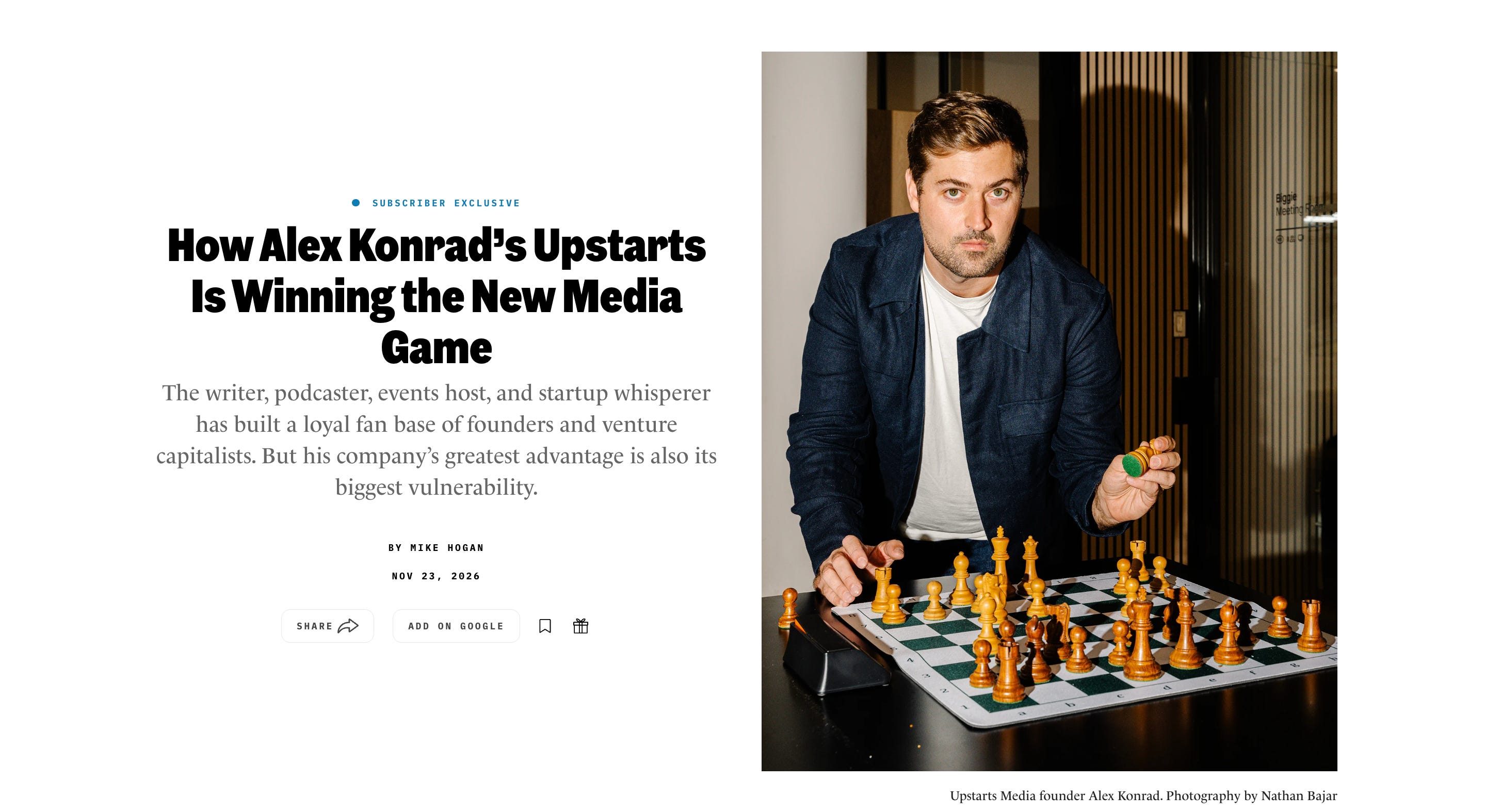
I’m pretty familiar with the art of the startup founder profile. Writing hundreds of them over the past 15 years, from Fortune to Forbes and now at Upstarts, creates some muscle memory.
Which made it bizarre, exciting, and nerve-wracking to go through the experience on the other side, when Inc. Magazine published the first profile of Upstarts and me earlier this week.
Following that same muscle memory, but backwards, I went through the process from the founder’s seat:
My personal media relations expert (my spouse and Upstarts advisor Natalie, naturally) prepped me to avoid saying dumb stuff
I made a list of notable past subjects, former colleagues, and peers, and asked them to serve as references
I organized a day of meetings so the reporter could shadow me on a startup office visit (where I walked into a self-own lede by botching the hands-on robot demo), a CEO interview, and a video taping, in order to provide on-the-ground “color” for Inc.
I fielded questions and kept focus across several Zoom interviews, follow-up calls, a fact-check, and photo shoot (shout-out the Flatiron Banana Republic for helping me pick a fall ‘fit 15 minutes before)
I waited nervously for the story to drop, including a publication delay due to the Anthropic IPO (don’t worry, we ended up on the day of the Nvidia CEO’s return instead)
Having gone through the experience from the other side, I feel deeper empathy for the startup founders that I cover. It turns out – big surprise! – that you can worry about similar questions, too.
But when I finally read the story, my main reaction was gratitude.
Gratitude that reporter Mike Hogan, photo editor Nathan Bajar and the Inc. team put true craftsmanship and care into accurately reflecting who I am, what motivates me, keeps me up at night, and above all, what I’m trying to build at Upstarts now and for years to come.
Gratitude that of the two dozen founders, investors and peers I pinged about chatting with Inc. about me, everyone said yes. The Inc. story featured a CEO I covered a decade-plus ago at Fortune (Zocdoc CEO Oliver Kharraz), a Forbes cover profile subject (Zoom CEO Eric Yuan), and the first-ever startup we profiled in Upstarts, Granola (CEO Chris Pedregal). Investors weighed in from atop the Midas List (Sequoia’s Alfred Lin) and from firms whose startups we’ve featured (Human Ventures’ Heather Hartnett and Homebrew’s Hunter Walk).
Even better, the story took the space to give Natalie Sportelli her flowers, from encouraging me to take the entrepreneurial plunge myself, to the positive role she plays in the wider startup ecosystem at Clay and beyond.
A big thanks to the other CEOs, investors and peers who spoke for the piece, including TBPN’s Dylan Abruscato and Vanta’s Danny Hutto, and my former editor Bruce Upbin. Thanks also to everyone who spoke, or offered to, and didn’t make it into the final piece.
Above all, I’m grateful for you: the Upstarts community.
Whether it’s as subscribers or subjects of our writing, viewers and sharers of The Upstarts Podcast, or as lurkers or commenters on our Founding Upstarts WhatsApp group, your buy-in and support makes this whole operation possible.
The tension around Upstarts highlighted in the Inc. story focused on how I’m still a solo operation, with part-time help, creating its own kind of ‘key man risk.’ Nvidia’s recent evidence aside, I take the point.
We’re now hiring for a founding chief of staff to professionalize and level-up our operations as we grow in 2027.
If you are or someone you know is interested in a high-agency, extremely internet-pilled, and lightly chaotic startup role, respond to this email or DM me.
And as we come out of Thanksgiving week, I plan to bring fresh empathy for founders whom I profile in Upstarts, and renewed energy to do right by you all. Your response to this moment of celebration has meant the world to me.
Below, I’ll share three tips for startups seeking, or facing, media coverage from my experience.
Then, in the words of Sequoia’s Lin, who knows a thing or two about building a generational startup: “Congrats on the nice profile. Now back to work.”
A MESSAGE FROM OUR SPONSOR
Ship pricing like a product

Different product bets have different business goals. You’re either chasing market adoption, revenue growth, or profits. You need to test fitting pricing models for each of those goals. Fast. Chargebee can help — Price for usage credits, outcomes, complex contracts, or any other modern commercial construct.
1. Every quirk counts
Profile reporters will fish for anecdotes that speak to a theme about you or your company.
Across your interactions with a reporter, be mindful that everything you share is fair game – even, and especially, seemingly random fun facts about your history.
In my case, my grade school chess career became a surprise focal point when, seeing chess boards set up in the Nidus office, I digressed with one of the startup’s co-founders about our past experiences with the game. This deep cut from my personal bio ended up driving the headline and lead image of the Inc. article, and serving as a recurring motif.
At Forbes, editors taught me that effective business journalism still centers around people. As a founder, your quirks humanize you and make what you’re building more relatable. Know what those could be. Share them strategically.
2. Embrace list cringe
The highly online will tell you that lists aren’t cool. Don’t listen to them.
When I was at Forbes, I’d tell candidates for the lists I helped manage – The Midas List, Cloud 100 List, and Under 30 in Venture Capital, mainly – that a list won’t make or break your career, but it can serve as an accelerant for you and your business.
In this case, Upstarts appeared second on a new Inc. list, the New Media Power Rankings, in the weeks before the publication reached out about a profile. As an editor working on the project framed the story on LinkedIn, we played into a ‘dark horse’ challenger narrative: Did you notice Alex Konrad on our list and think, who’s that? Here’s the answer!
As a founder or startup operator, you have to lean into any visibility that comes your way.
3. Know ‘why’ you’re talking
When startups ask me about getting press coverage, my first question is always: Why?
It’s not about being snarky, but about thinking tactically. What’s the desired outcome of that coverage, besides impressing your parents, or college classmates? (Maybe that’s partly the goal; if so, it’s still good to be honest about it.)
Are you trying to increase brand exposure and drive new top-of-funnel to your business? Get in front of high-priority hires? Seem more legitimate to prospective investors? Or maybe gain a public reference that you can point to that explains your motivation, values, and your startup’s goals?
In my reporting career, I’ve profiled startups motivated by all of those considerations, sometimes several at once. Now as a challenger brand at Upstarts, I think about our ‘right to win’ whenever approaching a new story: why is Upstarts the right publication to tell this story? Why would the Upstarts audience care?
When Inc. reached out to me, I identified concrete goals that attention from a new story could drive: new subscribers to the newsletter and podcast, and qualified candidates to join Upstarts as our founding chief of staff.
What positive outcome would media coverage bring your startup? If you can’t think of one, it’s maybe a signal not to invest the time and energy just yet.
the profiler gets profiled
💯💯💯