


The Upshot
Sports betting and prediction markets are all the rage among Gen Z. Twenty-four-year-old entrepreneur Ben Haber sees it with his friends, and has a counter-offer: What about pre-IPO shares in OpenAI or SpaceX? Evergreen funds like Blackstone? Maybe some real estate?
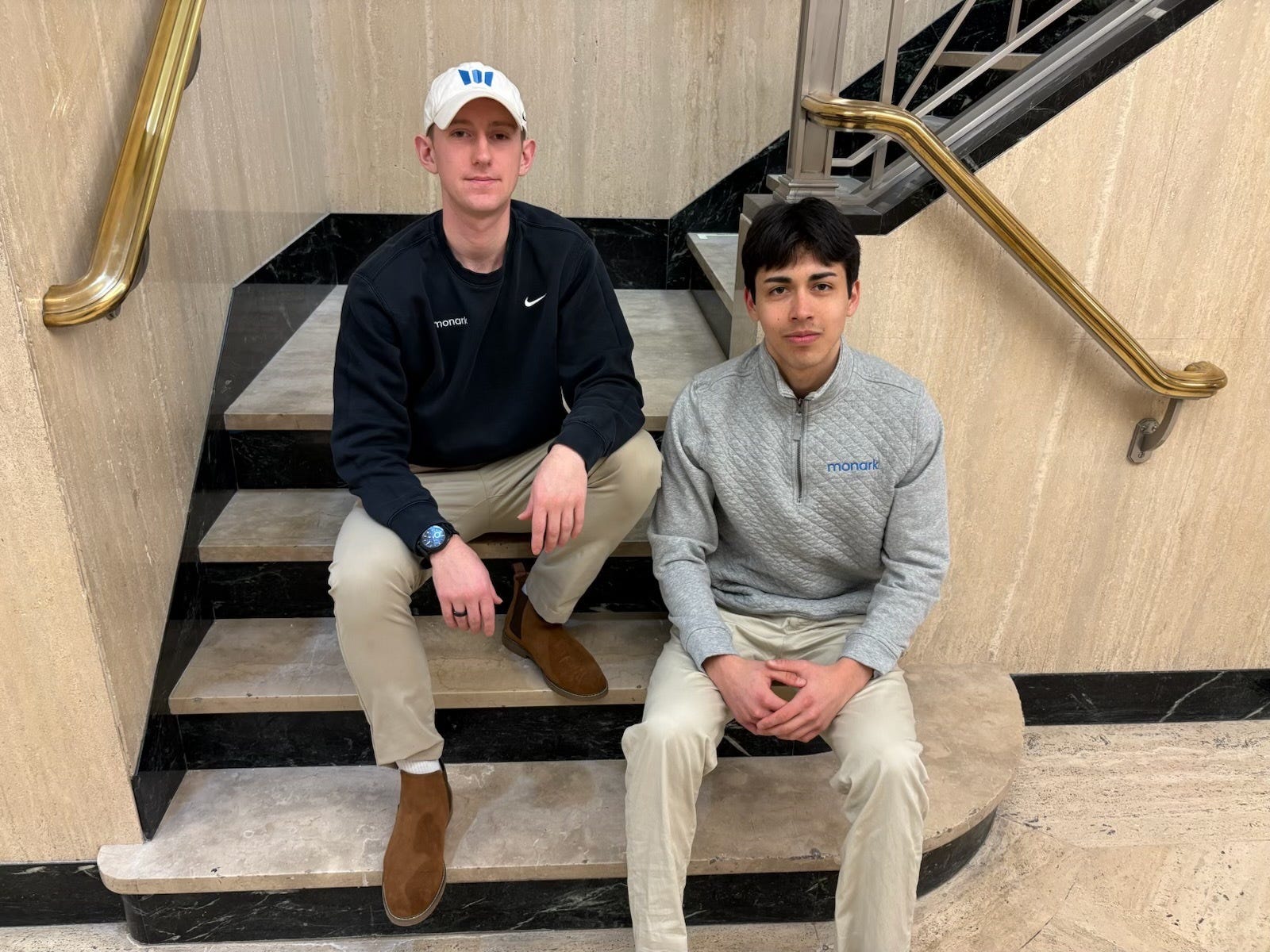
As co-founder and CEO of startup Monark Markets, Haber’s working to make such private assets, also known as alternative assets, or ‘alts’, more accessible to retail investors everywhere.
“All this other stuff, you can argue whether it’s gambling or not, but it’s not healthy. It doesn’t build a foundation for a stable society,” Haber says. Compare that to the excitement around private businesses (many of them startups) in AI and manufacturing, the ‘American Dynamism’ thesis pushed by some investors like a16z, Haber adds: “I think more people should believe that, buy into it, and have the ability to participate in that.”
His New York-based startup, Monark Markets, is looking to help, not by building the next viral app like Kalshi or Robinhood, but by providing better software rails to connect private market assets to the existing apps and brokerages that retail investors already use.
Monark already integrates with platforms like Altruist, Apex, Vested Finance, BBAE and others to help their customers access these assets in real estate, private credit and private shares in buzzy pre-IPO tech companies like OpenAI and SpaceX. Other alt assets, such as evergreen funds from the likes of Blackstone and KKR, are coming soon.
Founded in 2022 by Haber and his NYU classmate Paul Davis, Monark and its team of 18 already claim a wide reach: the combined user base of their customers spans more than 50 million retail investors, Haber says.
That leaves many, many millions to go. Retail trading accounted for about a quarter of all activity last year; more than 60% of Americans report owning stock.
“It’s very important if you’re a retail investor on Webull, or Robinhood, or Fidelity, or Schwab, that you’re able to access this market and do so in a transparent, fair way,” Haber says.
To do so, Monark is loading up. The startup has raised $8.1 million in new funding led by F-Prime Capital, Upstarts reports, with participation from Commerce Ventures, BBAE, Grit Capital Partners and The Treasury.
And it’s smart to move fast. With a friendly regulatory environment and wider interest in companies that could be public by year’s end like SpaceX, Monark’s not the only company looking to capitalize here. Charles Schwab beefed up its private markets offering by acquiring Forge for $660 million recently; Morgan Stanley snapped up EquityZen.
Monark Markets purports to be the only player turning on such capabilities by API, without asking for access to consumer data or requiring new accounts. But it’ll inevitably face a land grab as more brokerages look to build, buy or partner with other players.
The startup’s next phase will provide an interesting case study for the wider ecosystem. Will Haber prove savvy to shun building his own consumer app, or is he stunting Monark’s upside? And will the current interest in private assets outlive the hype around just a small number of outsized private tech companies like SpaceX?
More on those questions, and Monark’s approach to them, below.
A MESSAGE FROM OUR SPONSOR
Mercury + Upstarts: Radically Different

When I launched Upstarts last year, I knew we needed a banking partner that could move at our speed, and grow with us, too. I chose Mercury. And I’m excited that Upstarts is partnering with Mercury as the presenting sponsor of our flagship podcast, The Upstarts Podcast, too.
Mercury is thoughtfully designed for the unique needs of entrepreneurs like me, offering an easy and intuitive banking experience so I can spend more time with the founders we like to cover.
Visit mercury.com to learn more and apply online in minutes, like I did.
Mercury is a fintech company, not an FDIC-insured bank. Banking services provided through Choice Financial Group and Column, N.A., Members FDIC.
Let him cook
The son of entrepreneurs who grew up in the Boston area, Haber spent his teen and college years covering his costs as a cook in restaurants (he’s still got the chef knife tattoo to match).
His founding journey with Monark started as a freshman at Hofstra, which he attended before transferring to NYU, where he started trading options through a finance club. He and Davis became fascinated by a number of companies popping up promising access to fractional real estate.
“The conclusion we came to was that people are going to allocate way more capital to private markets over the next decade: from no exposure to 10% to 20% of your portfolio, if not more,” Haber says. “But it’s not going to happen through your direct-to-consumer platform; it will happen through your existing brokerage account, where you invest in public markets today.”
Existing sites like Robinhood and Webull, meanwhile, lacked some of the infrastructure for private assets, from compliance to documentation.
Monark’s big decision was not to compete, but to partner. The reason is simple, Haber says: a private asset app would be fighting for just that 10% to 20% of volume, but pay as much or more for customer acquisition. “The unit economics just doesn’t really scale,” he says.
Haber and Davis ended up buying one of the venture-backed companies that had tried that and flamed out. Real estate focused LEX Markets had raised $27 million and reached 10,000 users before going bankrupt; with the support of an angel investor, they got its trading system and brokerage relationships for about $1 million, all while still in college.
The first season of The Upstarts Podcast is underway! Watch our first episode, with Canva CEO Melanie Perkins, below. Our next episode with another exciting startup founder arrives on Thursday. Subscribe to catch each episode on Apple, Spotify and YouTube.
For the next several years, they worked with potential early partners like Apex Fintech Solutions, which ultimately announced a partnership last year. Today, Monark says it can go live with a new partner in about 3 weeks, providing a single integration for it to handle compliance and documentation across each type of alt asset.
“People want speed, and they want the software to actually work,” Haber says.
Above all, Haber and Monark offer no threat of stealing away a customer. “They’re bought into the idea that we’re really building towards a broader ecosystem that benefits everybody,” he adds.
The asset altar
Access pre-IPO to the shares of tech’s big-name unicorns is the obvious door opener for Monark. After BBAE partnered with Monark, it was able to help customers buy pieces of a $2.5 million allocation into each of SpaceX and, ironically, prediction market Polymarket. Haber says Monark has closed on $14 million in SPV volume so far, also helping retail investors get into Perplexity, OpenAI, SpaceX and Stripe.
That work is still somewhat manual today: Monark’s staff source allocations across about 50 brokers and venture fund syndicates, running a process to check for retail demand before providing the shares to their brokerage partners (where purchasing is automated). Monark signs for the shares, a risky move, but Haber says no deals have fallen through to date.
Investors backing Monark argue that the shift in capital markets that’s created more interest in secondaries won’t go away. “What used to be small cap growth is now captured by the private markets,” says Matthew Bellows, a partner at Grit Capital. “With recent legislation, and technologies like Monark’s, that change won’t disappear once Stripe and Space X are public.”
And they argue that the pre-IPO shares will be more the sizzle than the steak over time. Jeff Cruttenden, the co-founder of fintech company Acorns and an investor at The Treasury, writes by email that he expects evergreen funds to drive significant growth for Monark’s network.
And David Jegen, who led the most recent round as a partner at F-Prime Capital, says that Monark’s opportunity is much bigger than as a secondary market maker. “They have the opportunity to be the core infrastructure that in 10 or 15 years makes them a player like DTCC is in settling every public equities trade,” Jegen says.
Two other existential questions face Monark: The first: if this market is so attractive, will every large brokerage eventually build its own tooling, keeping it at the fringe? Haber’s rebuttal: the markets are moving so fast that the cost-benefit analysis won’t make sense for most, while others will want the wider access and interoperability of a neutral provider.
The other: will those young people like Haber’s friends actually care about private assets as they become accredited and qualified investors who can make these purchases?
That one isn’t so simple, Haber admits. “I think the biggest challenge for us is that the end investors are still very early on the journey of understanding why they should even care about private markets in their portfolio,” he says. “Public equities feel necessary, and alternatives still feel like a nice‑to‑have side bet. Until we change that mindset, all the infrastructure in the world doesn’t really matter.”
