


In what looks like a workshop rig set up in the middle of a more typical startup office in New York’s Flatiron neighborhood, the teleoperator shows me how to stabilize the robotic arm with my left hand, then reach with my right, the gripper approaching at a 45 degree angle until its prongs are just over the floor.
Press the trigger, and they close on the target – a section of wire, its ends exposed from their protective shielding – ideally about 3 inches from the end. Now comes the hard part: lining up the wire ends straight on with a rotating wheel. With a flick upwards of the wrist, he gently guides the two together, the wheel brushing and grouping the wire’s fibrous ends together in a neat bunch.
That’s how it looks when he does it, at least. My first effort makes contact off-center, and the ends tangle in every direction. A second try is more respectable, but I’m not going to be offered a job.
“I wanted to see what happened if it went the wrong way,” says my host, Nidus Technologies CEO Justin Sealy. “You kind of can know pretty quickly with people if they’re going to be good or not.”
The team at Nidus, all dozen or so of them, are much better at this unusual task. That’s because the data they collect from doing it thousands of times, across a growing number of these rigs, play a crucial part in training AI models that the startup then wants to deploy with defense industrial customers, speeding up their production without having to rebuild their existing processes from scratch.
They’ve started with wire harnesses, a pre-manufactured mass of cables, wires and connectors that makes them easier to install in everything from automobiles to satellite receivers, and aircraft to tanks. But the ambition is to move beyond wire harnesses into other processes that take hours of human busy work today, from kitting and pre-assembly to printed circuit boards.
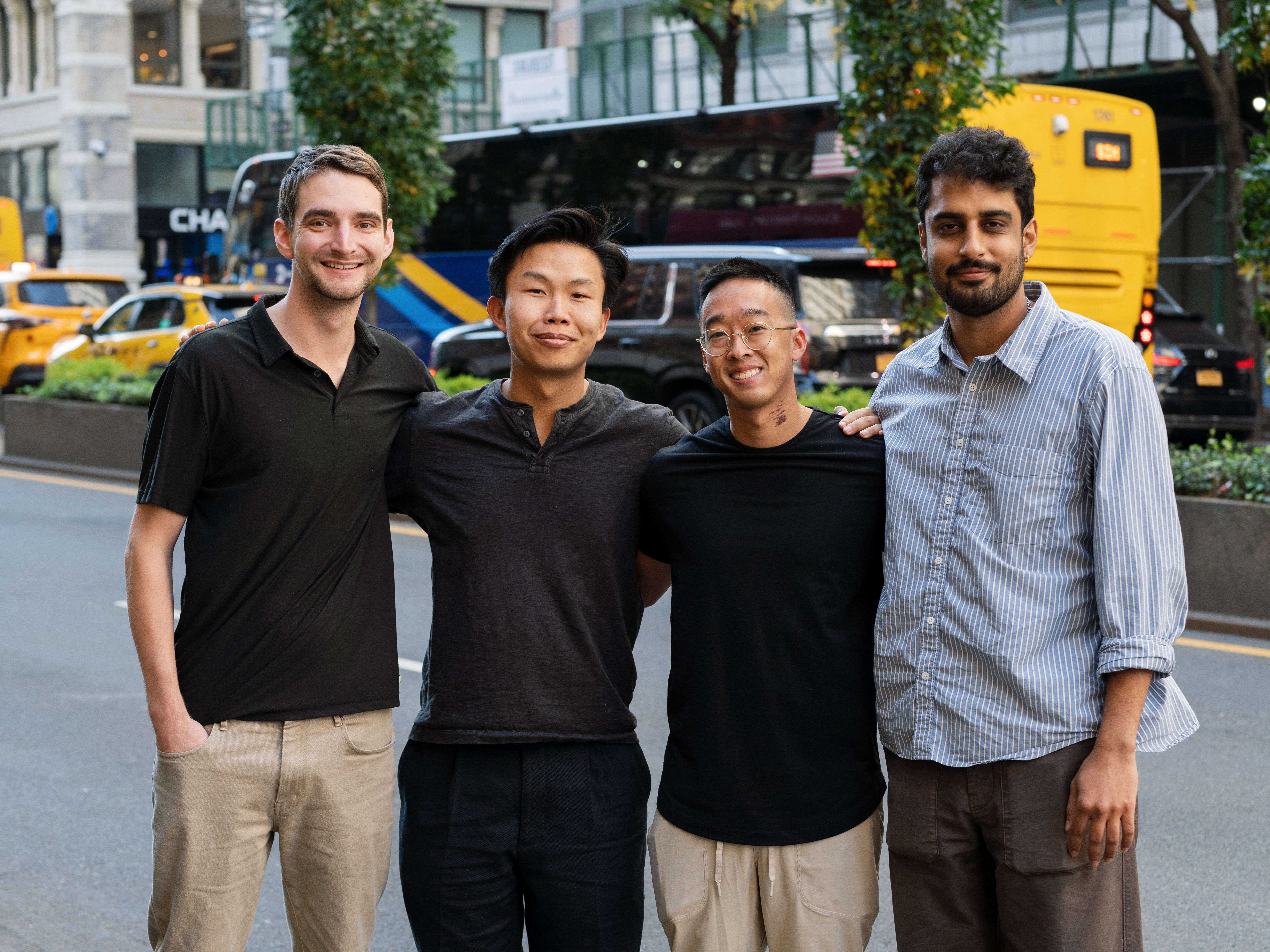
Founded earlier this year by Sealy and three co-founders who all worked together on the hardware team at defense startup Vannevar, Nidus says it has reached more than $1 million in bookings with unnamed defense industrial customers in just four months.
Today, Nidus announced that it’s raised $30 million in funding: a pre-seed led by Costanoa, and a seed round led by Kleiner Perkins, Upstarts exclusively reports. Ludlow Ventures, Absolute Partners and angels including Hadrian CEO Chris Power and Amca CEO Jai Malik also participated.
Nidus plans to use the funding to hire aggressively at its New York HQ, in a bid to build a leading robotics AI lab in the city, ramping up data collection and training for more (secretive) customers.
The startup stands out for other reasons, too. Sealy and co. are motivated, they say, by the need to reindustrialize more of America’s supply chain in the face of potential geopolitical tension with China (a concern we looked at from the logistics view recently with our launch story on Watchtower).
And they’re making a bet that general robotics AI labs, like Physical Intelligence, Skild AI, Figure AI and many others, won’t be able to easily expand into the precise needs of the defense industry.
“Oftentimes Silicon Valley technology goes to the easiest commercially viable path, versus where it needs to go in the most urgent capacity,” Sealy says. “Defense is just such a different customer than folding towels at Holiday Inn.”
More on how Nidus plans to do it, and stay ahead of well-funded rivals, below.
A MESSAGE FROM OUR SPONSOR
Ship pricing like a product

Different product bets have different business goals. You’re either chasing market adoption, revenue growth, or profits. You need to test fitting pricing models for each of those goals. Fast. Chargebee can help — Price for usage credits, outcomes, complex contracts, or any other modern commercial construct.
A family mission
Growing up in a military family in Greenwood, South Carolina, Sealy watched friends’ parents lose their jobs to offshoring of the local textiles industry. At Clemson, he took multiple leaves of absence to work as an engineer at a local manufacturer to try to help.
But it was a 2018 ad in the Wall Street Journal that pushed him to apply on a whim for a job at Palantir. Explaining that he wanted to help his siblings deployed in the Armed Forces to get home safely, Sealy was surprised to be offered a job in Palantir’s New York office, where he quickly got security clearance to work on government contracts, and spent three years as a deployment strategist.
After a stint at safety startup Peregrine, he joined Vannevar, a defense startup working on intelligence tools for national security and government customers, with an eye toward deterrence against China. It was there that, after being asked by Vannevar to build out an AI hardware team for use cases like drone detection, he began working with Harrison Nguyen, Charu Dwivedi, and Cane Punma, who brought expertise in operations, robotics and AI, respectively.
Then last Christmas, Sealy wrote an essay about his belief that U.S. industry needed to tap more into accessible robotics capabilities in order to depend less on China. “In order for us to actually compete, there has to be a technology shift. There has to be something where we can build more with the existing capability we have in the U.S.,” he says now.
The post made the rounds among venture capitalists, and Sealy realized he was sitting on a new company idea. With the blessing of Vannevar’s CEO, the four formally founded Nidus in March. They spent the next few months visiting potential customers to see what process made sense to start working on.
“If you walk around a factory and you look for places where a human is standing still, doing the same job over and over again, it’s typically in front of machines,” Sealy says.
Cutting and prepping wire harnesses for production stood out as a task where highly skilled workers still toiled with hand tools for hours. “How do you get more product out of the craftsman?” Sealy says they challenged themselves. “How do you take a lot of the manual stuff that they’re doing, and allow them to build faster?”
To make those workers 10x more efficient, Nidus’s founders devised a business model by which they would leverage the best existing AI models – initially open-source, and now frontier models – then collect their own proprietary data to fine-tune them for the specific industrial use case. That custom model could then be deployed in the factory, effectively putting a GPU alongside an existing robot already in use.
It’s a page out of the Palantir playbook, Sealy says: “The value is found on the edge. Go solve problems there.”
A rising tide
Sealy and his co-founders believe they’re taking a different approach than many other AI robotics labs today. “There’s a lot of people doing robotics, but what excites me more is the burgeoning need for reindustrialization,” says Nguyen.
The data that Nidus collects and uses with each customer is also private and proprietary, notes investor Aatish Nayak, who led its most recent funding at Kleiner Perkins, meaning it’s tougher to replicate.
Other robotics and AI labs might be more interested in partnering with Nidus, given its access and trust with such customers, says Nayak, versus playing catch-up getting a foot in the door. Nidus can also demonstrate results faster than some of the big-swing fully autonomous factory projects underway, like Jeff Bezos’s well-funded Prometheus.
“There’s something to be said for a mission-driven team that’s very pragmatic, customer-first, and not necessarily technology-first, but technology agnostic in many ways, because they’ll benefit a lot from the various hardware and software advances,” Nayak argues.
Still, if the market is so attractive, and the need so great, other startups and tech giants will compete. Nidus isn’t the only startup working broadly with wire harnesses already. The investor concedes: “Speed is the name of the game.”
Nidus’s founders aren’t worried. When I meet with them in October, they’re more focused on the local utility fixing an issue getting new fiber-optic cable online for their building, so they can upload their training data faster to a secure cloud environment. (The utility hit a gas line, causing much excitement on their block for a day.)
“The addressable problem set of robotics is so much larger than one company,” Sealy says.
But there isn’t an infinite supply of engineers who are better than me at robotically cleaning wires. The founders want you to know they’re hiring, and their CEO makes a final pitch:
“There is no world-class physical AI company in New York, and we have the opportunity to be the first.”