


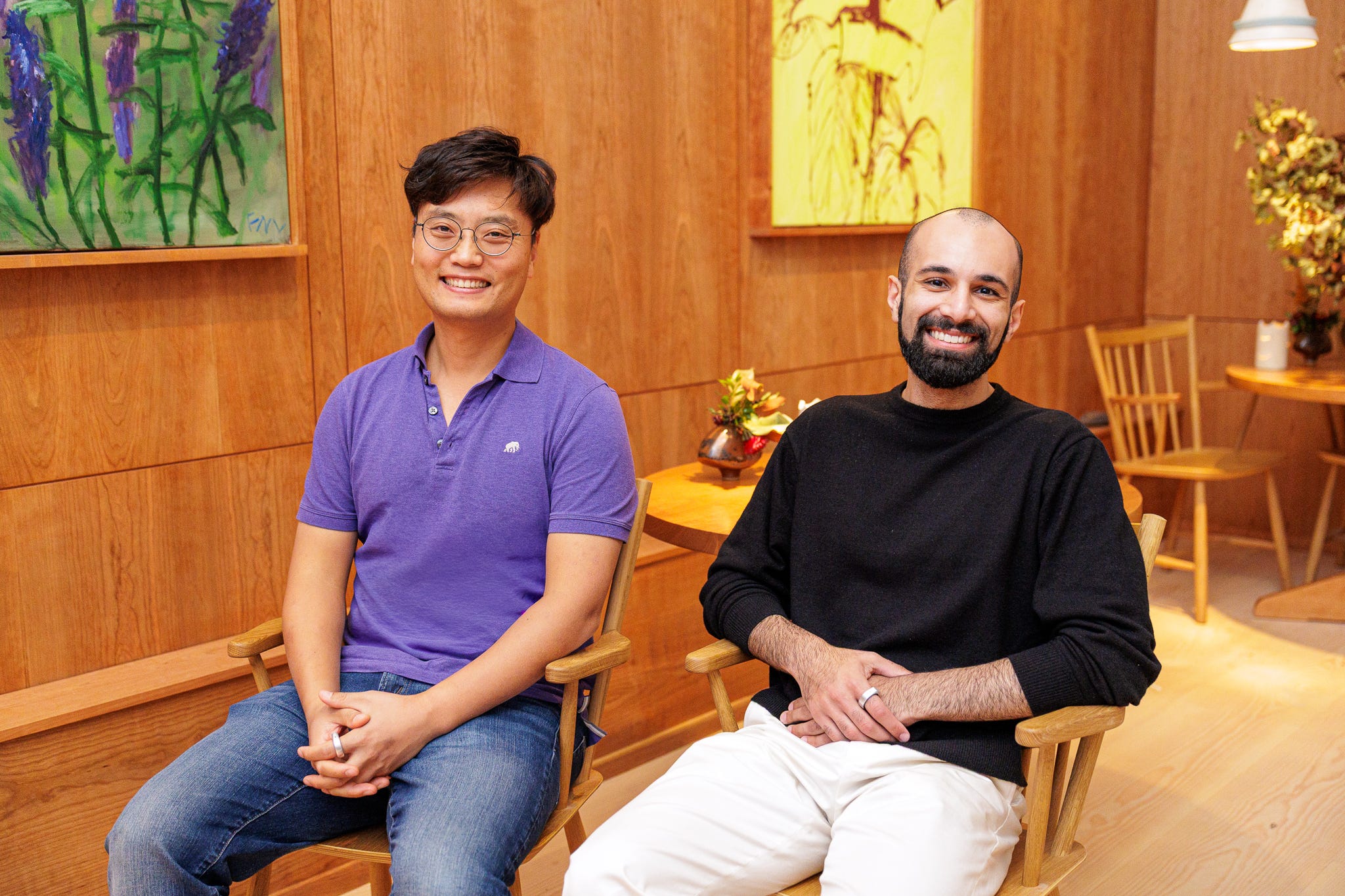
AI hardware devices finally – maybe! – are on the cusp of going mainstream. And founder Mina Fahmi wants to give Meta and OpenAI a run for their money with his startup, Sandbar.
Sure, Meta’s now selling millions of AI-enabled Ray-Ban glasses, and OpenAI spent more than $6 billion to work with famed former Apple designer Jony Ive on a rumored smart speaker, or maybe a lamp, or maybe whatever odd device Airbnb co-founder Joe Gebbia was spotted wearing in San Francisco a week ago.
And yes, a number of startups have tackled other form factors, like an AI necklace, or an AI pin, with less-than-rosy results. But Fahmi’s convinced that they’re all missing the most natural, historic form factor: a ring.
Rings are timeless for a reason, Fahmi argues: they’re ergonomically comfortable, aesthetically pleasing and convenient to wear all day. And they’re fast and easy to talk into – one quick raise of the wrist to bring thumb and forefinger to the mouth – in a motion that Fahmi argues is both convenient and a socially-acceptable signal for taking single-player, non-invasive notes.
Private, intimate, immediate: Sandbar believes its Stream AI ring device can deliver on all three, without involving people who don’t want to be, or removing the most important person at the center – their wearer.
“Our North Star is that it’s like an extension of you, not literally you,” Fahmi says. “There are a lot of design decisions we put into Stream to make sure you, as a user, feel like you’re in control.”
Those design choices are reflected in great detail in the Stream device, which Fahmi and co-founder Kirak Hong announced last fall, and which has since been tested by several hundred visitors at a couple of demo events. (After those events, a first batch of pre-orders of the Stream, running $249 to $299, sold out, the company says.)
While its bands cram serious hardware including a haptic motor into a sleek, buttonless metal frame, Sandbar’s software blends a number of tweaked open-source AI models to turn user audio inputs into notes, ask relevant questions, and resurface pertinent past notes that can date back months.
The result is, as Fahmi argues, a healthier human-machine relationship that doesn’t replace humans – and one that could easily serve as an interface to connect with other apps, like Notion, in the near future, as well as autonomous AI agents over the long run.
Of course, first Sandbar needs to get Stream to market, starting with a version to be released this summer that will focus on note-taking and brainstorming, from grocery lists to trip planning and work ideas.
To scale its 15 person team in that run-up – and buy more breathing room to take the time to study how Stream is resonating, or not, with users – Sandbar has raised $23 million in a Series A funding round co-led by Adjacent and Kindred Ventures, Upstarts exclusively reports.
The startup previously raised $13 million in funding from True Ventures, Upfront and Betaworks.
Whether Stream finds a niche is one question. But Fahmi’s positions on how AI and humans can best interact – and how Stream fits into an increasingly agentic world – raise bigger ones.
“The thing that gets me excited is the promise of technology as an augmentation of the individual, that places the human in control, makes the human more capable, more free,” Fahmi says. “And I really don’t see any other product making that the center of all of their design choices.”
A MESSAGE FROM OUR SPONSOR
Radically different banking loved by over 300,000 entrepreneurs

When I launched Upstarts last year, I knew we needed a banking partner that could move at our speed, and grow with us, too.
Mercury is thoughtfully designed for the unique needs of entrepreneurs like me, offering an easy and intuitive banking experience so I can spend more time with the founders we like to cover.
Building a media startup comes with new challenges every day. But with Mercury, banking is one we don’t need to worry about.
Visit mercury.com to learn more and apply online in minutes, like I did.
Mercury is a fintech company, not an FDIC-insured bank. Banking services provided through Choice Financial Group and Column, N.A., Members FDIC.
Ergonomics as interface
Holding the metallic, slightly chunky ring on his pointer finger up to his mouth, Fahmi presses his thumb to the touchpad, then asks Stream to add Foreigner brand coffee beans to his grocery list. The ring vibrates softly – imperceptible to anyone several feet away, if he weren’t narrating it – and the grocery list on Fahmi’s phone updates with the new request.
Would he get away with that in a crowded subway car? Probably. He’d at least have better odds of not making a scene than if he spoke at normal volume into earbuds, to a blinking necklace or recording glasses.
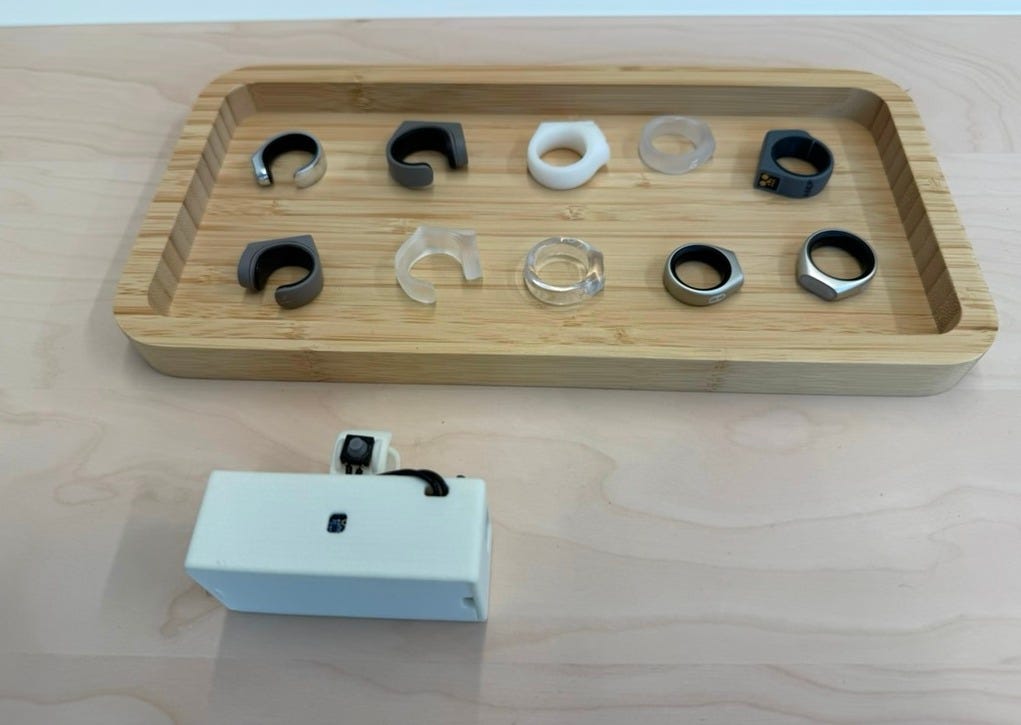
In front of us on the table at Sandbar’s offices lies a procession of past demo rings, ranging from comically clunky plastic to sleeker metal.
Fahmi and Hong, who met at startup CTRL-labs before it was acquired by Meta, working on a neural wristband project there, tested a few form factors and initial use cases after setting out to launch Sandbar in 2023.
They started out with goals like improving city navigation, or contextual search. But they gravitated toward capturing ephemeral thoughts like to-do items faster and easier than pulling out a phone and taking notes – and hardware to facilitate it.
Investors were initially nervous. ”Why the hell are you doing consumer hardware?” Fahmi recalls as a common response. “Please, dear God, do anything other than that.”
Building their own hardware would allow them to control the experience in a way you couldn’t off the shelf. To give a sense of the kinds of factors they studied:
Ease of recording hand motion
Width of band between fingers
Closed band vs. open one
Curvature of band edges
Band material: plastic vs. metal
Angle and thickness of touch pad
How a hand wearing a Stream slips into a pocket
Ability to use chopsticks and dumbbells
Bi-directional communication capability
Speech cadence control
It seems plausible that the growing popularity of wearable technology like the Oura Ring has helped Stream’s chances, but among test users, Fahmi says he hasn’t noticed a correlation.
Investor Nico Wittenborn, who co-led the investment in Sandbar, argues that the social signal of lifting and touching the ring to use it has helped make potential consumers comfortable that using such a product won’t put them on the wrong side of any social contract or privacy concerns.
“It was a very strong design decision,” he says.
Call my agent
Sandbar co-founder Hong has said he envisions a future where he can walk through a forest, soaking in the landscape, while coding via verbal instructions whispered into his Stream ring.
A scenario where Stream helps engineers keep tabs on their agents in coding tools like OpenAI’s Codex or Anthropic’s Claude Code — even checking up on agents maintained through them and issuing them orders via ring — would help make that dream a reality.

Sandbar would also benefit from being a neutral party; Fahmi says the company has no ambitions to generate code or images like the models themselves.
“There’s a lot of benefit to being a horizontal interface that offers consumers a lot of flexibility,” he says.
Sandbar’s investors get excited around its potential to supplant the smartphone as primary agent manager on the go. Mobile phones were designed for making calls and accessing apps in ways that might seem obsolete in just a couple of years, argues Kindred managing partner Steve Jang, the round’s other co-lead.
Instead, he pictures a future where many functions of a phone’s use are handled by agents, either autonomously, or by voice-control. “When agents actually hit primetime for mainstream consumers, what is the right computing device?” Jang asks.
“Instead of a human computer interface, I want a human agent interface.”
Knock it off
Sandbar has obvious partnership potential with other applications that take and maintain notes and long-running information, such as Granola and Notion — but that also means such apps could grow into more direct competitors over time, getting into hardware themselves, or looking to make direct partnerships with the AI labs that might try to avoid the need for hardware like the Stream.
Oura Ring is another interesting player to watch, as a health-tracking ring wearable already popular with many tech folks. But does the company want to redesign its product to include voice and haptic response to an AI assistant? Could it be a potential partner? Wittenborn, a former personal investor in Oura, doesn’t see Stream as a direct challenger.
The more immediate concern for Sandbar would be that its form factor doesn’t resonate with a wider audience at all, and the Stream simply finds no market traction. In that event, Fahmi and co. would need to lick their wounds and push to try again, before losing too much ground to competitors.
Everyone seems a bit sensitive to the idea of knockoffs, made in China or elsewhere, undercutting Sandbar’s market.
While Sandbar is well funded to experiment and absorb any setbacks, keeping ahead of such competition is where the startup should feel the most urgency, says Wittenborn.
For now, Sandbar is focused on seeing how users interact with Stream, and which use cases prove stickiest. Among early test users, those have ranged widely, from a professor updating lesson plans in the car to investors logging new bits of info into their personal CRMs, Fahmi says.
Meanwhile, Sandbar’s CEO is defiant about the knock-off threat: showing off a display of such devices that form part of a sort-of mini-library of competitors’ hardware in Sandbar’s office, he scoffs at the idea of taking a cheap smart ring, connecting it to a chatbot, and calling it a day.
“Doesn’t work. We’ve tried,” he says.
