


The Upshot
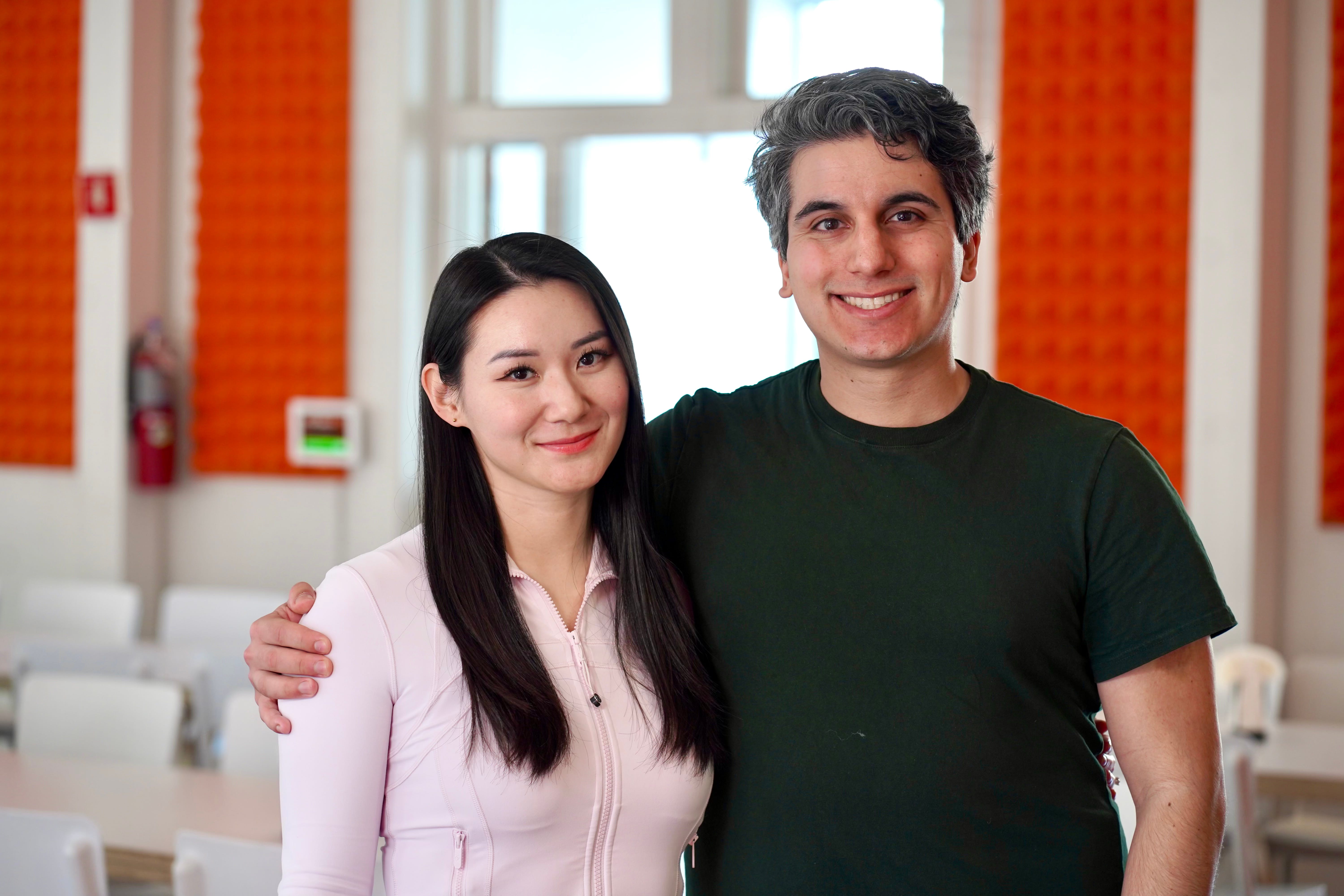
As a Y Combinator employee, Catheryn Li rubbed shoulders with illustrious alumni like Coinbase’s Brian Armstrong, Airbnb’s Brian Chesky and DoorDash’s Tony Xu as they talked about the power of entrepreneurs to go from an idea to a public company.
She never expected that as YC founder herself, her own big idea would revolve so much around hawking cuts of meat – specifically, Omaha Steaks.
Not just the types, either – but the pack sizes and special TV offers, the holiday gift boxes that come bundled with extra chicken, too.
“We’ve ordered every single kind,” Li says. “A lot of fake steaks.”
That’s because Omaha Steaks is a key customer for Li’s startup, Simple AI. And, after multiple pivots since its 2024 founding by Li and Y Combinator colleague Zach Kamran, the startup has found success by focusing on the details.
Simple AI is building what Li hopes will be “the world’s best sales agent”: one that consumers are happy to hear answer the phone. More human-like and fast in its responses, Simple AI’s agents learn a company’s product lines and all the context around them to serve as a first stop for inbound calls – meaning shorter wait times and missed calls, and even potentially better rates of sales.
(Simple AI can also manage requested outbound calls similarly, but puts less emphasis there as cold outbound calls would be illegal.)
It’s a highly technical challenge, requiring Simple AI to run multiple models concurrently on every call. But when it works, it can reduce hiring costs, decrease wait times, and boost sales for customers. In addition to Omaha Steaks, DoorDash and X.ai are customers, too.
Upstarts is headed to London next week for a fireside chat and Q+A with Synthesia CEO Victor Riparbelli on February 17. We still have a few spots left for startup builders and ecosystem members, so RSVP here to join.
Now Simple AI is looking to scale up from its 10-person team. The startup has raised $14 million in a funding round led by First Harmonic, Upstarts exclusively reports. Y Combinator itself, Massive Tech Ventures and True Ventures all participated.
Simple AI is one of a host of startups building in voice AI; we’ve covered startups using it in everything from customer support to clinical trials at Upstarts. Li and co. believe they’ve cracked a previously unsolved use case – over-the-phone sales – that they argue has been under-appreciated in recent years.
How Simple AI’s making it work technically is interesting – but for the wider startup ecosystem, it’s the questions its traction raises that might be even more.
How Omaha Steaks is adapting its sales strategy, and what employees think, stands as an in-progress experiment; zooming out even further, there’s the bigger bet that the AI era will spur a renaissance for voice as a preferred interface.
“Using voice to communicate is actually the most natural form of interaction,” says Li. “I’m very calling pilled.”
But is it really that… Simple? We’ll get into it below.
A MESSAGE FROM OUR SPONSOR
Mercury + Upstarts: Radically Different

When I launched Upstarts last year, I knew we needed a banking partner that could move at our speed, and grow with us, too. I chose Mercury: and now I’m excited to share that Upstarts is partnering with Mercury as the presenting sponsor of our flagship podcast, The Upstarts Podcast.
Mercury is thoughtfully designed for the unique needs of entrepreneurs like me, offering an easy and intuitive banking experience so I can spend more time with the founders we like to cover.
Visit mercury.com to learn more and apply online in minutes, like I did.
Mercury is a fintech company, not an FDIC-insured bank. Banking services provided through Choice Financial Group and Column, N.A., Members FDIC.
No mis-steak
For Li, an MIT grad who spent a few years working at Meta on Instagram stories and Facebook’s newsfeed product, and Kamran, a former founder and technical lead, building software for Y Combinator provided a rare opportunity to experiment. The message from their bosses was simple: don’t overthink it, don’t be too theoretical, and just try things.
And when batch founders and partners alike caught the large language model craze, Li and Kamran were no different. “I was inspired, but at the same time I was frustrated by the lack of progress on the consumer front,” she says.
In what has become a small tradition for YC software staffers, they quit to go through the program themselves. “Here are the top 10 mistakes that founders make,” Kamran says about their approach. “We should just not do those.”
They coded 30 different functions for their better Alexa app, but it was the voice dialer that took off. Simple AI went viral on TikTok as one user filmed it getting them a flight refund from Priceline; actress Reese Witherspoon name-dropped it as a favorite app in Variety.
But Kamran thought they had a problem: such use cases wouldn’t be consistent – unless something goes wrong, no one wants to call their travel app. So building a big business charging $9 for consumer use, Simple AI might eventually struggle.
About a year ago, he convinced Li to lean into another use case they were hearing requests about: business calls. Surveying the landscape, they settled upon one high-value, high-difficulty area that didn’t appear solved: sales.
So started Simple AI, take 3: a multi-model system for fielding phone sales. To work fast and effectively enough, off-the-shelf voice models wouldn’t get it done. So Simple AI built its own stack: models from the big labs and open source, product data and business logic from customers, and reinforcement learning to focus it all.
When a consumer calls a customer like Omaha Steaks, at least three models work with the raw audio packets to tell Simple’s agent when and how to reply. (An agent won’t magically know when a human has finished speaking, but has to be told, Li notes.)
We announced Season 1 of The Upstarts Podcast on Sunday! Watch the trailer below, and subscribe for Thursday’s debut episode on Apple, Spotify and YouTube.
Omaha identifies the agent at the start of every call, but people still seem to forget and humanize it, says Dillon Jensen, Omaha’s vice president and chief sales operation officer.
“There’s been surprises of people saying, ‘I’ve talked to other virtual agents before, and this doesn’t sound like them,” Jensen says. “People will call it ‘honey,’ or ‘ma’am’ – the customer engaging with the agent in that manner.”
The result: an upsell rate far better than the seasonal temps, and, according to Simple AI’s founders, even exceeding some of Omaha’s best reps.
Training wheels
For Simple AI to get the right customer data, its team has to work hands-on with a customer, more akin to how Palantir or AI labs embracing forward-deployed engineers operate. The data comes from a company’s best sales reps, whose own call transcripts help train the agent on best practices for that product line.
That work is a big part of Simple AI’s moat: a more general voice AI company, or one focused on customer support, would have to retrace those steps to begin to compete.
But what do the human reps think about it? This has been a relevant question for years as software companies have built sales tools, dating back to Gong helping to analyze the productivity of calls. The goal for the business is ‘consistent performance’, but are the best reps losing some of their leverage?
Li argues that Simple AI customers maintain their human sales teams, who can join calls at more interesting moments: complicated questions, or to close a bigger sale. “You get to do the fun stuff,” she adds: short-term, creative A/B tests of flash sales; experiments with how accents and AI agent genders can influence certain customers.
Jensen at Omaha Steaks is confident that his full-time employees understand that Simple AI’s tools are meant to relieve their stress, not add to it. Efficiency gains in headcount are so far entirely with temps, he says; employees who do talk to sales leads warmed up by the AI agents benefit by avoiding tedious parts of a call like contact information collection, he says.
“It’s there to enhance their job, expediting some of those monotonous tasks,” he says.
But if Simple AI’s agent can sell better than those human reps – improving all the time – what’s to stop Omaha, or other companies, from feeling tempted to move more of their resources away from the human team to the agents all of the time, too?
To be clear, Omaha’s not doing that right now, maintaining what its exec calls a steady-state baseline of people behind the agents, but it’s not a stretch to imagine that some companies might be tempted.
As J.J. Fliegelman, Simple AI’s lead investor, puts it (with positive spin intended): “Wouldn’t you want to use agents for 90% of your calls, if they were so much better?”
Simple AI and other startups pursuing sales will need to walk a delicate balancing act to ensure that the experts making their system smart see it as friend, not foe.
Voice revival
If you’re still reading about Simple AI and skeptical that anyone’s really making calls in the first place, you’re not alone: that was our reaction, too: Wait, don’t younger people hate talking on the phone?
At Omaha Steaks, Jensen confirms that callers can skew a bit older and less tech-forward, but to him, that’s a sign that the agents can work for anyone.
Outside of an urban, techie millennial bubble, people still pick up the phone more than you’d think, Simple AI’s founders say. And for those who avoid it, they argue it’s more about the experience than the format.
“You may say you hate making phone calls [to businesses], but you don’t hate talking to people,” Li says. “You hate making phone calls because the experience sucks. You wait on hold for an hour, and then you’re met with a phone tree. Press one for this, and press two for that. Then it’s sent to someone outsourced in India or the Philippines that doesn’t really care about you.”
A “magical experience” call without a wait time, with a knowledgeable agent, and a quick, successful resolution can convert skeptics like me back, she adds. Chatbots and texting introduce ambiguity that goes away with the additional cues of our natural voice.
Which leads to the other big implication of Simple AI’s bet: that AI tools are driving even the tech-savvy back to audio-based experiences, beyond just phone calls. Whatever hardware device OpenAI eventually puts out, there’s a good chance we’ll talk to it. You probably know someone who already leaves voice notes for ChatGPT or Claude.
“I’m talking more than ever: I’m talking to my computer, I’m talking to people, to AI bots. I think we’re having a voice renaissance,” says Fliegelman.
In that world, maybe talking to an AI agent over the phone won’t seem weird at all. You might even have your own personal AI handle the call for you, in an AI-to-AI call, to really speed things up. Let’s just hope it works.

As someone who started his career in sales selling trash bags from the white pages (google it), in a tiny boiler room, I'm excited to see a company investing in actual phone sales. Sure, AI puts a twist on it (a massive one), but I'm here for it. This is a massive market ready for disruption.