



When Somos Internet CEO Forrest Heath first started hooking up homes in Medellín with better internet in 2018, even he wasn’t sure what where it was going.
Social project? Side hustle? Colombian adventure before moving back to the U.S.?
Whatever it was, Heath grew obsessed with the puzzle. Network limiting speeds? Architect a new one. Routers too slow? Make those, too. Software and firmware can’t keep up? Write better.
“It captivated me that it seemed like there was so much headroom to build better infrastructure,” Heath says. “It just felt like nobody had really thought through a lot of the underlying principles.”
In just a few years since, Heath – now effectively a Medellin local, with scruffy facial hair, signature rainboots and a Toyota Hilux – has built Somos into a high-growth, soon-to-be international business.
Today, Somos already employs more than 1,000 people and has become Medellín’s third-largest provider, the company says, while growing fast in its second market, Bogotá. Somos says it works with 80,000 customers overall, growing 6,000 each month; the startup projects revenue to reach about $30 million this year, then more than double in 2027.
Now, Somos is launching in Mexico City as its first international market outside of Colombia. The company is also working on technological improvements like a recently-announced fiber network inspired by data centers, called FiberX.
“We’re not just building another functional internet,” Heath says. “We’re building the internet that everyone wished they had.”
To build it all, Somos has raised $40 million in a Series B funding round co-led by Bracket Capital and Ribbit Capital, Upstarts exclusively reports. Union Square Ventures, Kaszek Ventures, Not Boring Capital, Zero Infinity Partners and Y Combinator participated.
Investors claim that just as a better telecom business for Colombia, Somos can grow into a multi-billion-dollar company. But what Somos so exciting – and why it’s interesting to Upstarts as a company to watch even if you have no Latin American ties – is Heath’s far greater ambition to build a new kind of infrastructure layer for the AI era.
Heath doesn’t just run Somos; he also founded a sister startup, Autoridad Panandina (APD), that’s looking to build data centers for AI computing needs close to Colombia’s ample hydroelectric power.
To celebrate our first birthday at Upstarts, we’re running our best sale ever on a premium subscription, for a limited time: 25% off an annual membership.
You’ll receive exclusive premium stories, get first word on events, and support more in-depth, original reporting about startups — all for less than the cost of a monthly sandwich.
The vision: a more closely connected Americas corridor in which someday U.S. companies can buy cheaper compute and power from as far as Colombia, or even Chile; and in which Somos and APD enable people to effectively run supercomputers in the cloud, leaning on effectively unlimited internet connectivity to run AI models and agents cheaper and faster than stringing together a bunch of Mac Minis.
But to do it, he’ll need to become one of the startup world’s best recruiters. He recently hired Jill Szuchmacher, a former Google Fiber leader, as chief operating officer; to scale like Heath wants, Somos will need to hire a lot more tech talent, and not just people with Latin American ties.
That makes Heath, who recently wore his boots to The Hill and Valley Forum in Washington, D.C., a potential partner – and rival for talent – with some of the startups in America’s emerging industrial startup corridor.
“I think in a really weird way, we’re this alternative bet on building crazy, ambitious infrastructure, not just in El Segundo, but doing it in places outside the U.S.,” Heath says.
More on how Somos is doing it, what customers and investors say, and lessons for other startup builders below.
A MESSAGE FROM OUR SPONSOR
Radically different banking loved by over 300,000 entrepreneurs

When I launched Upstarts last year, I knew we needed a banking partner that could move at our speed, and grow with us, too.
Mercury is thoughtfully designed for the unique needs of entrepreneurs like me, offering an easy and intuitive banking experience so I can spend more time with the founders we like to cover.
Building a media startup comes with new challenges every day. But with Mercury, banking is one we don’t need to worry about.
Visit mercury.com to learn more and apply online in minutes, like I did.
Mercury is a fintech company, not an FDIC-insured bank. Banking services provided through Choice Financial Group and Column, N.A., Members FDIC.
On-the-job training
“If you asked me 15 years ago if I’d be running a vertically integrated infrastructure and internet provider in South America, I probably would not have said that was on my bingo card.”
Growing up in North Carolina, Heath was fascinated by infrastructure projects like high-speed rail, an area in which he tried to build a short-lived company as a teenager. A dropout from school, he spent a few months in Estonia with a friend; when that friend moved to Colombia to teach English, Heath visited and never left.
(You can read about Heath’s background, and about Somos’ tech stack, in painstaking detail in a 33,000 word post by one of its investors, Not Boring author Packy McCormick.)
The idea for Somos came about as Heath helped out with a project attempting to bring blockchain-based internet mesh to low-income neighborhoods in Medellin.
“I realized that the whole blockchain thing didn’t make any sense, but people wanted cheaper, faster internet,” Heath says.
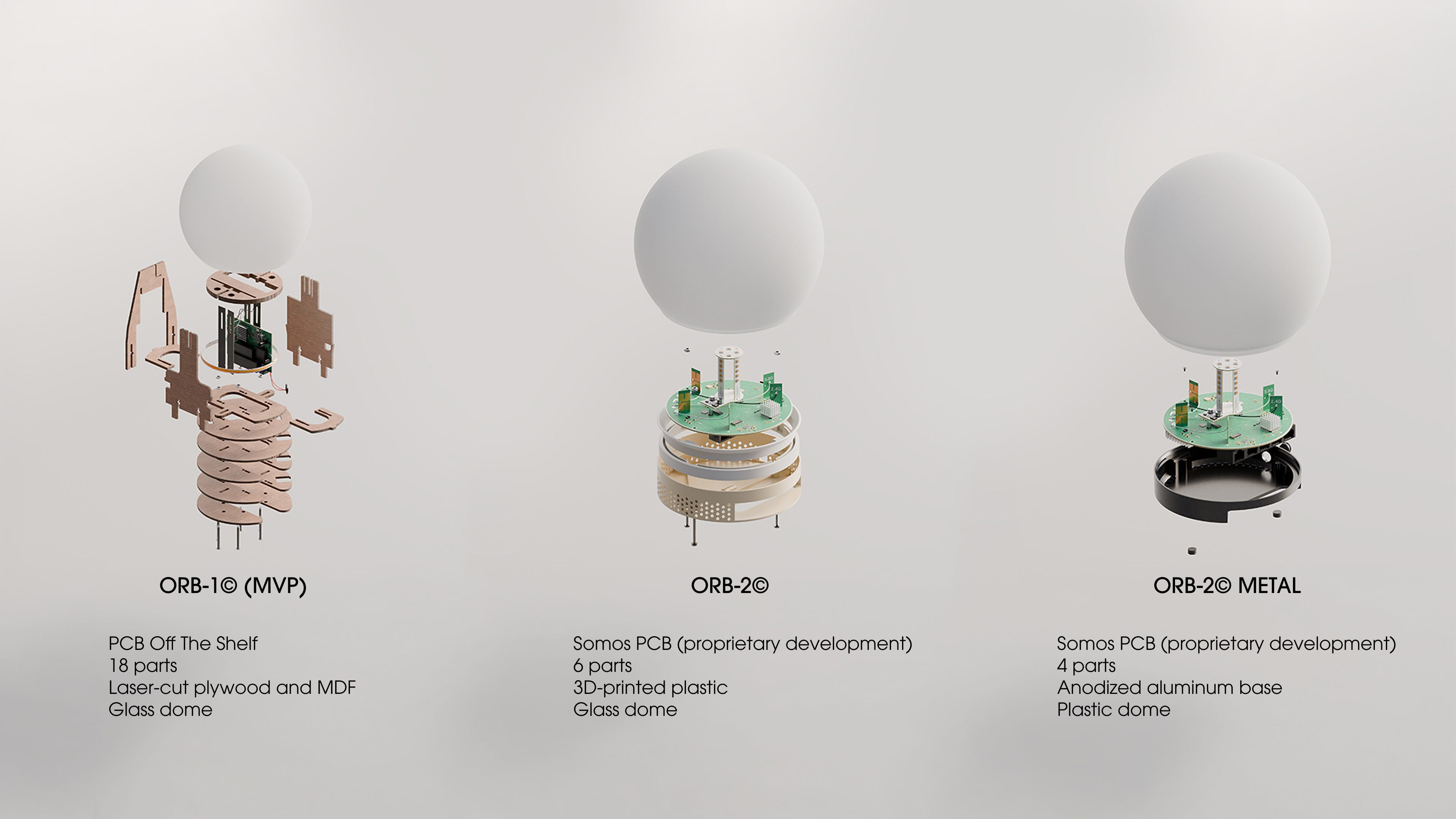
The next couple of years involved “eating a lot of s***” as he tried to provide that, while re-learning how an internet service provider operates from first principles. That eventually involved developing its own router, the Orb, with manufacturing partners in China that had more capabilities and doubled as a stylish lamp; Somos’ software, meanwhile, allowed it to get more performance out of a fiber network.
It was still a hands-on job: Somos employees, including Heath early on, had to install hardware at buildings to connect them; Somos staffers would then go door-to-door in those high-density buildings offering to sign people up.
Fashion designer Carolina Arango lived in the same building as Heath and his wife, and now counts them friends; she was one of the last people to sign up for Somos, however, distrustful of too-good-to-be-true marketing from ISPs.
A 30-day free trial, by which Somos offered its internet alongside her existing provider with no strings attached, got Arango over the line. “That was ballsy, to give it away for free,” she says. “I was like, ‘You know what? Let’s do it.’”
Somos has signed up many of Arango’s peers since; she recently moved to Bogotá for work, and is hopeful that the service will come to her new building soon.
Like Arango, business customers Tomás Saldarriaga and Mateo Ríos of brand designer Invade Design say they have found Somos to be about twice as cheap, and fast, as their previous work internet provider. (Somos subscriptions start around $17 per month for a home plan.)
But they especially like Somos for its better WhatsApp-based customer service and edgier marketing. “It’s like chatting with one of your friends, it feels very easy,” says Ríos, who notes he’s a fan of the Orb’s design aesthetic. “Their social media, and the marketing they do on the street, it feels disruptive,” adds Saldarriaga.
That said, these customer pals of Heath and Somos CFO Ross Garlick also speak to how much room Somos has to run. Arango’s parents would be unlikely to try Somos given their loyalty to their phone, internet and TV bundle, she says (Somos now offers its own bundles to compete); Invade Design’s leaders say few fellow business owners they know are also customers yet.
Playing the options
Listening to Heath talk about possible expansion into Caracas in Venezuela, and how he can sell cheaper GPU access from data centers near Colombia’s rainforests back to the U.S., he projects a confidence that helps explain how he got into Y Combinator’s Winter 2021 batch, and why name-brand investors like USV and Ribbit have lined up millions behind him.
Brad Burnham, who led USV’s investment in Somos, remembers his team reacting in surprise when Heath told them, about a year after their initial check, that he was launching a second company in APD.
“Our first instinct was, ‘you’ve got a lot on your plate,’” he says. “Then within 30 seconds we were looking at each other going, ‘you’ve got to just let Forrest be Forrest.’”
Somos on its own doesn’t look like a traditional venture capital play, Burnham admits, but USV bet above all on Heath himself – and now sees the growth of its ISP business as promising.
Were Somos to simply ‘win’ the Colombian internet market, that would represent a multi-billion-dollar opportunity, argues Zack Rosen, Somos’ lead investor at Ribbit Capital. A new-gen utility that captures the demands of a new generation reminded the Ribbit team of investments like Revolut, or Robinhood, he says.
But where investors could see an outsized return with Somos is if Heath gets the bigger picture right: connecting its network connectivity to energy, bundling AI compute like it does a mobile plan; working closely with yet-to-be-built data centers.
“What got us comfortable is just building the telco,” Rosen says. “These other option bets are what make it a generational business.”
By sticking to high-density urban areas, Somos thinks it can avoid much competition with Starlink or satellite-based internet projects, meaning it only has the traditional incumbents to beat, and Heath likes those odds.
But an obvious risk for Somos: it over-extends, both in terms of resources and Heath’s own focus, and collapses on itself.
Somos actually resisted the temptation and pressure to expand faster in the ‘go-go days’ of 2021, Heath argues, and now has the playbook down. Whereas traditional telecom businesses take five years to make money on a new customer, Somos’ payback period is already down to 13 months, he says, even with that free trial and installation.
“It’s basically a SaaS product, but it’s way more defensible and harder to copy,” he argues.
Where Somos’ CEO and investors agree he needs to nail the next phase: recruiting. As Somos and APD grow, that could mean hiring talent for R&D in San Francisco, or finance in New York. But for now the company’s working hard to repatriate Latin American tech leaders back to Colombia, and attract others like Heath and Garlick who have no heritage ties, but are eager for an adventure.
“I’m trying to build a place where if you’re in Latin America, and you’re an ambitious, amazing person, you would be dumb to go anywhere else,” Heath says.
Punching reality
Somos’ CEO has a pitch for the startup ecosystem that tweaks the ideology popular in some startup circles today: not American Dynamism, but ‘Americas Dynamism.’
If his vision works out, startups in the Bay Area or hyperscalers in Seattle could tap into cheaper GPUs in Colombia, helping solve some of AI’s energy and computing challenges. (As for better internet, Heath says that many Americans actually have slower speeds than their Colombian counterparts, and that due to patchwork infrastructure around city streets, Somos is unlikely to be able to help.)
One lesson from Somos for would-be founders in any geography: Heath says he had no aspirations to be an entrepreneur, and that he questions the ‘pomp and circumstance’ around entrepreneurship generally.
“I didn’t set out to say, ‘I’m going to go change the world,’” he says. “I sometimes feel like people are doing this because they want to feel the act of being a founder, not just actually do the thing.”
Instead, Heath and Somos have taken the approach of going from one problem to another, rejecting anything they’re told can’t work well because of the status quo, and trying to redo it from the ground up.
That takes a willingness to scrap, and take lumps, Heath warns: “We built this culture of, let’s go punch reality in the face, and we’re going to be wrong, but let’s be wrong quickly and iterate.”

Let's go!
Corre Forrest corre que el internet de Somos nos está alcanzando . Muy buen artículo y lo mejor para el equipo