


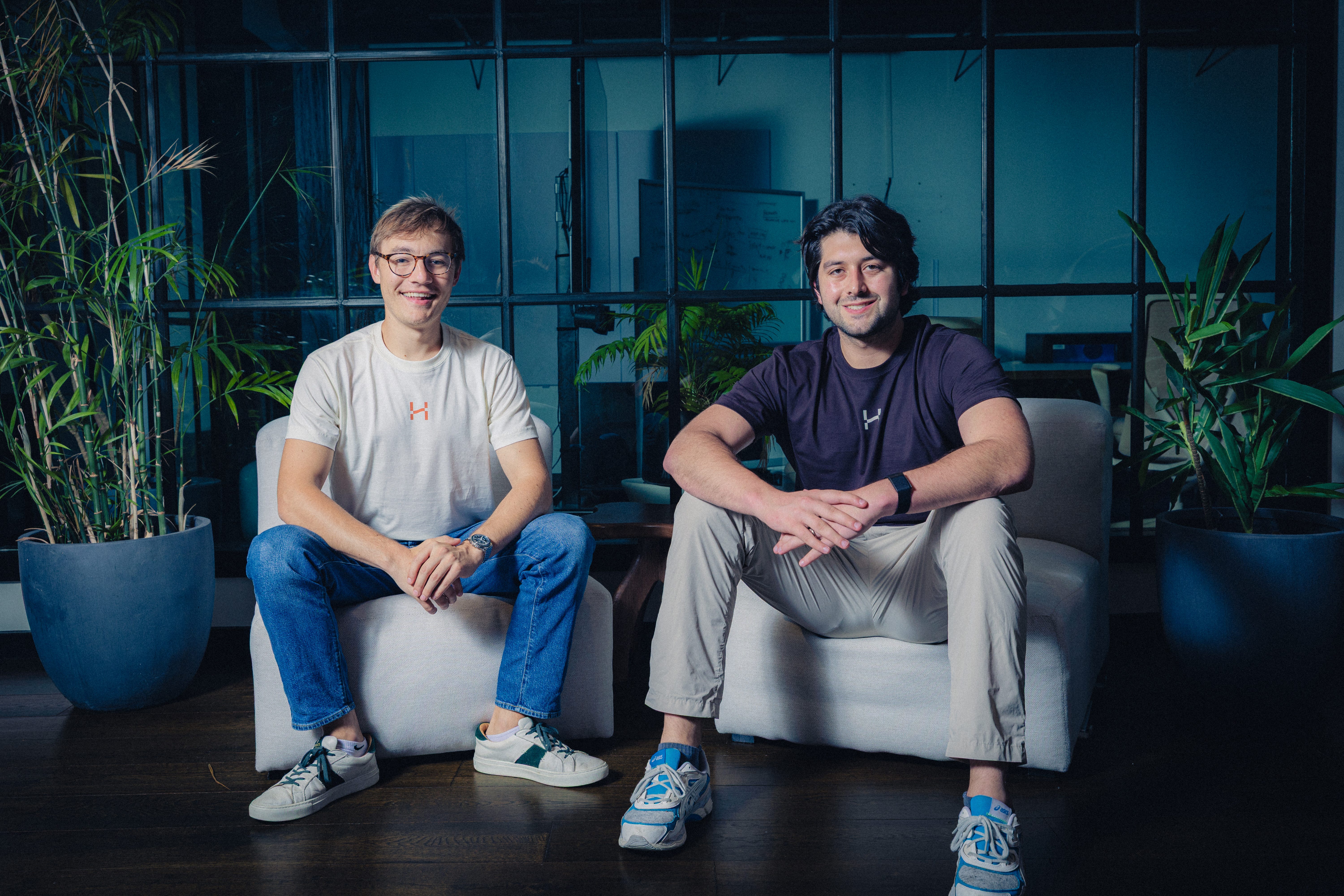
In 2024, Henry AI founders Sammy Greenwall and Adam Pratt were midway through Y Combinator’s summer batch when they delivered their pitch to a skeptical venture capitalist.
Henry was looking to solve back office blockers in commercial real estate using AI-powered software, Greenwall, the startup's CEO, explained.
“You seem like a smart guy,” the investor replied. “I would not build this business, because this is a terrible customer base to sell through.”
Brokers are a tough crowd. The best have honed playbooks over years that they’re not going to easily entrust to an outsider. And it’s a relationship-driven, network-dependent field where multi-million-dollar deals get done over group text.
“100%, it’s historically a terrible market,” Greenwall says now.
That’s historically. Today looks different. Henry’s core Deck product, which generates marketing materials around a property with the requisite branding, maps and data, condenses about 15 hours of work by a designer to a median turnaround time of less than four, with only 30 minutes of that actual human review.
For more startup stories like this, take 20% an annual subscription as part of our Summer Sale. Support our work, and get exclusive scoops and interviews, for less than the cost of a sandwich each month.
In less than two years in the market, the tool is now used by more than 150 firms including Newmark and Berkadia, and spanning four of the five largest brokerages in the U.S. Henry doesn’t disclose exact revenue, but with pricing starting at $2,000 per month and scaling to seven figures based usage, it runs in the millions.
And with the launch today of a new product, Henry Deal, the startup is significantly widening the aperture of its work with this seemingly niche, but large industry (combined annual revenue: $112 billion).
Leveraging in-house tech and outside AI models, Henry Deal automates more of the deal process, including buyer lists, memos and underwriting.
To build it, New York-based Henry is also announcing a funding round it quietly raised last fall: $16.5 million in Series A funding led by FirstMark Capital, along with Thomson Reuters Ventures. Other return backers include Y Combinator, Susa Ventures, 1Sharpe, StoryHouse Ventures, Pioneer Fund, RXR Arden Digital Ventures, Karman Ventures, and Coalition Operators.
And that same investor who warned Henry’s founders against commercial real estate – FirstMark’s Adam Nelson – led the round and has joined its board.
The result of a madcap product sprint – more on that below – Henry Deal is still unproven with most of the startup’s customers; the name of the game is now execution, and it’s early, Henry’s founders admit.
“We’re at the forefront of what I would call the hard part of AI,” says Pratt, Henry’s CTO. “Great, it exists. Clearly, it’s disruptive and people are making huge bets on it. But it’s up to us to figure out how different industries, and different people figure it out.”
More on that, including perspective from several Henry AI customers, below.
Here at Upstarts, we pride ourselves on our in-depth startup launch coverage. Interested in sponsoring the newsletter to align with stories like this? Drop us a line at partnerships@upstartsmedia.com 👋
The deck guys
One of my favorite questions for founders: did they imagine running a company in their category when they were growing up?
Greenwall might be one of the first that Upstarts has covered who can plausibly respond with a “yes.”
Growing up in the East Bay, his family ran a commercial real estate business, so the shoptalk of brokers entered his consciousness by age 7 or so. In high school and college, he worked ‘coffee run’ internships to learn the industry, and started his professional career as an analyst at Toll Brothers, where he got used to getting “yelled at a lot.”
Greenwall’s move into startups happened when the founder of Lev, a startup looking to build software to optimize commercial real estate (CRE) financing, brought him on as a domain expert co-founder in 2019. They raised multiple rounds of funding on what Greenwall describes as an up-and-down journey before his departure to start Henry AI in 2024.
(Lev now pitches itself as more of an end-to-end tech stack for CRE, advertising against Henry AI’s search results on Google; Greenwall says he learned about that only recently from an employee, and wishes Lev well as a mostly non-competitive business.)
To build Henry, Greenwall tapped Pratt, a high school friend who had built and sold an app for managing fire department equipment while in college, and later became an engineering manager at Zocdoc. The pitch: to be the Harvey (legal AI) or Rogo (finance AI) for CRE.
That pitch, and their focus on the back office as an area to automate, got them into Y Combinator, where they competed in a friendly rivalry with Greenwall’s wife, Eden Ovadia, the co-founder and CEO of FINNY, a startup building tools for financial advisors.
Henry’s founders were motivated by parting words from their group partner, Michael Seibel, who warned them that if they didn’t stay in the Bay Area, they would fail. “We took that to heart,” Greenwall says. “We were like, ‘We’re going to outwork the SF tech people.’”
Back in New York, Henry and FINNY both worked out of the married couple’s apartment for months; visitors found employees asleep on couches, in a scene befitting San Francisco hacker house culture.
Renaming himself “The deck guy” on LinkedIn, Greenwall reached prospects through his content and personal outreach; both would hop on planes for pitches, with Pratt live-coding changes from inside the meeting room.
For Shaun Riney, a broker at Marcus & Millichap NYC, a backlog of decks was a years-long source of anxiety that would ironically get worse as business was brisk. A hapless in-house designer might get phone calls late at night from brokers looking to expedite a sale, but often the process could run weeks.
With Henry, Riney was able to leave only the highest-value, most important decks to those specialists.
“The freedom of being able to do something on your own at 9pm for the following morning, without involving someone else, it’s huge for the business,” he says. “Part of me now is like, ‘I don’t want too many people to know about this.‘“
Hearing footsteps
But even as Henry grew quickly, its founders had reason to worry early this year, when Anthropic released its Claude Opus 4.6 and 4.7 models.
Against a backdrop of a ‘SaaSpocalypse’ challenging the viability of software businesses, Henry noticed weakening demand among prospects and upselling opportunity in its customer base. It was still growing, but Greenwall and Pratt saw cracks forming if they stuck to decks.
“There was 100% a level of fear here that we have to be moving faster, and providing more value every day,” Greenwall says.
So they put the startup through a grueling, 35-day product sprint to launch Henry Deal for test users by June 15. Unlike the decks product, which still involves some human intervention on the back-end for now (to be phased out over the next year or so), Henry Deal was designed to work fully autonomously from the start.
And whereas the decks tool might have faced existential risk as just a ‘wrapper,’ Henry designed its new software to swap, and benefit from, whatever state-of-the-art models it needs for a task, more like an interface, says Pratt.
At Grandstone Investment Sales in Ohio, founder and CEO Meir Perlmuter specializes in selling self-storage facilities. “The biggest time suck,” he says, is putting together what’s called a “BOV,” or broker opinion of value, that estimates the property’s market price to help expedite a bidding process.
With Henry, Perlmuter’s firm was able to have one analyst produce three or four BOVs per day; now Henry does it all across the firm’s seven brokers, no analyst necessary. “We’re all in on it,” he says. (Henry says that more than 20% of its customers have similarly cut overhead by using it – welcome for the bosses, not so much those displaced staff.)
‘Front lines’ of AI value
The disruption that Henry’s founders feared from Anthropic hasn’t materialized, they say, but served as a good forcing function to shift into higher gear.
Instead, they say they find at large corporate prospects that buyers are facing pressure to deliver on AI transformations, sometimes running up multi-million-dollar bills on Claude. “It’s brutal,” Pratt says.
“I probably could do this on Claude myself,” counters Perlmuter, who says it’s a topic of conversation among his peers. “But then it would be my problem. I would rather it be their problem, because they do a much better job.”

The Claude (or ChatGPT) versus everyone else debate is reminiscent of what Harvey CEO Winston Weinberg discussed on The Upstarts Podcast back in March. In that conversation, Weinberg conceded that “a bunch of functionality” within Harvey’s basic productivity suite for legal work would get commoditized over time.
What wouldn’t get gobbled up, however, were its integrations deep in a workflow, its vertical-specific knowledge, and its proprietary data not available to the models to train off of, he argued then.
What will prove Henry’s most defensible moat? One guide could be Crosby, an AI-enabled law firm we wrote about last October, whose CEO Ryan Daniels posted on LinkedIn earlier this week about moving to insured, AI-only outcomes for clients. That’s directionally the way that Henry seems to be moving for CRE brokers.
Nelson, their lead investor at FirstMark, says that for now it’s a matter of execution, and out-hustling the field.
“With a lot of these companies right now, we’re seeing this marriage of product and go-to-market,” he says. “Because so much of the product is ultimately going to be augmented and reinforced by the way that the software is used, and the context derived from it.”
Greenwall notes that the night before Henry’s founders spoke to Upstarts a final time last week, they and half a dozen others were in the same conference room at 2am, working on a customer fire drill.
“If there is a reason that Henry isn’t successful, it’s because we’ve failed ourselves,” Greenwall says.
Pratt, meanwhile, says that with all the billions of dollars being poured into AI today, it’s startups like Henry that can “prove the value in the weeds.” “If this doesn’t work at scale, all that infrastructure doesn’t really matter,” he argues.
Still, they know that what they’re building isn’t as romantic as, say, their YC batch mate, Starcloud, looking to build data centers in space. “We’re the deck guys,” Pratt adds. “So of course there’s a chip on our shoulders.”
This is a great example of where AI is creating real value. The biggest opportunities aren’t in building another foundation model, they’re in deeply understanding one industry’s workflow and removing hours of repetitive work. I think we’ll see many more vertical AI companies like Henry AI over the next few years.