


When SF Compute co-founder Evan Conrad set out to raise a Series A funding round last fall, he hit a wall. Business at his AI computing marketplace was booming, but investors weren’t biting.
“Super candidly, I was really terrible at fundraising,” Conrad says. “We had all the numbers to be quite successful, but I don’t think I gave off the impression that people expected me to have.”
To get the process back on track, Conrad flew out to New York for emergency sessions with one of his earliest investors, Sumeet Singh. The former a16z investor had invested personally in SF Compute; when he launched his own fund last year, Worldbuild, he doubled down on his bet.
In those meetings and others back in San Francisco, Singh and Conrad “hammered home” the vision and upside for SF Compute, which had started out as an audio model company and backed into a more lucrative role connecting other companies to flexible computing capacity. And Singh introduced Conrad to Wing Venture Capital, which ended up co-leading a $40 million Series A in SF Compute last November.
“There’s lots of people who will swarm around you when you’re doing well,” Conrad tells Upstarts. “Sumeet was one of the people who swarmed around us when things were not.”
In venture capital circles, Singh is still more of a behind-the-scenes fixer, a character also known for his Renaissance side pursuits in music (he’s a DJ and creator) and fashion (he previously ran a custom clothing line)
But as Worldbuild announces it’s raised a $30 million debut fund after one year of operation, Singh’s already building a track record worth watching.
Through Worldbuild, he’s backed SF Compute, space energy startup Aetherfux, and a number of promising newer startups, like AI hardware maker Truffle, in his first year. Through his stints at Nyca Partners and a16z, Singh helped the firms get into anti-fraud startup Sardine and fintech Revolut, among others.
But it’s Singh’s approach – taking the time and reputation risk to publish theses (like this one in Every) around where the intersections of technologies will go – that has made him valuable to founders, who have used them to raise from firms like Founders Fund and Sequoia.
“There is so much noise in venture today, that actually leading with original thoughts can have a competitive advantage,” Singh says. “We want other, larger platforms to view Worldbuild as a tastemaker for where they should be spending time six months, or 12 months from today.”
For startup builders, Singh represents another signal: in venture capital’s current climate of boutiques and mega funds, more ambitious emerging investors are going the founder investor route.
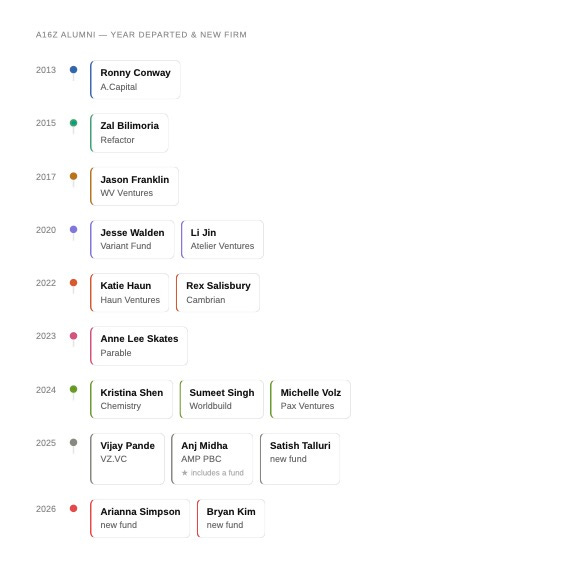
That’s especially true among the ranks of bigger firms like a16z, where investors including Bryan Kim, Anj Midha, Arianna Simpson, Satish Talluri have joined an alumni network of founder investors that includes Singh, Kristina Shen, Michelle Volz, Vijay Pande and others.
They’re motivated by a few factors: the ability to move fast and invest in non-consensus (even non-AI areas); economic upside with fewer mouths to feed; and the ability to extend themselves more with new tech.
A16Z declined to comment. But we spoke to a few sources to get more info on what several of those recent departures are up to below.
“VCs look at companies and talk about how AI is going to disrupt them,” says one. “We never look in the mirror and say why AI is going to disrupt me.”
To celebrate our recent 1st birthday in operation, Upstarts is offering 15% off our annual subscriptions, for a limited time. Sign up for exclusive premium coverage and first word on our events.
The family business
Even before Worldbuild, Singh has always been surrounded by entrepreneurs.
His parents emigrated from India in the 1980s; they, and many other relatives, spent the ‘90s running small electronics shops all over Manhattan, selling cameras and cell phones.
Singh spent early years running around those stores before his father moved on to owning Dunkin’ Donuts franchises in Long Island; the two still talk about potential new ventures regularly, Singh says.
After starting his career in finance, Singh talked his way into Nyca, a firm without $1 billion in assets, where he learned the venture trade. As a junior investor, he eventually “pounded the table” for one potential investment, consumer finance startup Brigit, threatening to quit if Nyca didn’t do the deal;, conscious of his own lack of startup building experience, Singh decided to join Brigit to help lead strategy.
He started two weeks before Covid-19 shut down business across the U.S.; Brigit was exposed as its customers were hit hard, and had to scramble. “I thought we were going to die every day for six months,” says Singh. “I now recognize that as not near-death moments, but moments where you need to punch through a glass ceiling.”
In 2021, with Brigit stabilized (it was later acquired for $460 million), Singh joined a16z as one of its first New York hires. Singh’s job was to go down ‘deep rabbit holes’ to identify potential opportunities, then bring them to more established partners like David Haber and Angela Strange.
“You will never be poor at a16z. But it’s harder to be generationally wealthy.”
— An anonymous former colleague
A thesis around the intersection of crypto and fintech led to a bet on Sardine, now valued at $660 million; one around super apps in the ‘global South’ helped a16z to make an investment in African app maker Carry1st, which announced a $27 million round in 2023.
But in a larger organization like a16z, with hundreds of employees, Singh grew restless. While established investors at a16z can write checks unilaterally, Singh often found himself pursuing buy-in from two or three teams and funds within the firm.
And at a moment when multi-stage firms are writing checks in the hundreds of millions to billions of dollars, getting a firm excited about company formation-stage checks could prove tougher.
“Early stage, where there’s the most change and the most chaos, that’s really what excites me the most,” says Singh. “Ultimately, I needed to build a firm to reflect that.”
In launching Worldbuild, Singh tapped his network from angel investing while at Brigit and his work at a16z. Four of Worldbuild’s portfolio are previously backed founders, like Browserbase CEO Paul Klein IV, whom Singh personally invested in while he was working on another venture, Stream Club.
When Klein was thinking of launching Browserbase, which we covered in detail last June, Singh helped Klein to frame the company as more than AI infrastructure, Klein says. “He’s just been a great guy to bounce ideas off of,” says the CEO. “He’s the first call I’ve made on every single funding round, as one of their architects.”
Singh gets in front of new founders, meanwhile, through his theses and blog posts, which he started posting on Notion after leaving a16z, and which he now shares via Discord channels, Reddit and other social media.
“When you meet a founder and you can send them, here are four PDFs and blog posts I wrote on the very space you’re working on, they’re super impressed,” says Village Global co-founder Ben Casnocha, a limited partner in Worldbuild. Other LPs include a top 20 university endowment, according to Singh, as well as several prominent multi-stage VC firms.
“It’s very rare to have someone who is both plugged into what everyone is talking about, but also bold enough to conceive their own ideas.”
Offshoots from the money tree
Worldbuild slots into a fast-changing venture landscape that is absorbing outsized AI investments that one fund manager compares more to “banker type deals” than traditional venture ones.
And the splintering is seen more than anywhere at Silicon Valley’s biggest firms, where emerging partners with established brands are increasingly tempted to set up their own shops, a trend we covered in our final story at Forbes last year before striking out on our own with Upstarts.
Since then, Pande left a16z’s biology practice to start VZVC last year; Simpson left the crypto team three months ago; and Kim announced his departure in April.
They join a long line of investors who have founded firms immediately after departing a16z. We asked around to compile a list; if we expanded the criteria to former a16z employees who run firms but worked elsewhere in between, it would grow much longer, including investors like Kristina Simmons and Elizabeth Weil.
Why have so many folks left a16z? It’s partly a numbers game, given the size of the firm and the number of partners its funds support.
“A measure of the strength of an organization is how many people leave to start their own thing versus leave to join a competitor,” Volz writes Upstarts, comparing the alumni network to Palantir’s network, which we discussed with Chapter’s CEO two weeks ago. “It means you’ve hired smart entrepreneurial people and the only reason they’d leave is to build their own thing.”
But several investors who spoke anonymously with Upstarts say that driving factors include the ability to write checks faster, with fewer internal politics, while owning more of the upside. “You will never be poor at a16z,” says one. “But it’s harder to be generationally wealthy.”
As for the new wave, Upstarts poked around about what Midha, Simpson, Talluri and Kim are up to.
In Midha’s case, AMP isn’t a VC firm per se, calling itself an independent system operator for global compute; governed by a public benefit charter, AMP includes a venture fund that has received “billions of dollars of interest,” per a source, but functions more as a holding company to maintain that grid.
Simpson, meanwhile, plans to invest in seed-stage startups in crypto as she did at a16z, but also widen her focus to additional verticals in tech, per a source.
Talluri, who worked with AI companies including Pinecone and Grepr, is working on an unannounced fund in AI infrastructure, another insider says.
Kim is expected to continue to focus on consumer and prosumer AI, where he was an early investor in ElevenLabs and video maker Mirage among others.
Upstarts reached out to all three for interviews, and will update this story with comment if we hear back.
For his part, Singh says entrepreneurs can use more “first believer” fund managers, whether they’re at a new firm or bigger one. For founders of investors curious who might be the next VCs to leave a multi-stage firm, he advises to look for more untraditional backgrounds like his own.
“You could probably scan through the LinkedIns of any big firm and say, ‘Who has the most non-linear experience? That’s probably the person that’s going to start their own firm,” Singh says.
Ironically, that’s more of a headache with a16z: in reporting this story, we identified a number of fake LinkedIn profiles that purport to be former a16z partners, copying backgrounds from several real employees.
So, maybe don’t bet on new funds coming from folks with sketchy AI looking photos, and just a few hundred followers. But if they have their own podcast, like Singh does, that’s probably another sign.
'Sumeet was one of the people who swarmed around us when things were not going well.' That's the only investor test that matters and it applies to every industry, not just VC. I study brands that died and the pattern is identical. The investors, advisors, and partners who showed up during the growth phase disappeared the moment the numbers softened. The ones who stuck around during the hard quarters are the ones who actually understood what they invested in. The published thesis approach is interesting because it does something most investors never do: it shows you how they think before you're in a room with them. A founder can read four PDFs and know in twenty minutes whether this person understands the space or is pattern matching from the last pitch they heard. That's a massive time savings in both directions. Most fundraising is founders and investors slowly discovering they don't understand each other. Leading with your actual thinking in public compresses that to zero
Sumeet is the best. And not just because we share a first name. Great to see him profiled here!!