


Several weeks ago, just before 9am, I sat down with an online news channel, Mirage News Network, to talk about the state of startup news.
As far as such interviews go, it wasn’t my best. When I quipped that Upstarts is like a Mazda competing with big newsroom supercars, the show’s host, a besuited anchor named Marcus Sterling, returned a blank stare. Both of us seemed curiously low energy, like our hearts weren’t in it.
We each had a good excuse, though: they really weren’t there.
The Alex onscreen — unflattering camera angle and all — was an AI avatar, cobbled together from past real interviews I’ve given. Sterling and his immaculate suit don’t exist at all.
The interview was part of an experiment by Mirage, a five-year-old video AI startup based in New York that was formerly called Captions. Co-founded by CEO Gaurav Misra, a former Snap engineer, and Dwight Churchill, who worked on product at Goldman Sachs and Klaviyo, Mirage raised $75 million in March for its AI video-editing tools.
And it capped what Misra calls Mirage’s biggest experiment to date: a continuous, 24-hour ‘live’ broadcast in which Mirage simulated a news channel. Four anchors presented global news and interviewed a range of tech personalities, from Lenny’s Newsletter author Lenny Rachitsky to infamous Fyre Festival organizer Billy McFarland.
Mirage livestreamed the whole thing on X to a cumulative audience of about 60,000 viewers, who commented with feedback ranging from wowed (complimentary; derogatory) to decidedly unimpressed (amused; disgusted).
“Skynet vibes,” wrote Arena Magazine’s Jeff Feiwell. “People think this is good? lol” wrote another. My personal favorite: “There’s one secret human hidden in this episode.”
Speaking over the past week after the dust settled, Misra calls the whole thing a success: “It went way better than we expected.” Mirage beat out two human-led, live tech shows, TBPN and MTS, after a few hours, he says; it spent much of the day as one of X’s top trending topics.
Mirage’s top goal, as Misra had told me earlier this summer when he asked me to participate, was to test the limits of its technology, from the ability create avatars that could seem convincing for far longer than the typical 10-second clip to automated motion graphics like real-time news tickers, scrolling headlines, and B-roll; and the team’s accuracy in catching and preventing errors before they ran.
At the cost of about $50,000 in tokens, the Mirage team feels it pulled off something “pretty close” to convincing, Misra adds. But it’s not quite there.
“We’ve come pretty far on what’s possible,” he says. “There’s definitely something about more storytelling, more narrative, and something that pulls views in, that’s still missing.”
Personally, I’d go further. My overall impression of the show was that it befit Mirage’s name: hazily convincing at first glance, quickly unconvincing at closer inspection. If anything, it made me better appreciate the difficulty of what human shows like TBPN try to pull off – and how important a role that humans will play in the future of news.
Enjoying this weekly column? You can find last week’s here. If your business would like to sponsor them to ensure they can remain free, we’d love to hear from you, too. Respond directly, or email partnerships@upstartsmedia.com.
Inside the experiment
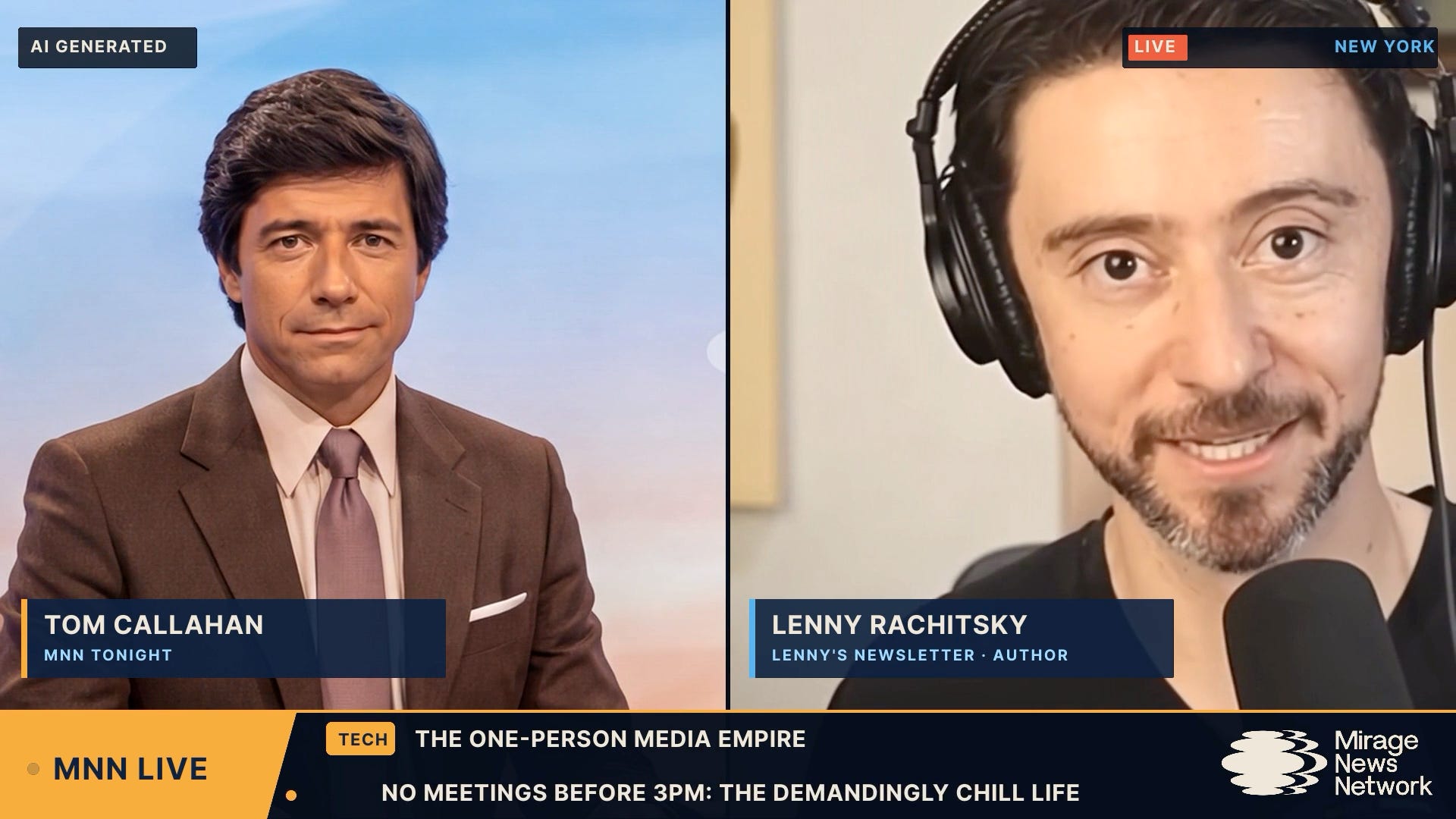
As with other tech startups re-creating industry knowledge from first principles, Mirage found that curiosity sells, but interest is tough to sustain.
Like everyone else who ‘appeared’ on the show, I gave permission for Mirage to use my likeness within the context of the project, providing links to a few real interviews I’d done. Every guest reviewed and approved an interview script generated by Mirage; none were paid.
Mirage did pay for the news reports read by its anchors in between those interviews, partnering with a leading wire service for the experiment’s facts.
To generate our avatars, Mirage used a Gemini voice model from Google for the anchors’ voices, and its own model, which Misra says can adjust for accent and delivery, for the guests. Video and graphics were generated by Mirage’s Avatar X model; the whole process was managed by Anthropic’s Claude models.
In terms of viewership, topics didn’t seem to have a major impact on audience viewership, which spiked a few times: at the stream’s beginning, after it ran a countdown; when people logged off from work, around 5pm; and right at the end, as it signed off. The average viewer only watched for about one minute, as Mirage detailed in its blog report on the show.
From a technical standpoint, viewers and Mirage’s own team recognized that the interviews came off flat: stilted in their cadence and delivery with audio that, even if pretty accurate, sounded monotonous and flat.
“The avatar is really good at talking, but it’s not as good at listening, because it’s not trained on it,” Misra says.
From an accuracy standpoint, the Mirage team was surprised by how many errors appeared in the draft scripts reviewed by the team, Misra says; they were able to spot and correct all but two, both of which prompted later on-air corrections.
Because Mirage ensured the feed always displayed an “AI generated” disclaimer, there were no disasters about people misunderstanding what they were watching, or guest appearances getting clipped or syndicated in misleading ways.
On a cost basis, $50,000 per day for such a show would be a tough proposition to continue, implying such a show would burn more than $1 million per month. Mirage believes it can cut down the cost of its video avatars by 10x or 15x in upcoming months.
Where this goes
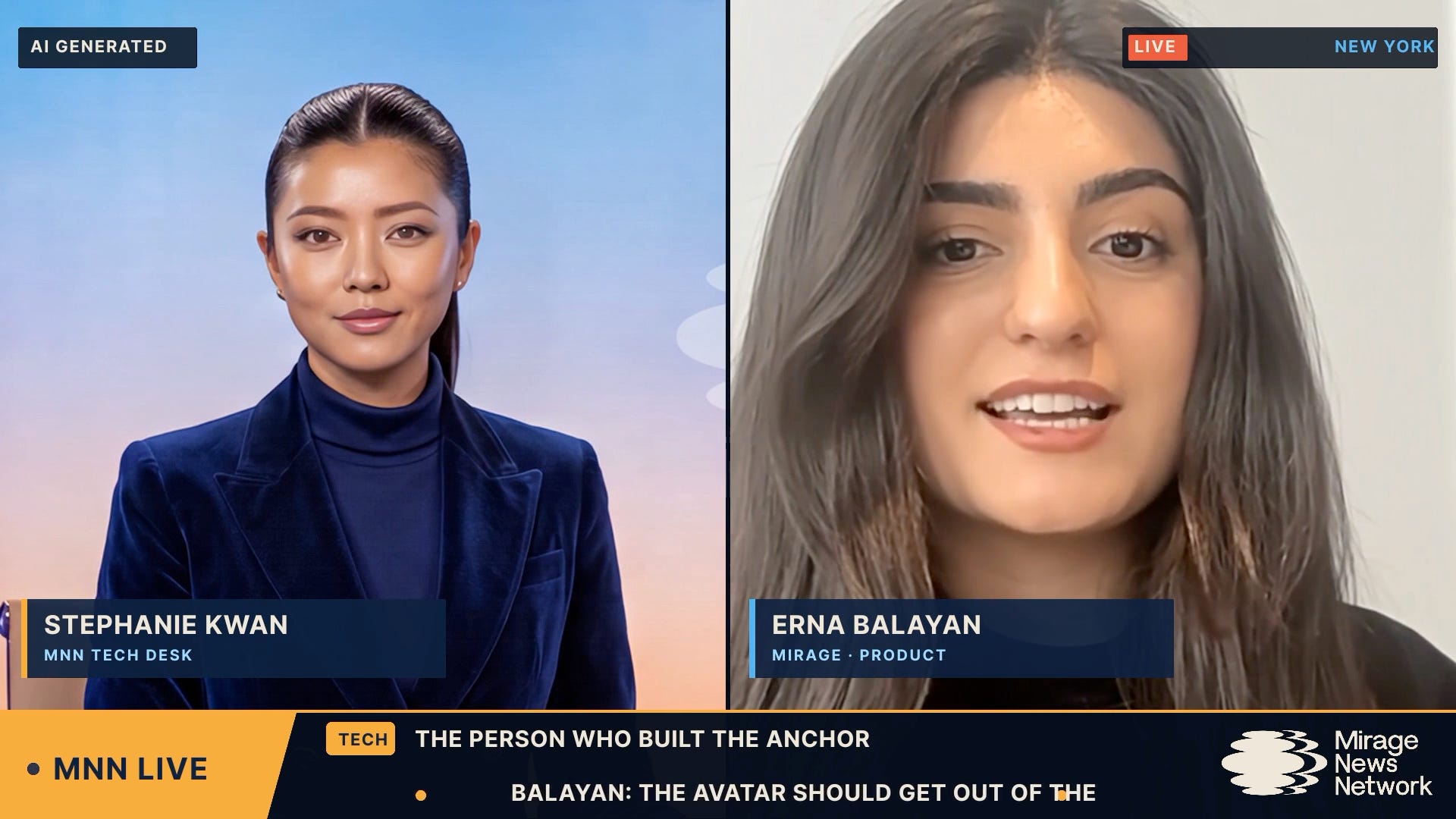
Assume Mirage is right, and the capabilities and cost to put on a show like this converge.
I can imagine three scenarios playing out:
Good: AI channels help distribute niche and local news
Bad: It proliferates social media-friendly slop
Ugly: It doesn’t spread at all, because it still sucks
The good case: Mirage’s tech helps niche news that wouldn’t otherwise get covered – think hyper-local, even neighborhood-level reports on road blockages or trash pickup changes, or niche sports that don’t get consistent coverage today.
“There aren’t enough resources to do everything in a broadcast style,” argues Misra. “For journalists and news, I don’t think this will be some sort of career ender. I don’t think any journalist needs to be afraid of AI taking their job.”
Squint, and you can sort of picture it: video content as PSA; a local darts winner chatting with an AI anchor about some achievement, amplifying their story in a way that it wouldn’t get covered otherwise. To do it right, you’d still need people to flow in that intel, and curate it; otherwise it would be easily manipulated or unreliable.
(I also don’t think an AI anchor could ever replicate the emotional connect, and ties to a community, that real-life news anchors have. If you’ve ever watched a beloved local news anchor on TV, or seen the joy people get in running into the person who does the weather at a restaurant, you know what I’m talking about. If not, just watch the clip below, an emotional tribute to Dolly Parton by Denver TV anchor Kyle Clark, and you’ll get what I mean.)


And then, you’d end up in the bad case: AI news as sensational or bogus rage bait. I can see that happening relatively harmlessly at first. Famous or busy people send, or approve, their AI avatars to conduct interviews on their behalf, an evolution of how tech bigwigs like Elon Musk currently appear at conferences over video link, while every other guest physically shows up.
The AI makes a mistake, or hallucinates Musk saying something he wouldn’t, and it goes viral. The clip circulates on TikTok, Reels or on X, and context gets lost. Aggregator news sites then report on the viral clip as news, further amplifying it, and maybe getting it noticed by more trusted news sources in turn. Soon, even an authorized AI appearance has taken on a life of its own, in a way no correction could properly stop.
Imagine that without the authorization, or Mirage’s persistent “AI generated” notice. Things could pretty quickly get to a dark place, where public figures and brands have to play constant whack-a-mole to take down what are effectively deepfakes, at a scale worse than the current, not-great status quo. Would Mirage or the technology providers be able to revoke access and enforce their own terms of service fast enough? Would governments or enforcement agencies be sufficiently resourced or motivated to step up?
Then there’s the third, perhaps reassuring ugly case, where this tech gets much better, but is rejected by consumers as unappealing slop
Watching the experiment feed myself, I felt more appreciation for what TBPN got so right, and what subsequent clones like the European Technology Network (etn.) and Monitoring The Situation (MTS) are trying to find now: PMF. In this case, that’s not traditional product-market fit, but personality market fit.
It’s really hard to be interesting and compelling day after day, like TBPN hosts John Coogan and Jordi Hays. And it’s even harder to get your guests to say something actually fresh. I keep working on this with our own show, The Upstarts Podcast, and that isn’t daily or live. I’m skeptical that AI-to-human interviews, let alone AI-to-AI ones, can really nail the type of clip-making, news-driving hot takes or updates that make these shows go viral, and their viewership spike.
At Mirage, Misra subscribes to the first scenario. He knows he’s playing with fire on such a “controversial topic,” partly why his startup was excited to run the experiment and provoke conversation, he says.
But like many startup founders, for better or worse, his default is to focus not on what could go wrong, but what could go right. Mirage has another experiment cooking for the fall, he tells me.
“We are planning an even bigger idea,” he says. “And it’s crazier, in some ways.”
Another possible "Ugly"scenario - the better and more realistic avatars become, the more they can be used for deepfakes. Slop is one thing, misinformation is another (just call me Cassandra:-). Although if slop and scams prevail, perhaps we'll see the rebirth of the town square as a key news source?