



The Upshot
After helping to oversee the launch of two of the most influential AI models in recent years – OpenAI’s GPT-3.5, also known as ChatGPT, and its successor GPT-4 – Angela Jiang spent the next year-plus meeting with policymakers and regulators on behalf of the AI leader.
By the time she left a year ago, Jiang was disconnect-pilled: the models were helpful in some fields, but for many people, the tools weren’t much more than a curiosity or abstract concern.
“There was still this missing piece,” Jiang says. “People just weren’t really experiencing magic moments of AI in their day-to-day lives.
With their new startup Worktrace AI,
Jiang and cofounder Deepak Vasisht, a veteran researcher and academic, are hoping to bring more workers inside the magic act by studying a company’s internal workflows, then helping them automate them with AI.
Developed in just eight months since the company’s founding, Worktrace AI already offers an agent to five design partners that are helping it to fine-tune the process and how much the startup can assist with the automation itself.
But with a high-pedigreed but tiny team of just four full-time and three part-time employees, the San Francisco-based startup AI now needs to aggressively hire engineers and research scientists so it can widen use of its tools.
Worktrace AI is launching publicly today, Upstarts exclusively reports, with $9.3 million in seed funding led by Conviction and 8VC. Word of the buzzy round, which closed this summer, was previously called out by Business Insider.
And Jiang’s former colleagues have turned out in force to support her new company: OpenAI itself has invested through its OpenAI Fund, as has alumni fund Zero Shot, former CTO Mira Murati, chief strategy officer Jason Kwon, and former developer relations lead Logan Kilpatrick.
Other backers include SV Angel, Genius Ventures, and Vasisht’s former colleague Ranveer Chandra, vice president of Copilot Tuning at Microsoft.
To lean on the tech cliché, Worktrace is just getting started. But it’s already positioning itself as a gap narrower for this generation of AI tools’ own Gartner ‘trough of disillusionment,’ tossing a rope across the “chasm” detailed in a seismic MIT report released this past summer that found that 95% of custom enterprise AI tools aren’t making it widespread or valuable use.
Against that backdrop, AI startups from the heavyweights like OpenAI to fledgling projects have invested heavily in staff – alternatively called forward deployed engineers, or AI engineers, or as coding unicorn Cursor described them to Upstarts earlier this fall, ‘field engineers’ – whose job is to embed with a client and contort the tech to fit their specific needs.
Worktrace AI is already interesting, and a potential harbinger of another phase of this race, by taking a slightly different, software-based approach.
“We have a ton of conviction that this is what we were missing in terms of bridging AI adoption at work,” Jiang says.
More on her approach, as well as early feedback from a design partner and investor Mike Vernal, below.
Help shape Upstarts in 2026
We’ve got a lot of ambitious plans for growing our own startup here at Upstarts next year, from the debut of our flagship podcast to special events we can’t wait to share. But we need your help.
If you’re interested in partnering with us on the podcast, newsletter or events, please raise your hand via this Interest Form 👋
And help us know our audience better – and tell us what stories you want the most – by filling out our annual Audience Survey 📝
Your AI consultant
Worktrace AI’s founders both were interns at Microsoft headquarters nine years ago, but didn’t meet. They almost crossed paths at conferences, too, as Jiang earned a PhD in deep learning from Carnegie Mellon, and Vasisht a PhD in computer science from MIT.
Vasisht stayed at Microsoft, working on its FarmBeats project to bring data to agriculture before becoming an assistant professor at the University of Illinois. Jiang, meanwhile, took a job as a product manager at AI startup Determined AI (acquired by Hewlett Packard Enterprise) before joining OpenAI in 2021.
But they ran in the same AI circles (Jiang is married to Vasisht’s former roommate), and when Vasisht took leave from teaching to come to Silicon Valley and get involved in its AI startup scene, Jiang helped introduce him to potential collaborators. Instead, hanging out together at startup hatchery South Park Commons, they decided to team up.
The duo worked on several ideas before landing upon Worktrace AI, thinking about AI literacy and upskilling. Their idea: rather than try to constantly retrain businesspeople on the latest AI tools, it would be easier and more sustainable to build a solution that leveraged that AI for them, starting with the repetitive and tedious work they already did.
“AI is very good at seeing a bunch of work, finding things that are repetitive, finding things that match a certain spec, or use certain tools, and then surveying them to figure out the exact format to input them,” Jiang says. “It’s a perfect task for AI that’s been done manually.”
The big consulting firms and even AI shops like OpenAI employ hundreds of people to connect those dots for customers, in projects that can span months. But the process is flawed today, Worktrace AI’s founders argue.
A typical process involves a company’s employees documenting all of their work processes in documents known as Standard Operating Procedures, or SOPs. Engineers will then compile those SOPs to identify use cases for automation or AI tools. Two big problems come up: the SOPs can be incomplete and quickly out of date; and the engineers can get bogged down meeting with colleagues to confirm where differently described processes might overlap, and how much.
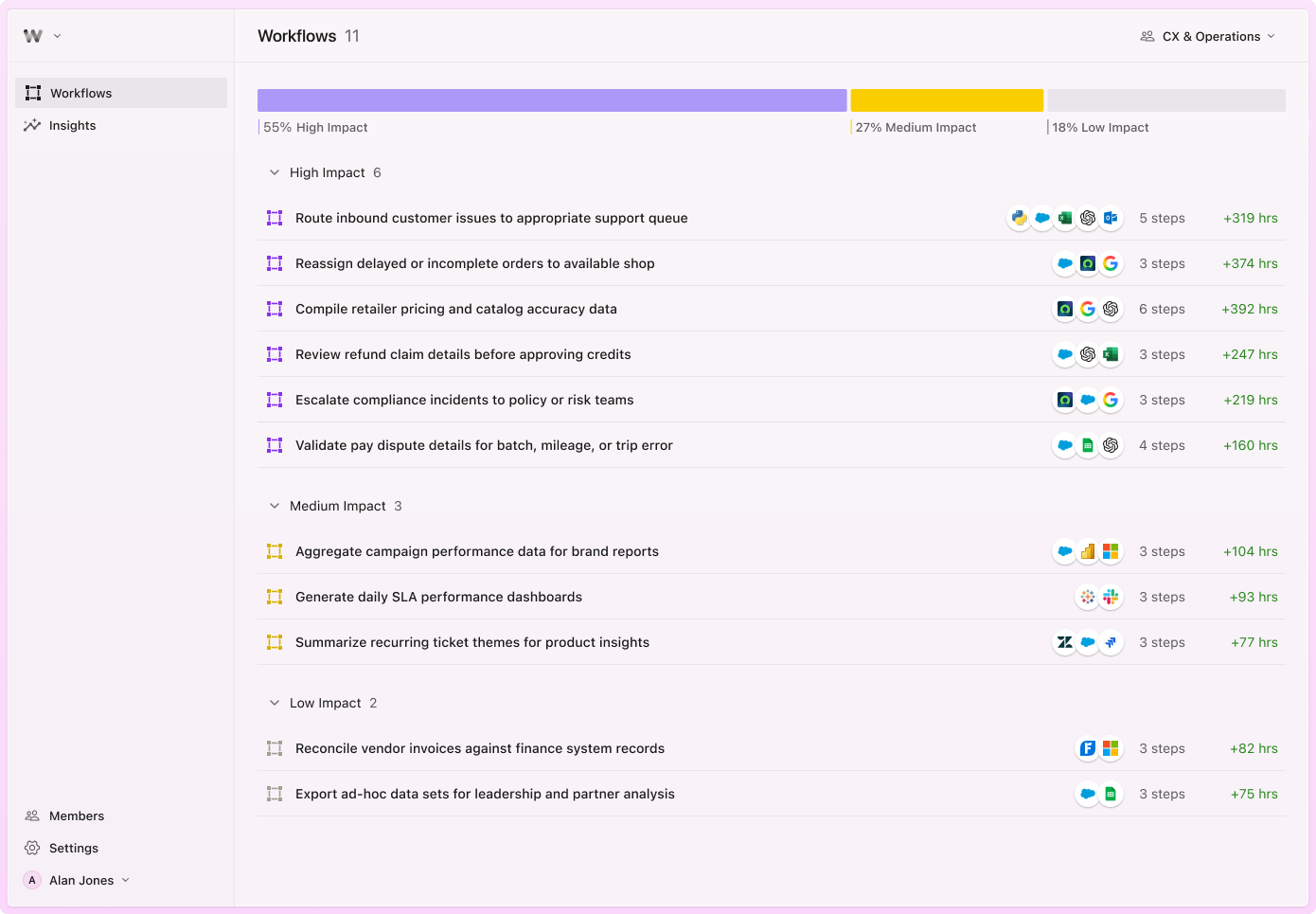
Worktrace AI’s solution is an agent built on top of the latest models from OpenAI and others that runs on the customer’s own desktop computers, passively watching workers do their jobs. Within a week or so, Worktrace’s software spots patterns where employees are doing the same, or mostly same, processes, and ranks each workflow as ripe for automation.
For now, Worktrace AI offers a code-friendly file back to the customer that it can re-upload to an agent builder (Anthropic, Microsoft, OpenAI and the usual suspects all offer such capability) to get up and running. In the second week, Worktrace AI’s agent can then watch that agent work, providing more feedback, so they continuously improve.
‘Initial friction’
Just like a staffer at a company probably doesn’t appreciate meeting with an outside consultant to describe their work (Peter meeting the Bobs in ‘Office Space’ comes to mind), exposing your daily routine to an AI agent can feel uncomfortable, too.
At an early Worktrace AI design partner in fintech, there was “initial friction” to the project, says its AI leader, who chatted with Upstarts anonymously as they didn’t have permission to talk to press. After “some convincing,” the company ran Worktrace AI, and found the tool gave more visibility than the internal process mining it had conducted, faster.
When it started saving people time, the response to Worktrace grew much more positive, the person says. Automating busy work hasn’t led to any headcount reductions so far. “We have more than enough work to take care of, so people are happy,” they add.
One challenge for Worktrace AI: continue to provide value after that initial project. Worktrace AI is still figuring out its pricing model – today it’s more of a traditional SaaS charge per seat – but the company may find that outcome-based pricing is more effective at keeping customers over the long run, as Worktrace’s agents update and add new automated workflows over time.
The design partner who spoke with Upstarts admits they initially expected the engagement to be a one-time exercise, but for now, plans to keep Worktrace AI active. “We think of it as a digital mirror for our SOPs,” the person says.
An obvious next step will be for the startup to help close the loop by automating the agent-building and maintenance process, making its process more accessible to companies without AI engineers. Worktrace AI is more likely to partner than create its own agent builder, Vasisht says; “We want to get as close to the automations as possible,” he adds, as part of a “natural progression.”
Can Worktrace AI build a big business in this niche? Competition will come from all sides – consulting firms, last-gen process automation software providers, maybe even the AI labs themselves – and it’s uncertain how lucrative maintaining such workflows will be for Worktrace AI sitting in between.
Mike Vernal, who co-led Worktrace AI’s funding round at Conviction, believes the automation opportunity can sustain “probably dozens” of companies, not one winner.
“Approximately 2,000 of the Forbes Global 2,000 want to figure out how AI can optimize and improve their business, and probably 7 of them are well equipped to do it,” he says.