


How does a software leader from the last generation make the transition into AI’s brave new world?
At Zendesk, the 19-year-old customer service company, CEO Tom Eggemeier hopes one answer is to invest deeper in its startup-serving roots.
Zendesk is announcing a refresh to its startups program today centered around a two-year, $100 million commitment of resources, Upstarts exclusively reports.
Zendesk is widening the aperture of its startup program, too: offering free access to its software, AI agents, and employees for startups through their Series B stage of funding, or until they reach about 250 employees, for up to two years.
That money number is more of an estimate, attempting to price a value of the various offerings, than a direct outlay from Zendesk’s balance sheet. But it still represents a major increase of 5x to 10x what Zendesk was previously allocating, according to its CEO.
Zendesk is also expanding its startups program to offer access to benefits from partners like Lovable and Notion, as well as to provide benefits directly through venture capital programs at a16z, Techstars and others.
“This is a new AI era, where people want different things,” says Eggemeier, who stepped in as CEO after the company was taken private at a valuation of about $10 billion in 2022.
Upstarts is headed to Boston Tech Week! If you’re local or visiting like us next week, we’d love to see you at our next Upstarts event. Join us for a tactical company-building panel discussion with local fast-growing CEOs and Q&A over lunch. Founders and Upstarts readers get priority. RSVP and share with founders you know!
Beyond the value for startups – and Upstarts spoke to one new participant you can hear from directly below – Zendesk’s commitment is notable as another smoke signal of how software businesses are adapting to the generative AI-infused moment.
We wrote last week about a startup unicorn, Remote, transitioning to focus more on infrastructure and services instead of subscription software despite $300 million in annual recurring revenue.
At Zendesk, we’re seeing a different flavor of the same transition play out: one where the business has already gone public, faced choppy markets, dipped back under the waves with private equity backstopping, and now poked its head back up again with a story around AI.
And Eggemeier sounds familiar, too, when he talks about how Zendesk will partner with a new crop of startups moving forward. “We want to move at an AI pace,” he says. “Our old program was not agile and flexible enough for the current environment.”
More on Zendesk’s revamped startup program and the takeaways from its AI push below.
A MESSAGE FROM OUR SPONSOR
How leading teams build with Plaid

Meet the leaders moving money forward.
See how growing teams use Plaid to build trust, reduce friction, and create better financial experiences at scale—featuring brands like Gemini, HealthEquity, GoFundMe, and H&R Block.
Real stories. Real financial progress. Whether you’re just getting started or growing fast—see what’s possible when powered by Plaid.
This will ruin the tour
Zendesk was a darling of startups when it was one itself. Today, it still claims graduated startups like Box and Uber, as well as scaleups like Canva and Discord, among its customers. Among the more recent crop of AI breakouts, it works with ElevenLabs, and acquired a customer service agent startup we’ve covered in Upstarts, Forethought, in March.
But on a listening tour of several hundred startups across the Americas, Europe and Asia in recent months, the company heard repeatedly that it was now competing not just with rival solutions, but opportunity cost.
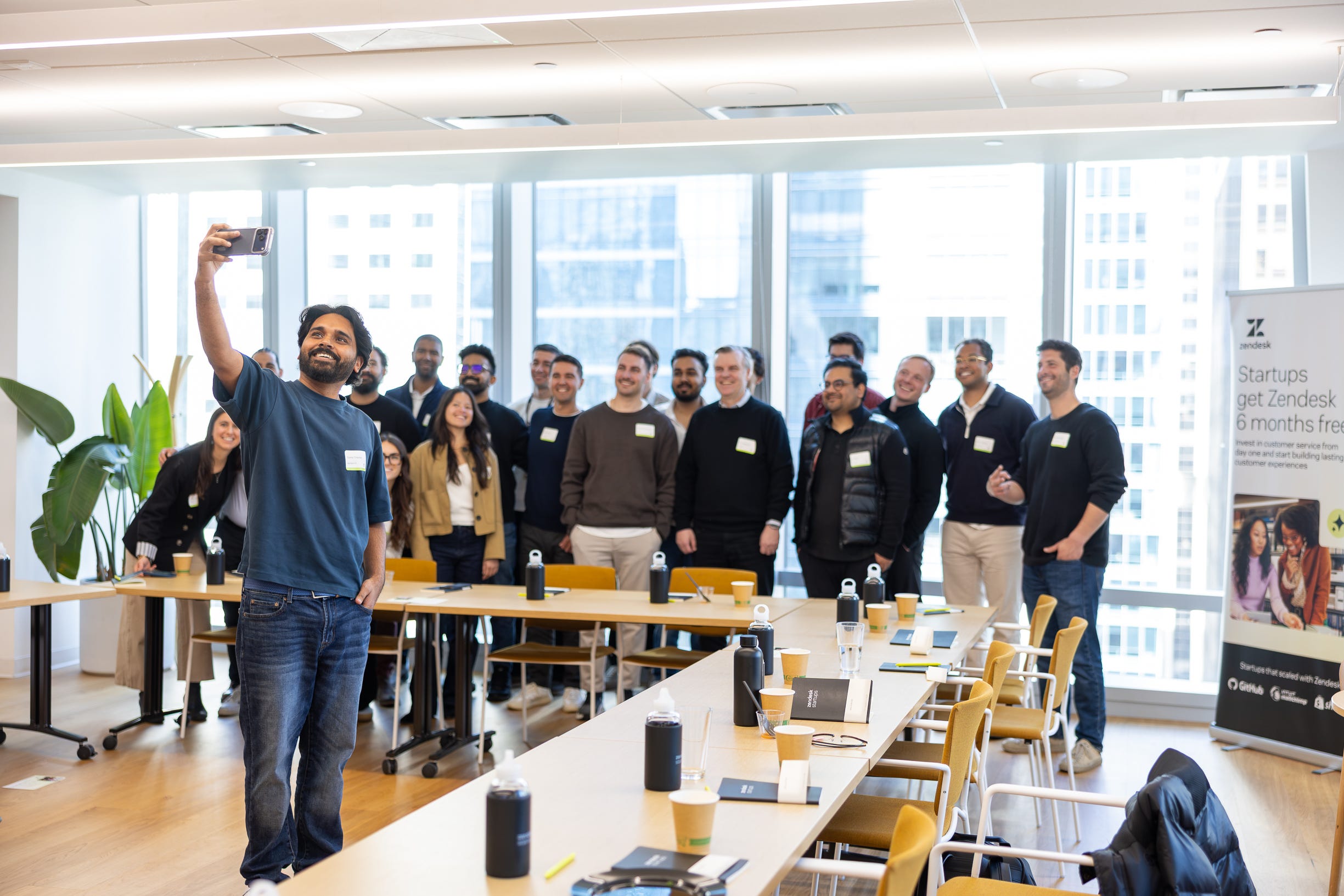
Eggemeier met with more than 30 startup founders personally, including for a breakfast last month, and heard variations on this theme:
“‘We really like your platform, we like a lot of things you’re doing with AI. But I’ve got a question right now,’” he retells it. “‘Do I go put some money into my service software, or do I go focus more of that on my product? And we heard that loud and clear.’”
Among the startups that Zendesk targets, budget is focused more on product and go-to-market right now, with fledgling companies turning to the cheapest or most easily vibe-coded or adapted agents to cover as much of the rest as possible.
They’re also looking to stretch their own revenue with as small a team as possible – a trend we’ve covered at Gamma and others – in what Eggemeier believes will be the new normal moving forward.
Zendesk for Startups’ new program is meant to meet that moment by being more flexible on when a startup outgrows it, not so strictly defined by a time period or size. It’s also added more features requested by AI-minded founders like an ecosystem marketplace, so that startups can pull in credits and access from other partners like Amazon Web Services and Lovable in one place – an attempt to expedite that process for “pressured” small teams.
The company will also now provide benefits for the networks of VC firms, including a16z, Techstarts, Lvlup Ventures and 500 Global.
The new approach is appreciated at one new admitted startup, MERIT, where Jovan Silva and Lauren Burke Silva are building a business focused on helping smaller contractors participate in federal contracts.
“We are a very lean team, and Zendesk helps us extend ourselves,” Burke Silva says.
MERIT is integrating Zendesk’s AI agents to help with customer support tickets and voice-based responses, adds her co-founder and spouse Silva. Based in Washington, D.C., MERIT has a full-time CTO, but its founders are domain experts in government contracting, not AI, they note.
“If you’re coming into building a platform without the deep technical expertise, or without a bunch of relationships in that [Silicon Valley] world, it can be very useful.”
The bigger picture
Zendesk’s efforts to reinvent itself in AI obviously go far beyond its startup program. At its annual conference this week, the company announced a number of agent-focused capabilities as part of a wider ‘Autonomous Service Workforce’ where companies can plug in Zendesk agents, connect Zendesk through APIs or its MCP to their own, or build new agents on top.
More than 1,000 people within Zendesk currently work on AI-focused product design and engineering, Eggemeier says; the company hopes to finish the year having supported more than one billion API calls, and with about $500 million in AI-based revenue, which is increasingly shifting to outcome-based pricing.
As such, Zendesk’s CEO says he’d be happy if the startups program exceeds the $100 million commitment. Success will be measured primarily by Net Promoter Score with participants, he adds.
“If we blow through that, and it’s $150 million or $200 million over two years, we’re going to be really happy,” Eggemeier says. “Ultimately, it’s going to be good for Zendesk’s top and bottom line, and good for our innovation.”
Our take: the move is relatively low risk for a company like Zendesk, particularly without the immediate market pressures of public earnings; the number is squishy enough that if fewer than anticipated startups participate, it won’t cost Zendesk much except in terms of customer opportunity and possibly embarrassment.
So we would expect more ‘last-gen’ or mature software businesses to follow suit, beefing up their startup programs and credits, while startup unicorns of a certain scale (like Canva or even ElevenLabs) will deepen their own startup programs, too.
For busy startup builders, that means it’s worth taking a break from managing your own agents to shop what your tech vendors can offer, at Zendesk, or others who follow suit.