


Welcome to the debut of The Upstarts Profile: quarterly, magazine-style profiles sharing unsung startup stories featuring our most ambitious reporting. If you’re interested in supporting The Upstarts Profile as a presenting partner, drop us a line.

Fintech’s iconoclast
As the co-founder of two leading fintech startups, first at Plaid, valued at $6.1 billion, and now Column – bootstrapped, but likely worth at least as much – CEO William Hockey is used to high-stakes negotiations.
Which makes it all the more notable when, in a planning session with top lieutenants this past September, he brings up the Ethiopia incident.
“I’m still traumatized,” he tells them. Then he turns to explain.
It was last summer, and Hockey was on one of his tours of African capitals to secure Column partnerships with local banks. Usually, these meetings follow a formula: the local ambassador tees up a few meetings; Hockey and team show up in suits; they field questions about how young they look, and rattle off arcane facts about the local financial system; they enjoy a formal dinner together; they close a deal with a handshake.
But this time, as soon as he sat down in the room in Addis Ababa, he could tell from his hosts’ expressions that something was very wrong. The bank leader slammed an article down in front of Hockey with a pointed question: how dare he show his face, after laundering money for drug cartels?
It might have been funny, if it wasn’t happening to him. Scrambling to read the article, Hockey realized he was looking at an opinion piece about TD Bank paying billions in fines for such malfeasance. But the article had been syndicated with the word “column” in its headline, and a bank monitoring service had flagged it as related to Column – his company.
Column would later spend months successfully lobbying the outlet to amend its title, but that was no help to Hockey on that unfortunate day.
“It was so physically uncomfortable,” he remembers. Nothing he said could salvage the moment, he says: “We tried, but I got up after 45 minutes and had to walk out.” Column doesn’t work with that bank, he jokes, perhaps because they still think he’s a money launderer.
For Hockey’s business, it was a relatively minor setback – he closed deals with other banks – but it speaks to the unusual tension behind what he’s building at Column. A natural introvert, Hockey prefers to spend his time at conferences answering engineers’ pull requests; at parties with more than four strangers, you’ll find him in the bathroom, coding on his Android phone.
And back home in Silicon Valley, it works for him. Already respected by his peers for his work at Plaid, Hockey has entered cult-like ‘if you know, you know’ status among his fellow fintech entrepreneurs through his work at Column. Even deeper behind the scenes than Plaid’s tools, Column’s software helps power a who’s who of big names in fintech, including Bilt, Brex, Mercury, Ramp and Wise.
Since taking the unusual step to buy his own bank five years ago, Hockey can provide them with more standard services like helping customers open new bank accounts, and processing payments and loans.
But it’s in the really wonky, technically trickiest parts of the flow of money – international payments and real-time processing made possible by Column’s custom-built direct connections to key systems like the Federal Reserve’s Fedwire – where customers like Brex and Mercury say they need Column the most.
“It’s rare for our engineers to look at a banking API and say, ‘wow, this is one of the best we’ve ever seen,’” says Mercury co-founder and CEO Immad Akhund. “I think folks underestimate the depth of what he’s building,” adds Brex co-founder and CEO Pedro Franceschi.
He’s probably right. Because Hockey has shunned outside funding – not even letting friends like Franceschi invest – Column’s valuation is hypothetical. ($6 billion? The number is in the ballpark of what investors have offered, Hockey says.) Hockey has kept its team relatively small at 110 people, without marketing or the soapbox of big VCs to hype it up.
But Column’s scale is quietly significant: The startup already powers as much as 40% of all money moving across the Bay Area’s tech industry, it says – enough to have doubled its revenue last year to $200 million, with free cash flow of more than $100 million, or about $1 million per employee.
When Column launched in 2022, Hockey forced himself to do a short press tour, then it blew up in his face (more on that later). He’s kept his head down since. “Is my time better spent grabbing coffee with [Upstarts editor] Alex every month, or hopping on the ground in Angola and shipping software?” he asks. “I know that about myself. And so I’ve inherently built a company that doesn’t benefit from that.”
So why exactly is Hockey inviting Upstarts to shadow him in meetings at his San Francisco office, and opening up in a series of exclusive interviews — to the surprise of his own friends?
Paid subscribers read this story a week early. Sign up for 10% off to get more exclusive coverage, early word on Upstarts events, and to support ambitious startup storytelling.
One answer: in the face of noisier competition like Cross River, reported to be eyeing an IPO, and Lead Bank, recently valued at $1.5 billion by firms including a16z and Ribbit Capital, being the wink-wink “best software” only gets you so far with customers and talent not already clued-in.
Say nothing, and others can set the narrative for you, like Lead CEO Jackie Reses, who says of Column: “You can’t move fast and break things in banking.”
There’s an education factor, too: Hockey is passionate about how he’s building Column “from first principles” as a counter-example for how to build a big, high-performance company that’s more rewarding for employees, starting with an unusual equity structure.
“I don’t think that people think a lot about durability, and we do,” Hockey says. “How do we build something that can survive and thrive for decades to come?”
And then there’s Ethiopia. Sure, it would be nice for Hockey if those bankers find this story before the next time Hockey’s in town. But behind Hockey’s unusually extensive travel to emerging markets there’s a deeply ideological motivation that he does want to talk about: a new Cold War for global financial influence that he says the U.S. is “sleepwalking” into – one in which China is “eating our f***ing lunch.”
Over the course of dozens of hours of research and interviews with customers, rivals and industry insiders, Upstarts is now telling Column’s story in full for the first time. You’ll find it in four chapters focused on different facets of Hockey’s experiment: origins, product, strategy, and structure – plus an epilogue about Column’s prospects moving forward.
Just how big is Hockey aiming? He thinks his financial infrastructure company is more intellectually challenging than OpenAI, and one of the few companies in startups now that has a chance at hundreds of billions in revenue. But that’s not what winning looks like to him.
“Our ambition is not to dominate sponsor banking in Silicon Valley. That’s f***ing boring,” he says. “What’s happening is that the world is dollarizing, and we want to be the operating system for that.”
Chapter I: Software welder
Hockey’s journey to building Column starts in central California, where he learned how to weld in his grandpa’s shop. The hands-on experience helped him gravitate to more abstract tinkering next, in computer programming; after heading east for college, he studied computer science and economics at Emory.
Some founders talk about setting up businesses as kids, their career one series of entrepreneurial ventures. Hockey’s path was more about learning, and independence, he says, from teaching programming for a summer in the West Bank to accepting an internship at consulting giant Bain in its Atlanta office.
After bonding with one of his fellow interns, Duke graduate Zach Perret, in the local rock climbing gym, the duo moved to New York to start a company together in 2012. Their first idea, a financial planning app, went nowhere. But the software connectors they’d built to tie it to users’ bank accounts – that was more promising.
Plaid took off by connecting the era’s hot fintech apps, like Acorns, Robinhood and Venmo, to thousands of banks so they could onboard and verify the balances of what grew to hundreds of millions of end users.
As CTO, Hockey put himself through a crash course in the obscure ways that their bank partners worked; it evolved into a longer-term fascination that led him to chase down out-of-print books about 1920s banking in China, Venice’s trade-based economy, and to read Federal Reserve manuals as his idea of New Year’s Eve fun.
“On vacations, he’s always reading books about the history of money movements,” says Victor Lazarte, a VC friend who tried to invest in Column while at Benchmark, and still calls it the top company on his investment wish list.
The founding idea behind Column – that a full-stack solution combining a bank with more advanced APIs could outperform either part on its own – came to Hockey as early as 2015, he says. In 2018, I first met Hockey and Perret as part of a Forbes magazine profile, dubbing them ‘fintech’s happy plumbers’. By the following year, Hockey had stepped back into just a board director role to research the concept full-time.
“I feel fortunate that I got to found a business for many years with my close friend,” says Perret, who still consults with Hockey on big-picture strategic questions about Plaid’s business. “I miss having him at Plaid, but I’m very excited for what he’s doing at Column.”
The idea wasn’t totally alien. A number of mostly smaller banks were hoping to specialize in partnering with tech companies as sponsor banks to assist with regulatory and compliance needs; startups, meanwhile, were already building software to connect to them, a category called banking-as-a-service, or BaaS.

The banks weren’t staffed or resourced to handle fintech needs, Hockey concluded; not owning the bank, meanwhile, meant BaaS players couldn’t control enough variables. “Everyone was like, ‘I don’t love my bank partner.’ They complained about bad technology, culture mismatch, and speed,” says Column chief operating officer Alex Du, one of the startup’s first hires.
Hockey got his chance to buy a bank in 2021. He wasn’t liquid wealthy, as a planned acquisition of Plaid by Visa was called off, but his paper net worth had soared with Plaid’s valuation peaking at $13.4 billion in a subsequent funding round. (It’s since dropped back to half of that.) Hockey and his then-spouse, Annie Robertson Hockey, sold some of his shares to pony up $50 million for a small bank in Chico: Northern California National Bank.
When they unveiled Column in 2022 as co-CEOs, they had a name-brand fintech startup, corporate expense manager Brex, as a marquee customer. “I thought it was brilliant when I heard about it,” says Brex co-founder Franceschi. “A traditional bank wraps at 5pm. You’re bound and limited by its tech stack.”
Since divorced, Robertson Hockey remains a board director and a primary shareholder in Column. “We were ambitious from the start,” she tells Upstarts. “It continues to be a joy to watch our team tackle what we believed were some of the most important problems to solve.”
Says William Hockey: “She’s been of great value, and I look forward to working with her as I have over the past five years, for the decades to come. Column wouldn’t be here without her help.”
Chapter II: The ‘little stuff’
From the get-go, Column was picky about its customers, but not always by choice. Regulators keep new banks, even an acquired one, under a tighter leash, limiting their transactions and the assets they can manage in accounts. As thousands of prospects reached out to work with Column post-launch, Hockey had to respond unsatisfyingly: come back in a year.
Others had to be turned away after wasting hours working with Column’s software in a test environment it made publicly available online, known as a ‘sandbox’. Only when developers asked Column to approve their use cases into live production did Column realize it would need to tell the companies – which included an Iranian Bitcoin miner, Hockey remembers now – that they didn’t fit Column’s risk profile for customers.
“It was naiveté about the market, but also poor messaging,” Hockey says. “Every stupid decision you make is pretty valuable. I’m happy we made it then, because as you grow, they get way more consequential.”
For the customers that Column did want, like Best Egg, Mercury and later Ramp, Hockey’s team carved out a foothold by tackling more niche, technically-complex use cases and asking them to try its relevant API.
Much of the industry, including newer players, still relied on two decades-old payment processors, Fiserv (market cap: $33 billion) and Fidelity National Information Services, or FIS (market cap: $25 billion) as key links to process transfers, deposits and card transactions. Column built its own, which the company claims is a big reason it can handle them faster.
“The little stuff adds up all the time, and compounds a ton,” Hockey says. “What makes us better? It’s 9,000 API fields, it’s clearing payments 50% faster across a border.”
Of course, whether Column’s tech is uniquely better is fiercely disputed. At Lead, Reses argues that her team is automating the sector with “programmable financial infrastructure” as well as anyone. “I think we’re the best at what we do, and that we’re largely perceived that way,” she says.
With $4 billion in bank assets, Lead Bank took in revenue of $107 million last year, on growth of 47% from the year before, the company says. It’s also profitable, with a net income of 30%.
That would mean that compared to Column, Lead is smaller, and growing slower. Reses responds that Lead is self-constrained by its focus on responsible growth. Like Column, Lead has a waitlist of customer prospects, and has leaned on zero outbound sales or marketing to date, she adds: “This is not a business where you can be fast and loose, or sloppy.”
Among the relatively small number of fintech unicorns, there’s fierce competition for logos: Lead Bank works with Affirm and Stripe; Cross River counts Revolut, public crypto exchange Coinbase, and Plaid as clients; Ramp, which Lead says is a customer, also works with Column – as well as BaaS startup Increase, and JPMorgan.
“With certain business lines, one of the things that will matter more than anything is cost. And the larger the bank, the more of a competitive advantage they have,” says Ramp co-founder Karim Atiyeh, who says his developers work closely with their Column counterparts in Slack. Column’s expanding its use cases within Ramp, but is unlikely to ever take them all.
One area where Column has ceded the field to Lead and Cross River: crypto. In December, Lead acquired fellow a16z portfolio company Loop Crypto, and put its CEO in charge of its stablecoins unit. Column won’t touch the category, Hockey says, unless it becomes clearer there are more emerging winners, and less market “froth”.
“Expertise around asset classes is needed in order to be good at them,” Reses says. “We understand [crypto] from the primitive level on up, so we’re able to apply our product expertise, and our engineering, and our compliance expertise, and do it well. Not everybody can.”
Zoom out enough, and everybody agrees that the pie is growing rapidly – particularly as non-fintech players in retail, manufacturing and other sectors look to add financial products, what’s known as ‘embedded finance’.
Column can only name one software customer like this so far, Carta, which uses it as a banking partner for automated cash distributions, per its site. Ron Shevlin, a longtime fintech analyst and the chief research officer at Cornerstone Advisors, says he’s bullish about both Column’s and Lead’s prospects in new categories.
“Their ability to rapidly customize, integrate and deploy these capabilities is a huge advantage,” he says – one that should be big enough to outweigh any inclination to trust a more traditional banking giant.
Chapter III: Cold war with China
On Column’s website, you’ll find a job listing for an “Emerging Markets Lead” in Dubai or a “key international finance hub”; a role for someone looking to lead a “new banking product” for Column internationally.
That new product isn’t exactly new: Column has just never talked about it publicly for now. It’s the same correspondent banking practice that brought Hockey on his ill-fated visit to Ethiopia, and which leads colleagues to rack up flight miles at a torrid clip.
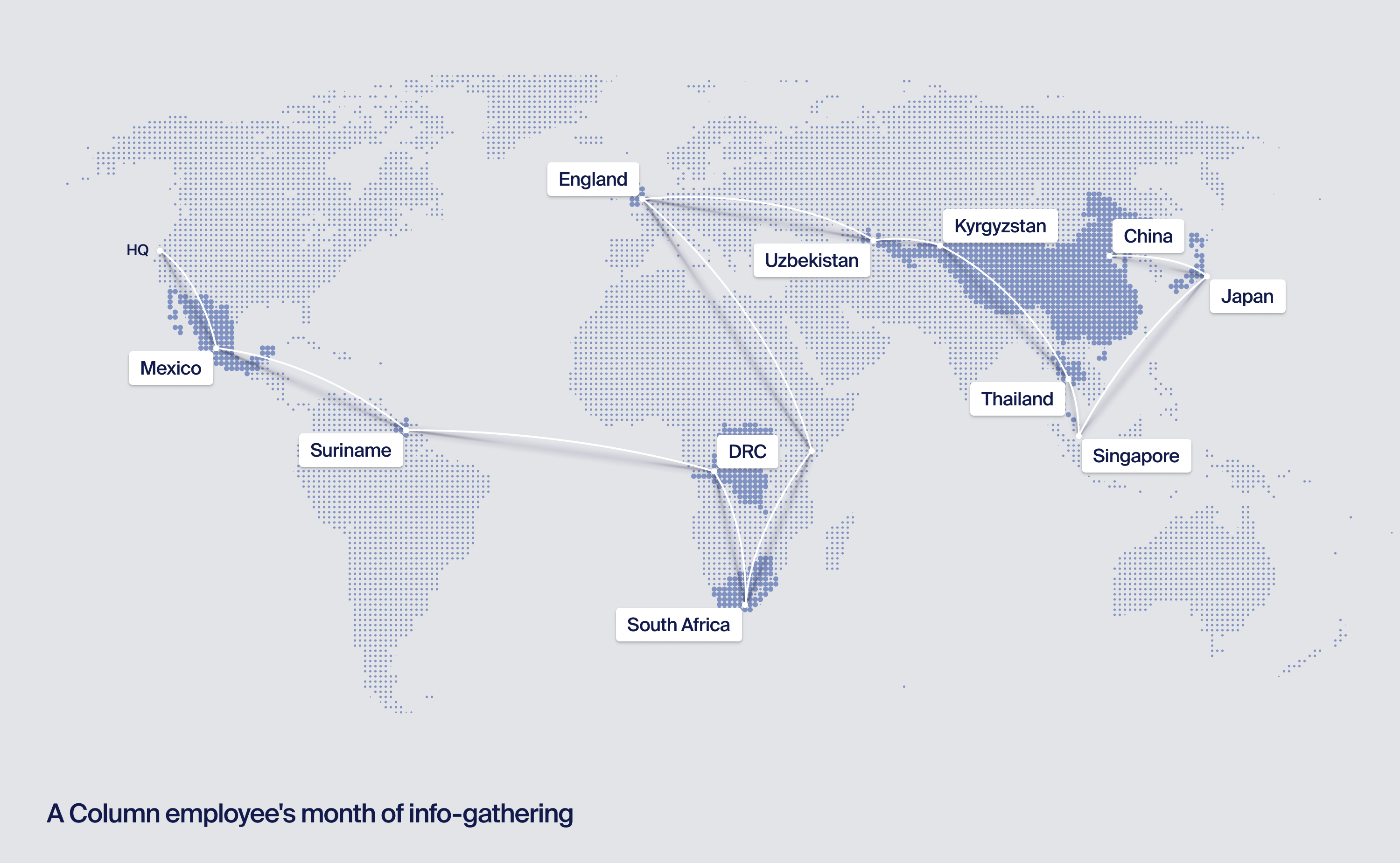
The week before our September walk-and-talk, Hockey personally visited Angola, the Democratic Republic of the Congo, South Africa, and Zimbabwe, while colleagues hit the ground in Armenia, Georgia, Kyrgyzstan and Uzbekistan. The next week, he’s off to Frankfurt and London.
Hockey encourages the team to get out of the Bay Area and put boots on the ground in such places as much as possible. A baby son with partner Nicole Johnson, a venture capitalist at Forerunner, has only partially grounded him, with his family joining him on trips (not the ones with State Department advisories, but more like Brazil).
“I’m not hucking a chat app, I’m selling something very different,” he explains. “We need to travel all around the world, to see what people are actually building there.”
What Column is selling in these places is, essentially, the U.S. Dollar: better access to it and the ability to move it across borders as an international partner. Local banks in places like Ethiopia might get access to incumbents in New York, but they won’t be a priority, and the clearing services they receive will be slow, Column argues. Then there are the places where traditional U.S. banks find it too risky to operate at all.
In such markets, Column’s competition isn’t other startups, or even those legacy players, but China and its banks, Hockey believes. Chinese banks can take advantage of state support to offer cheaper offshore settlements and write off losses, he claims.
Of course, they’re not working with dollars, then, but renminbi – increasing China’s sphere of financial influence, at the cost of America’s. “American power is important to world safety,” Hockey argues. “We are very far from perfect, but we’re sleepwalking into another Cold War, and you have to pick a side. I know what side I’m on.”
To attract allies in this struggle, Hockey descends on Washington, D.C., each month, meeting with department leaders and congressional staffers to push policy he believes can help Column and others compete, like a bill introduced in September to create an ‘Office of Strategic Currency Diplomacy’.
“I’m a very proud American, and I love employing a lot of incredible immigrants, and I will continue to do so,” Hockey says. “At the same time, I also think that the Chinese system is super terrible for the world, for their citizens and for us. I’m going to put all of my efforts into making sure that America wins the war.”
Last fall, he hired Jess Hoversen, a veteran of the CIA, State and Treasury Departments, to serve as Column’s chief economist. Hoversen leads the startup’s Substack newsletter, Hegemoney, presenting a U.S.-centric view of ‘geoeconomics’. Hockey’s a repeat co-author.
Hockey’s belief in the dollar may face growing headwinds, however. The Trump administration’s security policies in Europe, and around tariffs in developing markets, has challenged the greenback’s reputation as a globalizing force in some historically friendly places.
“The previous administration shot themselves in the foot by neutering the private sector, and the current administration is doing it by making us seem like isolated assholes,” Hockey says. “Republicans or Democrats, there’s a lot of stupid-ass shit that I’m embarrassed about.”
Then there’s the challenge of crypto – specifically, stablecoins. In its annual letter published on Tuesday, payments standout Stripe said that its stablecoin transaction volume had quadrupled in 2025. Stablecoin advocates see it as a cheaper, always-on alternative for cross-border payments. And Lead, investing in the category, has a friendly ear in the White House: Reses’ brother, Jacob Reses, serves as chief of staff to Vice President JD Vance.
Hockey remains a stablecoin skeptic, believing the tech is still more of a solution in search of a problem. And while he describes his politics as more right-wing than the “classic SF lefty type,” he resists partisan labels, believing his U.S.-centric position should be embraced on both sides of the aisle.
“Financial services are the glue that holds the entire global economy together,” he says. “You can’t have defense without the dollar, and you can’t have AI without commerce and financial incentives.”
Chapter IV: Minting millionaires
As a first-time founder at Plaid, Hockey says he would get caught up in the startup’s flashier signs of growth, like its continual need for bigger offices to fit more staff, and its rising valuation from investors.
Now, he plays a different game. He leverages VCs for their portfolio connections and attends their exclusive founder retreats, without taking their money. When he conducts diligence on a potential startup customer, one of his key questions is whether the company’s founders can control their own board.
In disputes between startup partners, he’s turned to as the veteran adjudicator. “I don’t want to be the bad guy, I just want to shut up and get paid,” he tells his team during a meeting about one such situation in the fall (Upstarts agreed not to name the specific companies involved in order to attend).
“So much of my life feels like it’s founder therapy,” he sidebars. “But I get it: these guys aren’t experts in payments, they’re experts in what they’re building.”
Among peers, Hockey’s private feedback – he shuns social media as much as possible – carries extra weight. “There’s a lot in the ecosystem that’s bullshit, and he more than other people gets straight to the point,” says Alexandr Wang, who asked Hockey to join his board at AI startup Scale AI as an independent director, and who is now chief AI officer at Meta.
But it’s his decision to build Column as lean as possible, as a revenue-funded business, that other fintech founders call Hockey’s biggest flex. “There’s a little bit of envy, almost, in that he’s able to keep his team really small and fully control the company,” says Ramp co-founder Atiyeh, who has raised nearly $3 billion in outside capital on the way to a $32 billion valuation.
Make no mistake: Hockey and Column are unique among bootstrapped companies in that other entrepreneurs don’t usually have $50 million in equity to leverage to get going, or the active connections that come from being the co-founder of a respected VC-backed unicorn in an adjacent space.
But Hockey says it’s not his fault that he’s simply one of the few founders to take an even bigger, riskier swing with a second act, while the first is still playing out. “I have a high risk tolerance for betting on myself,” Hockey says. “Most people pretend they’re good at it, but they’re not.”
How does a company with no plans to take investment, sell or go public attract top talent in a sector as competitive as tech? Hockey’s answer is a “big boy” culture that combines lower-profile high performance, with more consistent employee payouts.

At Column’s inconspicuous office in San Francisco’s Presidio district, where it’s quietly expanding across one floor of a building shared with a much more famous tenant, Lucasfilm, you’ll find Hockey on pretty much any day he’s not traveling, alongside his ‘super-mutt’ with full office access privileges, Ollie.
When Hockey realized how much time his staff were spending at the office to match him, he decided on a whim to offer anyone living within two miles of the office a $2,000 monthly rent stipend. More than half of the company now receives the perk.
“I’m a pretty intense guy. It’s always these AI kids that pretend it’s all about ‘996’,” says Hockey, referring to in-fashion startup culture that lionizes working from 9am to 9pm, six days a week. “I’m like, ‘bro, we’ve been doing ‘997’ since like 2012.’”
At the same time, Hockey feels passionate about respecting and rewarding his staff for their work. His tool of choice is an unusual kind of equity compensation, called a stock appreciation right, or SAR, that he believes makes it easier for rank-and-file to reap financial benefits of Column’s growth each year.
Unlike options, SARs don’t cost money to exercise; unlike restricted stock units, they don’t get diluted or follow investors in a preference stack; and unlike cash bonuses, they continue to appreciate as Column does, with employees who can only sell a portion at a time continuing to benefit from its ongoing growth.
Column SARs reflect the dollar value difference between a Column share at receipt and when it’s bought back by Column, using a portion of its profits; at that point they’re taxed as income, similar to RSUs. Column’s next tender offer is happening right now, announced internally in January.
(Doesn’t this process effectively set a valuation for Column that’s better than all the hand-waving? Not really, a spokesperson argues: the tender offers determine a share price using a mixture of signals, including an internal 409a valuation common to traditional equity structures, as well as other metrics like market comps. As such, a valuation for internal uses isn’t an apples-to-apples comparison to what investors might value Column at. The company declined to share last year’s calculation.)
The hope, Hockey says, is that every employee becomes a liquid millionaire who can easily afford family education costs, owning a home, and other material needs along the way – meaning that Column’s team don’t need to be rooting for an acquisition or IPO to make good.
“Valuations are worthless to employees unless they can get to liquidity,” Hockey notes. “If at the end of the year, they want money, they can get it.”
The less charitable view: Column’s compensation structure ensures that Hockey doesn’t get diluted, either – continuing to personally own about 90% of its equity. If Column is anywhere near as successful as Hockey expects it to be, that hoard would be worth many billions of dollars. But he says that’s not the point.
Instead, he says more founders should be outraged at how many startups end up majority-controlled by their investors. “It bothers me, and I think it’s wrong,” he says. “It’s super important for the employees and myself, the team actually building the company, to own the majority of it. If someone wants to do a coup and steal 30%, whatever, I don’t care.”
Epilogue: The golden ticket
One consequence of taking no investors: Column’s value is whatever price that Hockey decides.
Skeptics of Column fetching a price tag of $6 billion or more can point, among other things, to key customer Mercury applying for its own bank charter in December; Brex’s pending acquisition by Capital One could also naturally create in-house competition, too, they say.
For those specific examples, such doubts appear unfounded: at Mercury, CEO Akhund says he has no interest in ripping out Column for most complex use cases; when it comes to Brex, Hockey plans to make the deal an upselling opportunity: “Our fastest-growing business line is providing advanced infrastructure for other banks, so we obviously see this as a great development,” he says in February.
Still, fintech specialist Logan Allin, founder and managing partner at Fin Capital, argues that Column will inevitably face competitive pressures, not just from its direct rivals like Lead Bank and Cross River, but from challengers like his own portfolio BaaS startup, Synctera.
More choice means cheaper pricing, and “capped upside,” Allin argues. And while several Column customers tell Upstarts they have no interest in trusting a BaaS with their banking following the collapse of Synapse in 2024, Allin’s not alone in those doubts.
“I’m sorry, but JPMorgan offers the same exact things,” says Shevlin, the Cornerstone analyst, who otherwise considers himself a Column fan. “Everybody’s a tech company these days, so I’m not buying it.”
For a founder who prides himself on being low ego, Hockey bristles when prodded on why, exactly, Column should be treated like a tech company, not a bank. “I probably do have a chip on my shoulder about it,” he says. “The market looks at this in such a binary way.”
He points to Column’s high growth rate and SaaS-worthy gross margins – around 85%, Upstarts later learns from a source – and the fact that only 5% of its revenue comes from traditional bank lending, as evidence. “Our total addressable market is trillions of dollars, and I truly believe that I can build a multi-hundred-billion dollar company here in a way that I don’t think most companies can,” he adds.
So long as Column’s numbers are going up – which they sure appear to be – Hockey says it’s a waste of time to worry what hypothetical investors with no chance of investing in Column might pay for it.
It goes back to other founders wondering why, with the chance to build any kind of startup in the world, Hockey chose to build Column, of all things – and in this way.
“It’s just so global, and deep, and complicated in a way that nothing else is,” Hockey shrugs. “I think it’s really cool that we deal with complex issues in Zimbabwe, and the next day I’m talking to Ankur [Jain, CEO] at Bilt. We get to have our fingers in extraordinarily diverse things, and go really deep with them.”
Note: This story has been updated to include comment from Column co-founder Annie Robertson Hockey.