


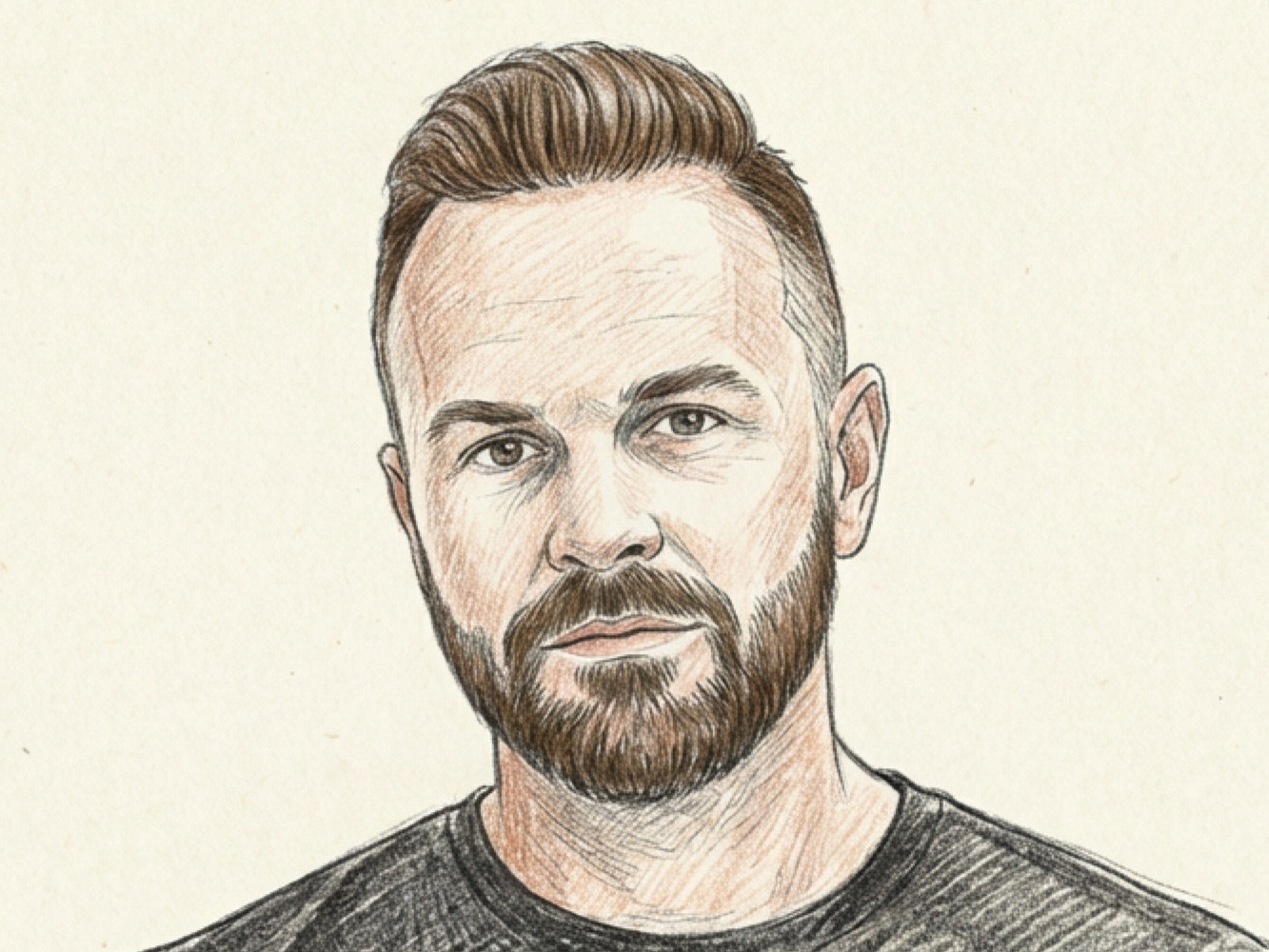
Day AI cofounder Christopher O’Donnell is betting his career on the fact that a new paradigm is coming in how we keep track of customers – the massive, unglamorous category of tech known as customer relationship management software, or CRM.
In the nearly 30 years since Marc Benioff launched Salesforce and helped kick off an enterprise software boom, a number of startups have taken aim at the CRM giant with a market cap of about $200 billion.
One of the few to carve out a niche: O’Donnell’s former employer HubSpot, itself now 20 years old, and ten times smaller. By and large, these startups have come and gone. Benioff’s had the last laugh.
But O’Donnell is convinced that the rise of large language models like OpenAI’s ChatGPT and Anthropic’s Claude have fundamentally changed the equation.
His startup, Day AI, is looking to rethink such software with a tool that knows everything about your business in just 15 minutes. It can do the basics, like automate meeting prep and note-taking, build and manage to-do lists and pipelines of prospects.
But it’s Day AI’s assistant, operating under a name each customer chooses, where O’Donnell believes his startup really proves its worth: guiding you through your own maze of info and acting on your behalf, as a savvy AI chief of staff.
The experience, O’Donnell says, should feel like how coding in Cursor feels for engineers – but this time for founders, salespeople and marketing leaders.
“This is the Cursor for CRM, it’s the same pattern,” Day AI’s cofounder and CEO says. “This is high-impact, highly difficult work that you can ask it to do, that a human wouldn’t sign up to sit around and do full-time.”
Founded in 2023 by O’Donnell and his cofounder Michael Pici, another HubSpot veteran, Day AI is still in early days, working with about 120 customers after more than a year of private testing. Now, it’s ready to bring what it calls ‘the first CRMx platform’ to a wider audience with general availability of its product.
And Day AI has raised more funds to do so, too: $20 million in Series A funding led by Sequoia, with participation by Greenoaks, Conviction, Sound Ventures and Permanent Capital, with Sequoia co-leader Pat Grady joining Day AI’s board. The startup previously raised a $4 million seed round led by Sequoia, too.
There’s a dramatic personal element to Day AI’s story: the HubSpot executives building what could someday prove a HubSpot successor, while taking aim again at the market leader they couldn’t really slow down.
But for startups and the wider business world that uses these tools, it’s the developing arms race to develop AI x CRM tools that should be most exciting.
Other startups have raised more money recently to chase similar opportunities, including Reevo, which raised $80 million from name-brand VC firms in November for its own ‘AI-native’ platform; Attio, which has raised more than $100 million to date, and Clarify, which called itself ‘the world’s first autonomous CRM’ when it raised $15 million last year.
The TL;DR:
We’re entering a boom of AI agents coming for CRM. And whoever wins the biggest piece of the pie – or whichever contestant you choose – you should be expecting a lot more from your software.
There’s a scenario where that’s still Salesforce or HubSpot, of course – but if that’s the case, they’ll have had to move fast to adapt to this new status quo. The customer will still win.
“I’m hoping that the best thing will win this category, but I worry that we’ll be Betamax, or Friendster,” O’Donnell says, invoking two mostly-forgotten also-rans in tech history. “Salesforce as we think of it today is not going to exist in two or three years. I don’t know if it’ll be us, but I really hope it’s us.”
RSVP: Upstarts is headed to London in two weeks to host our next startups-focused event! We’ll be sitting down with Synthesia CEO Victor Riparbelli on the heels of his startup’s new $4 billion valuation, alongside founders, builders and other ecosystem members.
The event is free, courtesy of partners Dawn Capital, Vanta and Taylor Wessing. We look forward to seeing many of you there!
Unfinished business

If all Day AI did were to kill all manual data entry in customer relationships, it would probably be useful. But that’s not “what gets any of us out of bed in the morning,” O’Donnell says.
The bigger motivation is to produce “wildly magical answers that you can’t get from a spreadsheet” – in a way, the same mission he and Pici have been chasing since their HubSpot days.
A computer lover and avid musician – he’s known among friends and peers for his guitar collection, and once dabbled in selling classical music recordings – the Boston-based O’Donnell joined HubSpot when, still a startup itself, it acquired a smaller one led by future Drift founder David Cancel in 2011.
O’Donnell was the product guy brought into board meetings to run demos, which is how he met Grady at Sequoia; he eventually led what was effectively a startup within HubSpot that got it into sales enablement software and helped it go public in 2014.
Eventually HubSpot’s chief product officer, O’Donnell and Pici, a sales and product leader, had talked about a self-updating CRM. But they couldn’t figure out how to make it work.
O’Donnell was working at Arianna Huffington’s wellness startup, Thrive Global, in 2023 when ChatGPT and its API for startups to build tools on top of it really started to take off. The two reconnected. “This is finally going to be possible,’” O’Donnell remembers saying.
They started Day AI that spring, and spent the next year-plus trying to figure out their new tech stack. It was Anthropic’s launch of Claude 3.5 Sonnet in June 2024 when things really started to click into place. “It was like magic,” O’Donnell says. “We could ingest all of this natural language stuff, the exhaust from someone’s work day.”
The duo built a meetings assistant and note-taker first, but made the conscious decision not to release it as a standalone, door-opening product. (We’ve written extensively about one such product we use here at Upstarts, Granola.)
Instead, that became part of a wider platform that could connect and ingest all of your data from email, Slack and other sources, then pull that into to-do lists and action items. Last was building out the virtual assistant that looks in practice like a more CRM-minded Claude, or Notion’s AI tool.
“We couldn’t go with a slice, because we were just going to be trapped in yesterday’s paradigm,” says Sequoia’s Grady. “We have to do the whole thing to actually move people forward.”
The LLM ‘open bar’
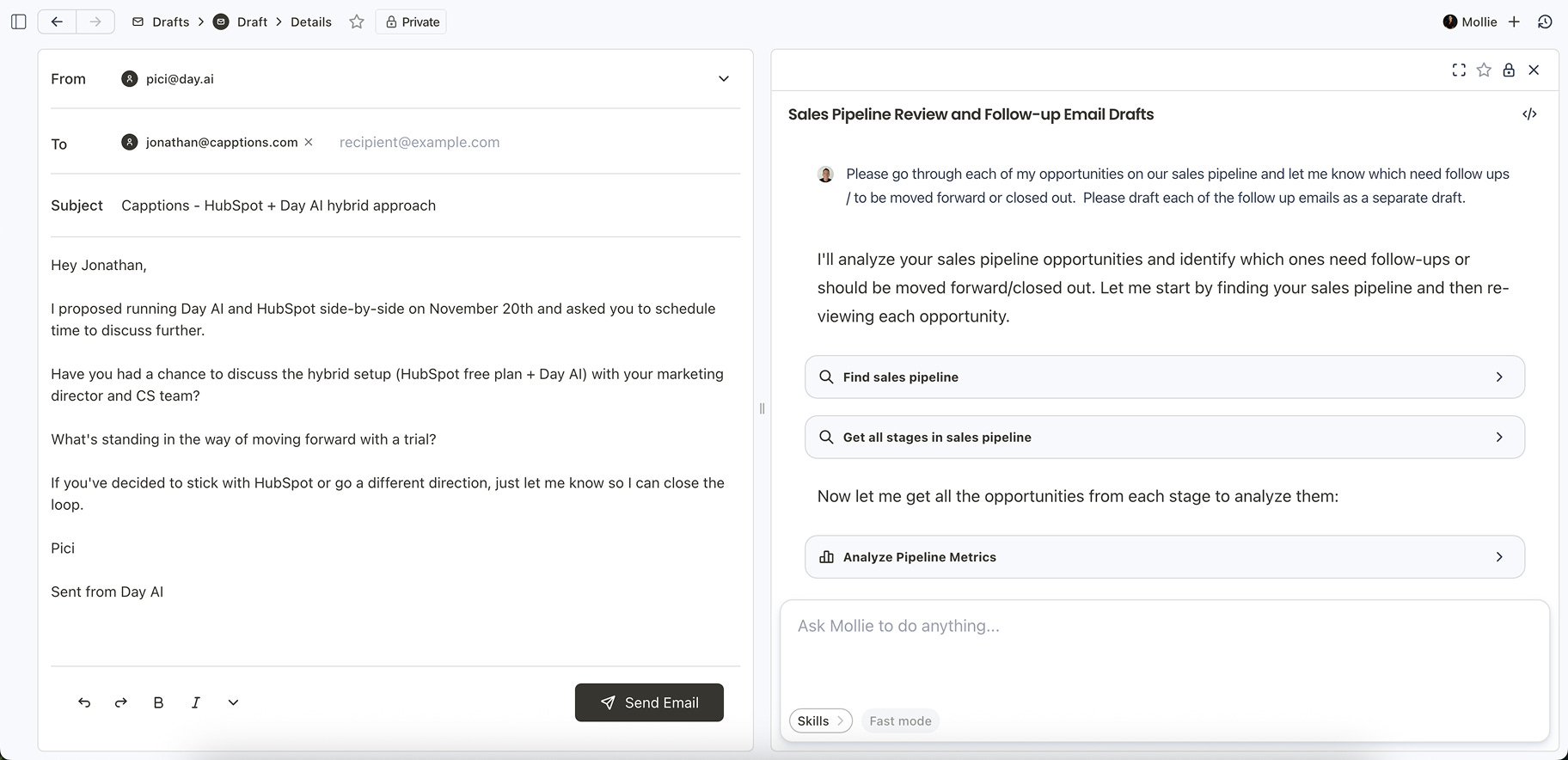
Early Day AI customers who spoke to Upstarts talk about its speed of onboarding as a differentiator. Oliver Pour, head of growth at fellow Sequoia portfolio company Sandstone, which makes AI software for legal teams, says he was “off to the races” after one 15-minute call with Day AI’s head of product, Daphne Funston.
Day AI has helped Pour do away with meetings to update colleagues on customer prospects; when they ping with questions about Sandstone’s pipeline, Day AI answers over Slack in his behalf.
“Those meetings drove me insane,” Pour says. “I can actually focus on the strategic aspect of my job.”
At Finch, another Sequoia-backed legal startup (this one for pre-litigation work, especially for personal injury firms), cofounder and CEO Viraj Bindra says that Day AI has helped his team save multiple customer accounts from churning over the past three months.
Account managers move faster to solutions when they know their colleagues are clued in and ready to rally around them, Bindra says: “Using Day helps make both good and bad news travel excessively fast.”
For customers too small to have paid for an expensive CRM tool yet, Day AI can represent a new expenditure. For now, the startup charges per AI assistant, but O’Donnell concedes that he may eventually need to follow Cursor and others that tack on additional pricing by usage or consumption for power users. (“I call it the LLM open bar right now,” he says.)
Others will already have HubSpot or Salesforce accounts to compare with Day AI – and those companies will fight to hold onto them with their own AI offerings.
At Stable Kernel, a software service provider in Atlanta, chief strategy officer Mary Elzey has been using Day AI avidly for the past few weeks, but has kept HubSpot active for her salespeople’s peace of mind for another three months. Unless Day AI screws something up, her company will fully transition at that point.
“It’s a safety blanket,” she says. “But we were really hamstrung by what the old system was able to do.”
O’Donnell insists it’s not personal, comparing competing with his former HubSpot colleagues to NBA players who hug it out after the final whistle.
But Day AI will have to walk a delicate line to avoid making a whole lot of enemies across the startup ecosystem, too.
There’s Granola and other note-takers like Read AI, Fathom AI and Fireflies.ai; but Day AI’s use cases could also converge with other players in the stack, including some of Sequoia’s other prominent investments, like Glean in enterprise search, Notion in productivity, and Clay in go to market software. (Disclosure: Alex’s spouse, Upstarts adviser Natalie, works on startups at Clay.)
If O’Donnell’s ambitions are big enough to absorb all of those use cases, he’s too smart to say so, at least yet. So for now, the ecosystem can take him at his word when he says there’s plenty of room for everyone in this new AI software era: “I really think we can all be friends.”
I’m a CRM expert. What’s the deep value of AI nativity for CRM?