


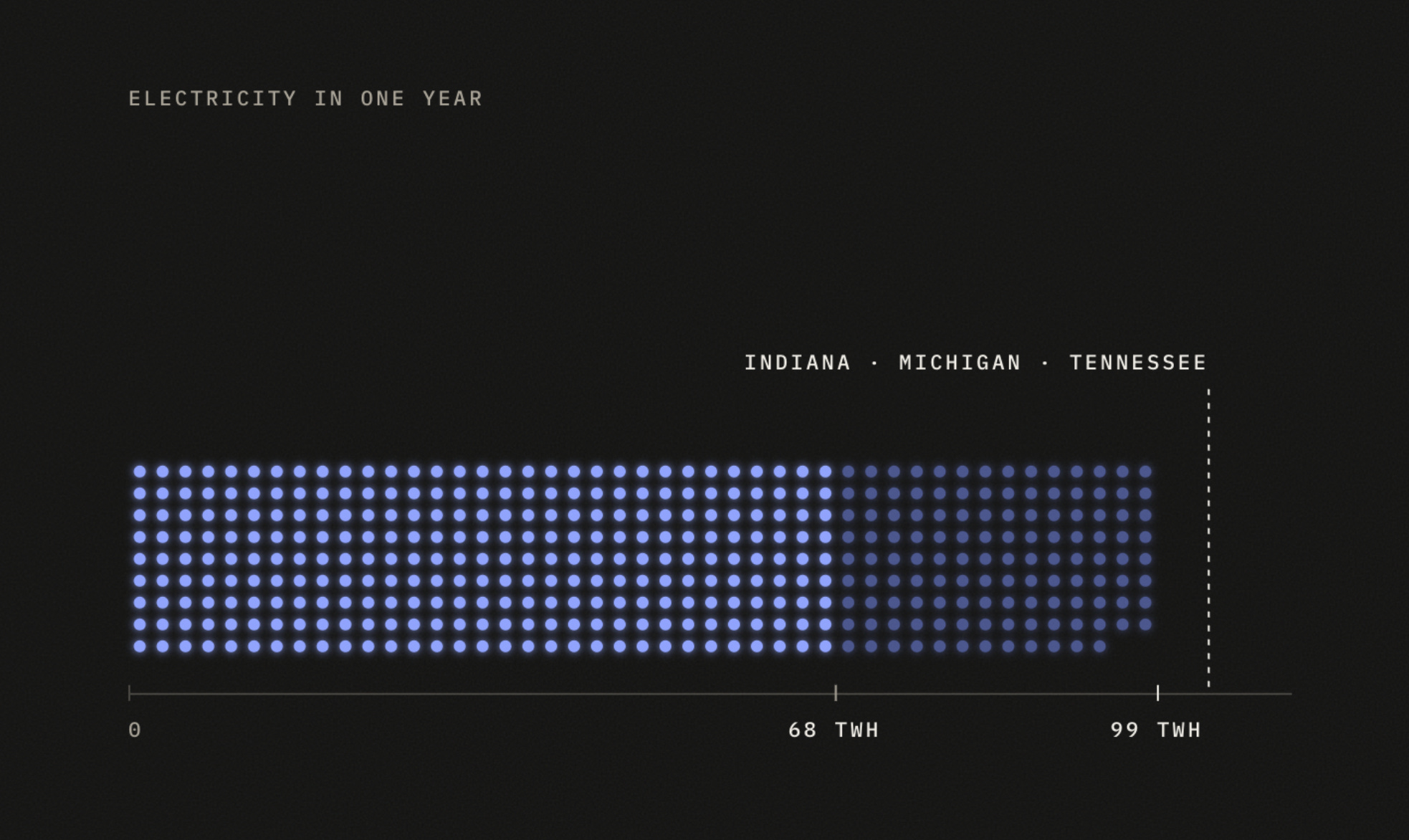
How much electricity do the biggest U.S. data centers use in a year? To find a reference point, you need to zoom out all the way to entire states: Indiana, Michigan, or Tennessee.
Picture every bar, restaurant, school, hospital and home in each of those states. Their combined use would match the high-end estimated use of a group of just 403 hyperscale data centers – up to 99 terawatt-hours, accounting for nearly 2% of total U.S. consumption.
Those findings headline new research out of the Harvard T.H. Chan School of Public Health published today in Nature Sustainability. The paper, the first peer-reviewed study of its kind in eight years, studied the centers over a one-year period between May 2024 and April 2025.
What they found helps quantify – and speaks to the magnitude of – rising consumption and emissions by data centers that correspond to a major increase in demand and capacity in recent years.
Those big data centers used between 68 and 99 terawatt-hours of electricity, the study found, up about 3x from 2018, the last year of a peer-reviewed study before this.
Most of that power – 54% – came from fossil fuels like natural gas and coal. The carbon footprint of these data centers grew at a comparable pace, too: these data centers contributed more than 25 million metric tons of CO2 emissions, up 2x to 3x over the same period.
Those numbers have likely increased since, says Gianluca Guidi, a postdoctoral researcher at Harvard who co-authored the report. Because the study, which went through three rounds of peer review, only tracked until mid-2025, it doesn’t include recent prominent projects, like xAI’s Colossus project in Tennessee.
Still, Guidi and his co-authors hope that their findings can serve as a baseline for future comparisons. They plan to add more findings around air quality, water usage and noise in the near future. And they’ve launched a new website, Never Just A Building, to visualize and interact with the data.
“We wanted to establish a baseline scenario such that then we can build on top,” he says.
Here at Upstarts, we’ve covered a bunch of fledgling companies working on projects connected to this compute boom.
Andromeda and OneChronos are both interested in futures markets around GPU capacity in these data centers; SF Compute is building what it calls the first physically settled one. Build Inc. exists to help locate and place new data center construction projects. And energy startups like Valar Atomics and Somos are looking to provide them with additional sources of power.
The survey data wasn’t able to break out AI-specific use at these data centers from their general cloud computing operations, and the researchers weren’t able to definitively snapshot every data center. (Also of note: that 2018 study used a different sample and methods.)
Upstarts is at the Slush conference in cold, dark and fun Helsinki this week. If you’re in town, drop us a line 👋
Still, their findings could prove valuable for startups working around this compute ecosystem to monitor – revealing the scale and pace of development, as well as quantifying environmental factors that contribute to widespread civic distrust and pushback against new developments. (If I’m a startup working in renewables or nuclear, I’m putting these numbers straight into my pitch deck.)
And just as Build Inc. looks to help place new centers, one could easily picture one or more startups forming around environmental advisory, too, helping Big Tech navigate these issues in local systems.
More on the study’s findings, and their implications, below.
A MESSAGE FROM OUR SPONSOR
Ship pricing like a product

Different product bets have different business goals. You’re either chasing market adoption, revenue growth, or profits. You need to test fitting pricing models for each of those goals. Fast. Chargebee can help — Price for usage credits, outcomes, complex contracts, or any other modern commercial construct.
Coal-powered crypto to AI
Just as CoreWeave and other compute businesses got their start as Bitcoin mining operations (and crypto entrepreneurs can be found across the AI infrastructure landscape today, from OpenRouter to Venice AI), so did the research by Guidi and team.
Inspired by a 2023 investigation by The New York Times that identified 34 leading Bitcoin miners and looked at their local impact, Guidi and team set out more than two years ago to build a scientifically validated data set around data centers.

To build their data set, they purchased data from a commercial provider around energy sources, and cross-referenced it against public data sources to estimate footprint and usage.
In addition to the findings around total electricity consumption and its sources, the survey looked at how such usage varied by region. They confirmed what those keeping tabs on data center rollouts might have suspected: more than half of the electricity tracked was used in data centers in just four states: Virginia, Oregon, Ohio, and Iowa. A quarter of the electricity was in regions using ‘dirtier’ energy sources like coal, which made up 15% of overall contributions.
Guidi notes that renewable energy sources made up just 7% of the electricity source, with nuclear 33%. “Why are we still relying mostly on fossil fuel?” he asks. Of course, he knows the answer: builders under pressure to bring compute online fast are taking whatever energy they can get.
A smarter system
What do the study’s publishers hope to achieve with their research?
When I ask Guidi, he points to a couple potential outcomes. First, he wants data center builders to learn from such data to factor local communities more into their planning, accounting for seasonal usage spikes and excessive emissions.
“We can potentially have more ethical considerations in mind, both in the models and the physical infrastructure,” he says. “We can build from now on with this in mind.”
They also hope that relevant parties across the gamut – scientists, policymakers, community organizers, journalists, and the tech companies themselves – can benefit from having a shared, open source of data moving forward.
“We have to align the velocities at which these things are being built with how all these stakeholders can keep track of them,” Guidi adds.
Worth flagging the limitation the authors are explicit about: the survey cannot separate AI load from ordinary cloud load. That matters well outside the study. The ratepayer fights now turn on attributing cost to a data-center class - BAAJA's 20 MW threshold, state large-load tariffs, utility cost-of-service filings - and the base for that attribution is estimated and cross-referenced, not metered per customer. The 2% is a useful baseline; the attribution gap is the harder problem.
Worth flagging the limitation the authors are explicit about: the survey cannot separate AI load from ordinary cloud load. That matters well outside the study. The ratepayer fights now turn on attributing cost to a data-center class - BAAJA's 20 MW threshold, state large-load tariffs, utility cost-of-service filings - and the base for that attribution is estimated and cross-referenced, not metered per customer. The 2% is a useful baseline; the attribution gap is the harder problem.