


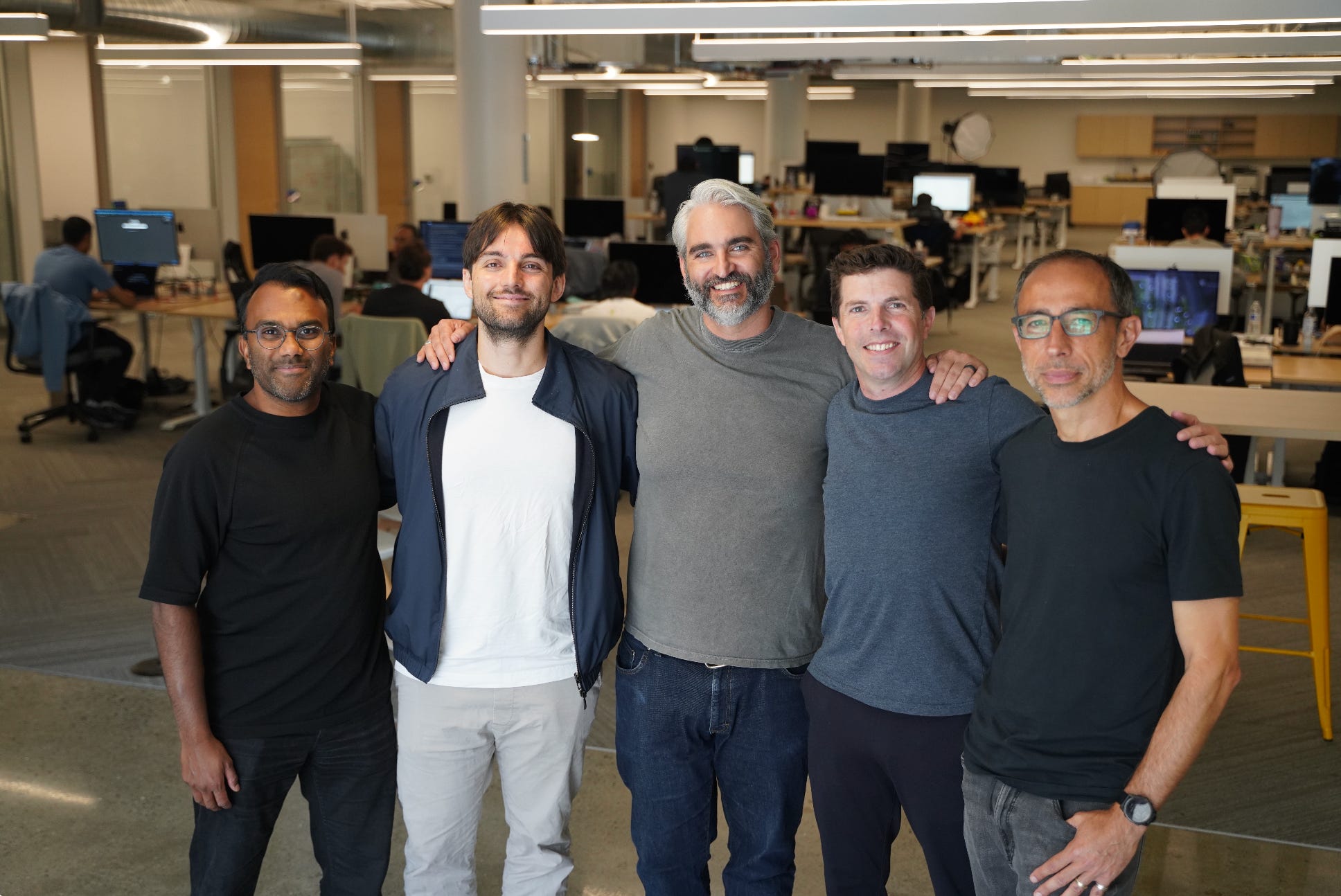
Before joining our meeting, CEO Keith Peiris happily spends his morning ‘burning’ tokens from his own startup, Lightfield. The company is about to go on a hiring blitz in sales and engineering, and Peiris wants to roleplay two different sales scenarios.
What if they hired 30 early-career sales reps instead of 10? Which new customers could they win? Which could they risk losing?
These are the types of questions that Lightfield has sought to answer since the startup pivoted from another product, Tome, last year.
That business, an AI presentation builder, had exploded in popularity in the months after the launch of ChatGPT, reaching 25 million users and raising $80 million.
But Peiris and co-founder Henri Liriani pivoted, slashing headcount from 70 to 7 to pursue a bigger opportunity more aligned with their own interests, and as importantly, where customers would gladly spend money: new-gen customer relationship management software centered around use by AI agents.
At its core, Lightfield customers use it as an AI CRM solution. But Peiris describes his startup as something bigger: an engine for answering any questions about a business, big (should we expand into Asia sooner?) and small (should we offer this prospect a discount?).
“Companies that love us the most treat us like their business world model,” Peiris says. “We are becoming the oracle to the executive team.”
Early momentum is promising. About 5,000 companies use Lightfield’s software today, according to Peiris, with some expanding to more than 100 employees actively on its platform. The startup didn’t disclose its annual recurring revenue, but says that net dollar retention, a metric that measures how spend increases within a customer base, stands at 400%.
Now, Lightfield is announcing that it’s raised a $47 million funding round led by a16z. Maverick Ventures, Coatue, Audacious, Alumni Ventures, Greylock, and Lightspeed Venture Partners participated.
The purpose of the funding, Peiris tells Upstarts in an exclusive interview, is to scale up Lightfield’s current team of 40, particularly in sales and engineering, back toward and beyond Tome’s previous peak.
The round is something of a reset, too – styled as a Series A, but featuring many of the backers who previously helped Tome raise a total of $80 million across previous Series A and B raises.
For Peiris and Liriani, Lightfield represents a second chance at building a generational business during a period of rapid technological change – one that, in hindsight, Peiris says is closer to the kind of naturally expansive, “infinite game” software they always wanted to tackle.
But in exiting one crowded, buzzy category for consumers, Lightfield is now taking a big swing in one even more cutthroat for businesses. Dozens of companies have declared themselves a Salesforce killer in the past 20-plus years; we covered another in February here in Upstarts, Day AI. Salesforce remains Teflon, with a market cap of more than $200 billion, and a fresh lease on life as AI-forward companies depend more than ever on its acquired subsidiary, Slack.
And Lightfield isn’t just taking a swing at the CRM king. Peiris aspires for Lightfield to cut into the business of a wide swath of fellow startups across the wider sales stack. That makes Lightfield a potential competitor to agentic sales tools like Attio and Reevo; outbound specialists like Apollo and Unify (which we covered last year); as well as go-to-market and growth-focused businesses like Clay, which just announced a funding round of its own at a $7.1 billion valuation, and newer entrant Monaco, which recently raised $50 million.
(Disclosure: my spouse and Upstarts advisor Natalie works at Clay; she had no input or early access to this story.)
When I ask Peiris who Lightfield isn’t taking on, he takes a pause. Then he answers honestly. OpenAI chairman Bret Taylor’s AI unicorn, focused on customer service agents, is about it – for now. “I don’t see us doing what Sierra’s doing, certainly for the next decade,” he says. “Everything else that’s customer-facing is fair game.”
This exclusive funding story is presented free for all Upstarts subscribers. If you enjoy the depth and perspective we bring to such stories, we’d love to talk to you and your brand about presenting partnership opportunities in Q4 and beyond.
A new business model
Central to Lightfield’s product approach is its ‘business world model’ – an architecture that provides the structure, and can process enough data, to allow users to tap into the wider knowledge base and context of a business to make decisions.
These models differ from the geospatial, physical “world models” like we’ve covered at General Intuition, which trains off video game play, or at companies working in autonomous vehicles, as we wrote about with DoorDash’s delivery robots. Peiris didn’t make up the term as a marketing gimmick, he notes. He’s been influenced by an academic paper published by two computer science academics, Cecil Pang and Hiroki Sayama, in June; he also cites a published conversation between Twitter and Block co-founder Jack Dorsey and Sequoia investor Roelof Botha from March, which gets into the same idea.
What you need to know: Lightfield isn’t an AI company in the sense that it trains its own large language models, at least yet. “$47 million is not enough for that,” Peiris says, leaving the door open for the future. “It’s an infrastructure that helps a frontier model understand a business, and simulate it.”
Lightfield’s bet is that whereas the most recent wave of CRM startups advanced the field in terms of auto-updating customer data and conversations – a classic complaint about Salesforce is that sales reps don’t fill it out – such improvements haven’t been dramatic enough to get most businesses, even tech-savvy ones, to change off Salesforce or rival HubSpot.
For small customers, Lightfield can help set up an early outbound function and customer pipeline; for big ones, it hopes to connect the dots in a way that agentic tools that layer on top of Salesforce – including Salesforce’s own more recent tools – can’t get perfect.
Implicit is a bet that AI will do more of the work over time – Peiris bets agents will automate 50% to 60% of go-to-market work in the near future – but Lightfield’s hope is that human users adopt it across an organization, starting with sales, then expanding to operations and finance, and eventually engineering as better insights about customers can inform a company’s product strategy.
Unlike Tome, Lightfield isn’t self-serve, Peiris says. Instead, much of Lightfield’s success depends on its team learning what a customer wants to track and automate, meaning it runs what he calls “sales-led consultative implementation.” In practice, that means all of Lightfield’s engineers rotate to work as forward-deployed engineers with customers, paired with ex-consultant business-minded colleagues. The goal: get in and out in 30 days.
“It was two years of pain, but we’re now closer-aligned to the company that fits our life’s work, rather than just chasing an opportunity.”
At AI code review startup Macroscope, CEO Kayvon Beykpour – who sold Periscope to Twitter and later led product at the social network – decided to try Lightfield after his team tested, and were unimpressed by, a number of other newer CRM companies. Macroscope started out using Lightfield as its interface for customer info, but gradually connected other systems, like Stripe, PostHog and its own software, to Lightfield to generate its revenue-related dashboards, which employees engage with often in Slack.
The tool reminds Beykpour of Linear’s success in issue management with its ease-of-use and “delightful” interface, he says. “It’s not like we set out at the beginning to be like, ‘We shall now make Lightfield the source of truth,’” Beykpour tells Upstarts. “It just organically became the easiest place for us to do stuff.”
It’s a similar story at Weaver, the AI-native services (remember our Gainsight story?) subsidiary of AI unicorn You.com. There, CEO Peter Grant – a former sales leader at Siebel in the earliest days of CRM, and later Salesforce’s manager for the U.K. through its IPO (“I used to bleed Salesforce,” he says) – notes that Lightfield’s forward deployed support made it easy for Weaver to get started on outbounding, sequencing and more strategic use cases.
Weaver input its product information, sales bible-like market requirements document, and more info like its founder story and core value proposition, so that sales reps can now ask Lightfield questions around pricing or sales tactics, instead of pinging Grant. Grant, meanwhile, uses Lightfield connected to a Claude skill to build his own investor and board reports.
“They’re ambitious, but it’s not until you sign the check and become a customer that you really see the true value of a business,” Grant says. “So far, I’ve been impressed.”
A crowded or green field?
Unless they’re young startups themselves, customers adopting Lightfield aren’t usually doing so with a blank slate. Many will simultaneously run Salesforce for a quarter to gain confidence, Peiris says; at Weaver, Grant was close to working with Reevo when Lightfield more aggressively won the business. At Macroscope, Lightfield co-existed with, and then replaced, the startup’s use of Clay.
Both he and Grant, Lightfield’s power users, say that generally speaking, they’d prefer to consolidate on one platform for better data security and ease of use. “Is that a religious or philosophical decision that we would make across all things? No,” Beykpour adds. “It’s case by case, and it’ll continue to be.”
Lightfield has a long way to go. Neither customer says they’ve used Lightfield’s simulation or predictive features yet, and the startup will need to explain this value to increasingly bigger customers that might be skeptical about over-promising, and AI hype.
“There is market education that we need to nail,” says a16z investor Joe Schmidt IV. “How do we tell people why this matters to them?”
Plus, there’s the question of whether Lightfield is fully prepared for the knife fight of taking on so many well-funded startups at once. Besides the usual challenges of execution and focus that come with building a product for many use cases, there’s a degree of opportunism to the Lightfield story.
Tome got a lot of press and VC attention, and so did its pivot, most recently in Forbes. Speaking now, Peiris admits he and Liriani considered a few directions for their pivoted business, before settling on sales.
He sounds genuine, however, when he gets more into the personal side of the founder journey – and the passion that perhaps he and Liriani lacked about Tome that can partly explain why another startup we’ve written about, Gamma, ended up taking Tome’s turf.
“The only way that a business has a chance of succeeding is if the product is the best possible one that you can imagine, you think it’s great, and you use it every day,” he says. By those standards, Tome’s presentations were “terrible,” he says – not something the “Michael Jordan of presentations” would ever adopt.
“The Gamma people executed really well. My hat’s off to them,” says Peiris. “It was not the business that we wanted to build, just to be super real about it.”
It’s different now with Lightfield, he claims: the market opportunity feels huge, and the timing not too late. “Our team had the stamina to go build this hard, really intricate thing for a long time,” Peiris says of Lightfield. “It was two years of pain, but we’re now closer-aligned to the company that fits our life’s work, rather than just chasing an opportunity.”
don't know the guys, no skin in this game but mad respect. there's nothing harder than a restart. it is, in many ways, more challenging than a fresh start.